top of page


Video Program
Regeneration


Curator 

Victoria Ilyushkina


5.09.2023, 19:00

7.09.2023, 19:00


Venue 


Institute for Contemporary Art (ICA Yerevan)

47 Avet Avetisyan St


Participants

Anna Ivonina (Russia)

Nadezhda Bey (Russia)

Marisa Benito (Spain)

Maria Kuptsova (Austria)

Selena Isho (Russia)

Anastasia Lonshakova (Russia)

Mariam Arami (Papoyan) (The Republic of Armenia)

Eléonore de Montesquiou (France–Estonia–Germany)

Gor Margaryan (Germany)

Pim Zwier (Netherlands)

New structures are appearing, adapting to the current world’s dynamic nature and resisting violence. They are launched by the disruption of traditional systems from sociopolitical cataclysms, eradications of the displacement of trauma, and losses.

In the works selected for this program, the artists reexamine notions common to us: language, motherland, home, nature, matter. They do it by deconstructing and rebuilding their personal stories and documentary evidence through the use of performative practice, verbal and nonverbal communication, digitizing and 3D modeling of their surroundings or by algorithms of computer-assisted instruction and artificial intelligence. — Victoria Ilyushkina


Սոցիալ-քաղաքական կատակլիզմերի հետևանքով սովորական համակարգերի քայքայումը, տեղահանման տրավմայի ամոքումը և կորուստները ստիպում են հարմարվել աշխարհի փոփոխականությանը և բռնությանը դիմակայելու նոր համակարգեր ձևավորել։

Այս ծրագրի համար ընտրված աշխատանքներում արվեստագետները վերաիմաստավորում են առօրյա կյանքին առնչվող այնպիսի ծանոթ հասկացություններ, ինչպիսիք են լեզուն, հայրենիքը, տունը, բնությունը, նյութը։ Նրանք դա անում են՝ ապակառուցելով և վերահավաքելով անձնական պատմություններ, վավերագրական ապացույցներ, կատարողական պրակտիկայի, բանավոր և ոչ բանավոր հաղորդակցության, թվայնացման և շրջակա միջավայրի 3D մոդելավորման միջոցով՝ օգտագործելով մեքենայական ուսուցման ալգորիթմեր և արհեստական բանականություն: — Վիկտորիա Իլյուշկինա


Marisa Benito

They're all dead (Todos están muertos)

6 min. 23 sec., 2023 The project aims to focus attention on the physical photographic medium versus the immaterial digital medium. It is about how the relationship with images has transformed since losing materiality and becoming volatile, perishable, and overabundant. Photography has become a means of communication; outdated, disposable, millions are generated every day, and we are drowning in an ocean of images. The use of animation and video post-production allows the artist to elaborate a discourse in space-time, to bring the photographs back to the present at a specific moment and duration. The aesthetic discourse revolves around the physical aspect of the support and its organic nature, which is why metaphors and visual and poetic games are articulated about the effects of the passage of time on matter and its degradation, disappearance or transformation. Marisa Benito (Barcelona, 1974) has a Bachelor’s Degree in Fine Arts and a Master’s Research Degree in Art. She lives and works in Córdoba, where she teaches Audiovisual Media at the “Mateo Inurria” School of Art. She combines her professional activity with audiovisual creation and photography. The aesthetics of her work are generated through images shaped by sensory experience, the imaginary and the memory, and photographic and cinematographic language.

Nadezhda Bey

To-Do list

2 min. 35 sec., 2021 Sound: Vasya Filatova In the ‘To-do list’ project, Nadezhda experiments with the “VR space as an art object” format. This is a variation on installation, created entirely in digital form and therefore allows the viewer to exist in it differently than in the physical world. What people experience in a physical space is a mental construct. And the digital space in this context is a continuation of the mental space. What, can the environment of their thoughts and experience — turned into a virtual place — tell us about the experience of another? Is it possible to find a way to communicate with another in the space of one’s perception of reality? The project mixes the physical with the mental and sensory experience, creating a tangled digital architecture that the viewer can immerse themselves in with VR equipment and try to step into the artist's shoes, in her experience. Nadezhda Bey is a VR artist and performer, as well as a professor in the Art & Science program at ITMO University. She teaches disciplines related to digital art and virtual worlds. Since 2021, Nadezhda has been developing the InterActive Virtual Reality Laboratory. She has participated in international exhibitions and festivals of contemporary technological art and was awarded the ASTA Prize in the VR/AR category. She was nominated for the Kuryokhin–2022 Award in two categories: "Grand Prix'' and "Best Media Object." She frequently speaks as a speaker and expert on topics related to art, creative education, and new technologies.

Selena Isho

I peel off my fragile skin
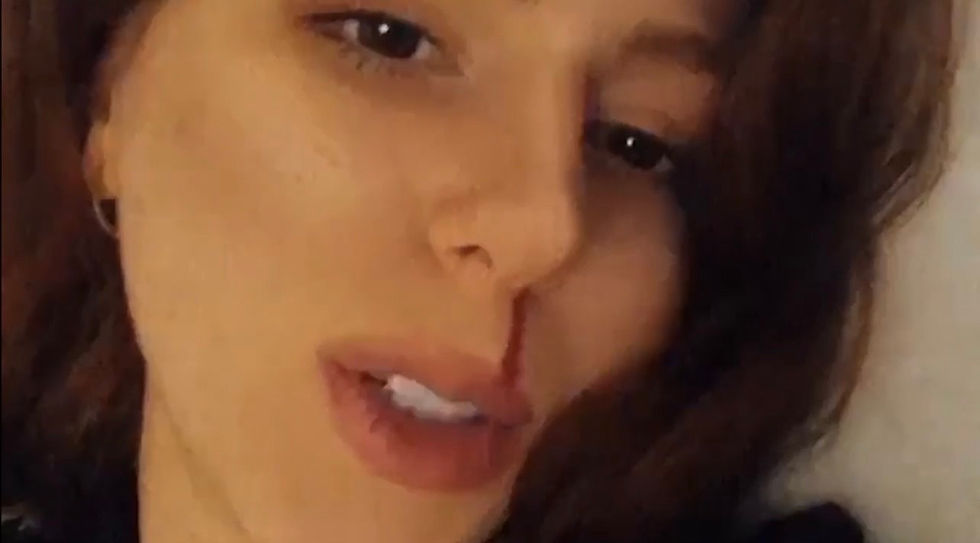
3 min. 24 sec., 2021 The artist's menifesto is aimed at criticizing the dominant masculine structure of the world, patriarchal authority, and social inequality. In an attempt to rebuild her own female corporeality and gain social power, the heroine only finds herself facing her own fragility and vulnerability again. The video features a voice-over of the artist’s feminists letter, read by a Google voice assistant. This represents a delegation of the familiar act of speaking to someone else, as her own voice has never been heard before. Unintentional language deformation occurs, raising the question of who the language belongs to. Born in 1993 in Kazan, Selena Isho has been living in St. Petersburg since 2013. She works in the genre of installations and three-dimensional objects of machine form. Her artistic practice includes porcelain sculpture, painting, graphics, textiles, video art, performance, and feminist writing. Her works predominantly feature existential, psychoanalytic motifs, themes of gender, corporality, and class privilege. Her works are held in private collections in Russia and abroad.

Anna Ivonina

Carry on

11 min. 6 sec., 2022 The film was created as part of the "Ether" project by the School of Young Artists, the PRO ARTE Foundation, in 2022. The film tells the stories of girls who left their homes in 2022 and invites viewers to explore what is kept in their luggage. "Carry On" provokes an examination into the concept of home. Is one's home based on belongings, people, networks? Is it the specific place where you were born, raised, lived, or the place where you are now? After leaving Russia in 2022, the artist focused on exploring the theme of home. Anna Ivonina developed an interest in space and environment through her work as a production designer in the film industry. When she became involved in contemporary art, she explored the theme of seeking new ways of coexistence and connection with the world in her projects. She examined the relationships between nature and humans, the living and the synthetic, the natural and the artificial, working with media such as installations and art objects. Studying at the PRO ARTE Foundation expanded her practice into photography and videography. After leaving Russia in 2022, the artist focused on research on the theme of home.

Maria Kuptsova

Science Art project

3 min. 54 sec., 2023 ARBOR is a cyborganic living entity grown through bio-artificial means using technology. It is a regenerative system in which the entire organism is alive, and the concept of life encompasses both biological and technological forms. The project offers an approach to extracting the intelligence of organic wood structures and reimagining their life cycle as a bio-artificial system that is alive in a cybernetic sense. The project proposes a method of capturing the diverse properties possessed by a living tree using machine learning algorithms to embed its logic into a digital form. This method enables the creation of hybrid materiality that contains biological intelligence within a digital structure. Maria Kuptsova is an artist, architect, and researcher. In her practice, she explores synthetic forms of intelligence and aesthetics, creating cyborganic objects, systems, processes, and interfaces. Maria’s Ph.D. research, conducted under the supervision of Prof. Claudia Pasquero at the University of Innsbruck, points towards the possibility of developing a bio-machinic design technique to impart biological intelligence into inorganic objects and synthetic environments, as well as reveals the potential of alternative modes of reasoning to become an active design agency.

Anastasia Lonshakova

SARMA project

Led film 21 min. 58 sec., 2017 Choreographer, Director, Editor: Anastasiia Lonshakova Composer: Matiss Chudars SARMA International project. Dance performance on the ice of the Baikal Lake. The Sarma project is the result of a master’s study and was filmed on Lake Baikal in winter with the LabirintLab group, which is engaged in the research, development, and construction of labyrinths. The video explores the relationship between man and nature, in which the boundaries of verbal communication break down. Since ancient times, it was believed that the forms of nonverbal communication — movement and dance — made it possible to get in touch with the nonhuman side of the world. The film is a documentary-plastic story of one week spent by the film crew on the ice of Lake Baikal in the village, where the strongest wind, the sarma, arises. Contemporary dance and film dance artist from Irkutsk, Russia. Creator of Baikal Contemporary Dance Art in Irkutsk, creative producer of the international festival on Baikal Radi Sveta: Baikal.

Gor Margaryan

Phantomfug

16 min. 48 sec., 2022 A film-essay delving into the memories of war and their enduring omnipresence that appears never-ending. Drawing upon personal and autobiographical considerations, the movie follows the imprints left by the experience of war. With the persistent emergence of new violent conflicts, they continue to exert a lasting influence on one's emotional realm and familial bonds. Gor Margaryan is a freelance artist and currently heads the media workshop at the Muthesius Academy of Fine Arts in Kiel. The focus of his artistic work lies in experimental film and media art, moving at the interface between art and new technology. Current works deal with human influences on our natural spaces, such as the destruction of the Amazon rainforest or the Siberian taiga. The aim of these projects is to show the viewer the aesthetics and beauty that are lost through this negative human influence. The focus of Margaryan's work is always on people: they form both the starting point and the fixed point of his artistic explorations. In his films, installations and publications, this becomes clear in his recourse to man as a source of inspiration as well as a guide.

Mariam Arami (Papoyan)

Dzhnhal (snow melting process)

9 min. 46 sec., 2021 The content of the work performed as part of the Festival of Snow and Ice Sculptures is checked through a word game. This is a video performance, the components of which are snow and earth. A word symbolizing the intensity of loss and pain that befell society and the Armenian people is born on a flat, snow-covered area, like white paper and a new page. The work "Dzhnhal", created by ephemeral particles of nature and the language of nature, conveys the allegory of the cycle of time, the warmth of memories and the pain of physical loss. Born in Armenia, in the city of Vagharshapat. As an artist, she is more of a conceptualist and does not limit herself to any means of expression or artistic language. The most expressive generality of her works is their duality, which, regardless of the idea, allows the audience to create their hypothesis, as if giving consciousness to the work, leading to a new self-discovery. Art teacher at Art school named by Eghishe Tatevosyan, paper conservation, and restoration at the History Museum of Armenia, art director of DADA hub ART gallery, graphic design, illustration, and book' modelling.

Pim Zwier (Special screening)

O, Collecting Eggs Despite the Times

80 min., 2022 From the translucent golden eggs of the Tibetan bearded vulture to those of the British guillemot with their Jackson Pollock-like splashes, German ornithologist Max Schönwetter (1874–1961) collected them all. He devoted his life to oology, the study of birds’ eggs. But while Schönwetter created order in his world of eggs, chaos broke out in the world around him on the eve of the Second World War. Archive footage of turbulent outside events contrasts with re-enacted scenes from Schönwetter's study. As Nazis march through the streets, he measures eastern subalpine warbler’s eggs. His correspondence with fellow scientists and collectors (heard in voiceover) evokes both the zeitgeist and the single-minded collecting urges of Schönwetter and his associates. A soldier on the Finnish-Russian front, for example, is delighted with the ptarmigan eggs he has found between battles. Independent media-artist / film maker. He obtained his MFA at the Piet Zwart Institute in Rotterdam in 2003. The artist makes documentaries, short films and video-installations. his films balance between documentary, experimental film and media-art. Zwier’s films and video installations were shown at different international festivals, exhibitions, and on television.

Eléonore de Montesquiou

Eksperiment Katja

9 min. 25 sec., 2022 Music: Lucy Railton Katja was born in 1992, an experimental generation for the new Republic of Estonia. She is floating, neither attached to Estonia, nor to Russia. Like Little Red Riding hood, she has freed herself from experiments and fears imposed on her. The film suggests several metaphors to describe the trauma of the displaced — from Little Red Riding Hood to the keyword of experiment. Location: Narva, Estonia. Eléonore de Montesquiou (born in 1970 in Paris, France) is a French-Estonian artist. Eléonore de Montesquiou’s work revolves around articulating private and official histories, personal and national identities. It tackles the intricacies and ambiguities of living in the margins, based on her experience of uprootedness. Eléonore is primarily working with video; she tapes testimonies, creating prosthetic memories of repressed histories. In her documentary-informed works, her camera becomes the voice of these voiceless people. Her work is based on a documentary approach, translated in films, drawings and texts; it deals mainly with issues of integration/immigration/meaning of a nation in Estonia, giving voice to the Russian community. A few years ago, she started working with asylum seekers from French-speaking countries in Estonia.
  • Instagram
  • Facebook
  • YouTube

Sign up for our Newsletter

Thank you!

Sose St., house 46,

Yerevan, Armenia, 0019

Ozo g. 28 - 35​

Vilnius, LT-07197

Lithuania

901Brickell Key Boulevard,

Suit 3705,

Miami, FL 33131 

USA


© CYLAND MediaArtLab 2007–2026. All rights reserved. 

bottom of page