top of page

Learning


1.09–14.09.2023


Venues


HayArt Cultural Center 

7a Mashtots Ave. 


Institute for Contemporary Art (I.C.A. Yerevan)

47 Avet Avetisyan St


Participants


Alan Boldon

Silvia Burini

Mascha Danzis 

Lyudmila Davydova

Maria Cristina Finucci 

Sargis Hovhannisyan

Natalia Kolodzei

Anastasia Kozachenko-Stravinsky

Ellen K. Levy 

Marc Lee 

Gustavo Matamoros 

Patricia Olynyk 

Maria Gatti Racah

Maria Redaelli

Ellen Pearlman 

Olga Shishko

Danielle Siembieda

Pre-Festival Special Event


International Media Festivals and the Evolution of Transcultural Communities


A Joint LASER: LASER New York and LASER CYLAND 


Date: 01.09. 2023, 20:00 

Duration: 60 min

Location: Institute for Contemporary Art (I.C.A. Yerevan)

Language: English


Speakers: Ellen K. Levy, Patricia Olynyk, Sargis HovhannisyanModerator: Natalia Kolodzei


We are witnessing the development of many new local digital communities and international media festivals in art and science. Along with showcasing interactions between, and the politics of, technology and culture — technoculture — at least part of this growth aspires to develop effective, collaborative responses to the pressing social and environmental issues of our time. Given the severe reality of our varied situations, many digital communities aim for common solutions that may elude us. This LASER panel will discuss some of the ways artists and curators are attempting to re-imagine our precarious future by reconciling often-opposed values, (e.g., intrinsic vs. instrumental values of art; local vs. global concerns). Examples will be drawn from a diversity of art communities and festivals.


Համատեղ ԼԱԶԵՐ. ԼԱԶԵՐ Նյու Յորք և ԼԱԶԵՐ CYLAND


Օր՝ 01.09 / 20:00

Վայրը՝ Ժամանակակից արվեստի ինստիտուտ (ԺԱԻ Երևան)

Տևողությունը՝ 60 ր. 

Բանախոսության լեզուն՝ անգլերեն

Բանախոսներ՝ Էլեն Կ. Լևի, Պատրիսիա Օլինիկ, Սարգիս Հովհաննիսյան

Վարող՝ Նատալյա Կոլոդզեյ


Մենք ականատես ենք բազմաթիվ նոր տեղական թվային համայնքների և արվեստի ու գիտության ոլորտում միջազգային մեդիա փառատոնների զարգացմանը: Տեխնոլոգիայի և մշակույթի՝ տեխնոմշակույթի և քաղաքականության փոխազդեցությունների ցուցադրման հետ մեկտեղ այս աճի առնվազն մի մասը ձգտում է արդյունավետ, համագործակցային աղերսներ մշակել մեր ժամանակի հրատապ սոցիալական և բնապահպանական խնդիրների հետ: Հաշվի առնելով մեր բազմազան իրավիճակների ծանր իրականությունը՝ թվային շատ համայնքներ նպատակ ունեն գտնել ընդհանուր լուծումներ, որոնք կարող են խուսանավել մեզնից: Այս ԼԱԶԵՐ-ի նիստը կքննարկի որոշ ուղիներ, որոնցով արվեստագետներն ու կուրատորները փորձում են վերապատկերել մեր անկայուն ապագան՝ հաշտեցնելով հաճախ հակադրվող արժեքները (օրինակ՝ արվեստի ներքին և գործիքային արժեքները, կամ տեղականն ընդդեմ գլոբալ մտահոգությունների): Օրինակներ կբերվեն արվեստի համայնքների և փառատոնների բազմազանությունից:


Alan Boldon

Vulnerability in art, education and change-making

Date: 4.09.2023, 16:00 Duration: 45 min Location: Institute for Contemporary Art (I.C.A. Yerevan) Language of presentation: English/Armenian Alan Boldon will present a range of curated arts and education projects that illustrate the vital part vulnerability plays in creativity. He will show how this has informed his work as an artist, curator, higher education leader and consultant to senior teams in cultural organisations and universities around the world. This talk will draw on these examples to propose ways to support interdisciplinary collaboration, reimagine learning and engage positively with the great challenges of our time. Alan Boldon is the Founder and Director of Weave, and the Managing Director of Dartington Trust. As an artist he has exhibited throughout Europe, USA, Canada and SE Asia. He gives keynote addresses all over the world and advised towns, cities, NGOs and Universities in many countries. His main areas of interest are the arts, leadership, learning innovation and placemaking. He is currently Co-Chair of the Leonardo LASER committee.

Silvia Burini, Olga Shishko, Maria Redaelli, Anastasia Kozachenko-Stravinsky, Maria Gatti Racah

Mapping Diaspora: Russian Art in Exile

Date: 12.09.2023, 19:30 Duration: 45 min Location: online / HayArt Cultural Center Language of presentation: English The Centre for Studies in Russian Art (CSAR) at Ca' Foscari University of Venice has launched a project that will become a rallying point and analytical space for artistic projects created by those who left Russia because of the war or their political position. The goal of the project is to trace and map what has been experienced in recent years, created, or is still in the process of comprehension. The exodus of a significant number of Russian intellectuals is linked precisely to deep solidarity and compassion for the country that is victim to the Russian invasion. The project is intended to bring together the results of various artistic forms of reflection and the experience of one of the most notable intellectual migrations of our time. Silvia Burini is full Professor in Contemporary Art History. She teaches History of Russian Art, History of Contemporary Art, and Contemporary Art Curatorship at Ca' Foscari University of Venice, where for over ten years she has directed the Center for Studies in Russian Art (CSAR). Since 2011, she has been a member of the advisory board of CYFEST, and since 2019 she has been part of the artistic committee of the Russian Pavilion at the Venice Biennale. Her research interests are in Russian figurative arts (XVII–XXI centuries) and international contemporary art. She has also been researching the comparative study of art systems (painting and literature). She deals with the semiotics of culture and the figurative arts (mainly concerning the works of Yuri Lotman, of whom she is a translator to). Anastasia Kozachenko-Stravinsky is presently studying a double Ph.D. program in History of Art (Ca’ Foscari University of Venice). She holds a Bachelor’s degree in Liberal Art, and a Master’s degree in History of Russia (People’s Friendship University of Russia). Studied History and Dialogue of Cultures from (Université Grenoble Alpes, France). She is a member of the scientific secretariat of the Centre for Studies in Russian Art (CSAR), a member of the International Association of Art Critics (AICA), and founder of the Stravinsky Family Fund. Maria Gatti Racah, Ph.D is a lecturer in Russian language and translation, a subject expert at the Department of Philosophy and Cultural Heritage at Venice Ca' Foscari, and a member of the scientific secretariat of the Centre for the Study of the Arts of Russia (CSAR) at the same university. Her research interests focus mainly on the cultural history of the Russian emigration, the construction of historical-political narratives in the Soviet and post-Soviet context, and Russian-Jewish relations. Maria Redaelli, Ph.D. is a research fellow for the project CHANGES — Cultural Heritage Active Innovation for Sustainable Society and a subject expert at the Department of Philosophy and Cultural Heritage — Ca’ Foscari University of Venice. At Venetian University, she received her Ph.D. in History of the Arts (2022) with a project focused on the development of New Media Art in Russia. She collaborates with the Center for Studies in Russian Art (CSAR) as the coordinator of the scientific secretariat. Olga Shishko is an art historian, curator, specialist in the field of New Media and Video Art, visiting scholar at Ca’ Foscari University. She is founder of the Center for Culture and Art "MediaArtLab", and founder and director of the MIFF Media Forum. Olga Shishko is the former curator of direction for "Pushkin XXI", The Pushkin Museum of Fine Arts (Moscow, Russia). She curated numerous large-scale exhibitions, including “Soul journey. Bill Viola” (2021, Pushkin State Museum of Fine Arts), “At The End is The Beginning. The Secret Brotherhood of Tintoretto” (2019, special project of “Pushkin XXI”, Venice, Italy), “Man is Like a Bird. Travel Images” (2017, 57th Venice Biennale, Italy).

Mascha Danzis

The Motherboard, digital motherhood and other close relationships

Date 7.09.2023, 18:00 Duration: 45 min Location: Institute for Contemporary Art (I.C.A. Yerevan) Language of presentation: Russian I started to notice long ago how the part of me that comes into contact with technology changes outside of it. All these texts about body extensions are just the first stage of accepting the technical in myself. We are part of technology from birth and even before it — the machines that transmitted the knowledge of my son's heartbeat in my belly, the machines that take care of growing my premature baby, the expansion of my womb, the machines that help me breathe, feed and teleport my physical body, teleport my voice, thought and feelings, they are all part of me and I am part of them. In fact, there is no more outside of the technical bodily experience, even when someone performs a ritual of merging with nature by the sea or in the forest, the train that brought him to the sea and the road that was built to the place are included in this process. In this way, digital motherhood is as natural as any other life process that has never been separated from technology. My presentation will focus on my observations as a cyborg, and the different experiences of others living with tech within themselves. — Mascha Danzis Mascha Danzis is an interdisciplinary artist, she works as a video artist and conceptual photographer. She graduated from the Academy of Art in Kassel at the Faculty of Visual Communication under the direction of Prof Björn Melhus and Prof. Bernhard Prinz, where in 2005 she received the highest award by the Kassel Academy of Art for the film “Lucy.” As part of the postgraduate program at the Berlin University of the Arts, she studied the perception of video installations in the exhibition space by the viewer. Since 2016 — Associate Professor, Department of Interdisciplinary Studies and Practices in the Field of Arts St Petersburg University. In her art, she explores the impact of mass media culture on everyday life, feelings and interpersonal relationships. In her work, she often uses herself as a research object — many of her works are autobiographical.

Lyudmila Davydova

Vulnerability of Memory

Date: 11.09.2023, 19:30 Duration: 45 min Location: HayArt Cultural Center Language of presentation: Russian Among the many diverse gifts possessed by humans, one of the most important is memory, that, at times, becomes a synonym of life, especially when life retreats to a distant past. One and the same memory might have many witnesses, and therein lies its vulnerability. Everybody sees the past differently. The subject of this lecture will be about vulnerability of memory as a phenomenon of ancient culture, of the myth, in which an imagined world of mythological characters was incarnated in quite tangible images created by ancient masters out of clay, metal or stone. An example of just such "vulnerability of memory" could be the statues of “The Muses” (patrons of arts and sciences, daughters of Zeus and the goddess of memory Mnemosyne) from the collection of Ancient Department at the Hermitage. They were all purchased in 1861 by the decree of Alexander II as part of the collection that once belonged to Marchese Giovanni Pietro Campana (1809–1880). The lecture's content will not only be the tale about the bright and tragic fate of this man and the story of gathering his collection that is currently housed in various museums in Italy, France, England and Russia, but, first and foremost, the stress will be made, on the vulnerability of ancient monuments, to be more precise, of the Greco-Roman sculpture, that is an inherent part of the great classical heritage. Lyudmila Ivanovna Davydova is Ph.D. in Art History. Professor of the Foreign Art Faculty at St. Petersburg Repin Academy of Fine Arts. Senior Research Associate at the Department of Ancient World and a sculpture curator at the State Hermitage.

Maria Cristina Finucci

How art can help the Planet and the humans

Date: 4.09.2023, 20:00 Duration: 45 min Location: HayArt Cultural Center Language of presentation: English Maria Cristina Finucci will illustrate, with numerous images and videos, the last ten years of "Wasteland," an ongoing artwork aimed at raising awareness about the critical state of the planet. It is a participatory and transmedia artwork that involves universities, institutions, and foundations. In 2013, at UNESCO in Paris, she established a new nation called the Garbage Patch State, whose territory is the plastic islands floating in the oceans. Since then, she has created numerous monumental installations in iconic locations around the world. Maria Cristina Finucci is an architect and artist, and started her creative research at a young age, encompassing painting, sculpture, architecture, design, video art, and film post-production. With the founding of the Garbage Patch State in 2013, Finucci gave a concrete image to the disaster caused by the plastic waste in the oceans. Her major installations took place in: a collateral event of the 55th International Art Exhibition of the Venice Biennale (Italy, 2013); ARCO (Madrid, Spain, 2014); MAXXI Museum (Rome, Italy, 2014); UN (New York, USA, 2014); EXPO (Milan, Italy, 2015); Bluemed (Venice, Italy, 2015); COP 21 (Paris, France, 2015); Mozia (Sicily, Italy, 2016); Rome, Italy, 2018); Fuorisalone (Milan, Italy, 2019, 2023); Italian Cultural Institute (Los Angeles, USA, 2022). In 2019 Finucci was honored with the title of Grand Officer of the Order of Merit of the Italian Republic. In 2020 she established the Finucci Foundation.

Ellen K. Levy

How Real Do Models Need To Be?

Date: 3.09.2023, 19:00 Duration: 45 min Location: HayArt Cultural Center Language of presentation: English Ellen K. Levy explores the entanglement of models (artistic and scientific) with life and their departure to and from reality. Her works often reference cascading events. She targets some of the complexities in planning futures threatened on multiple fronts. She fashions each habitat from a blend of patent drawings, modular units (dominoes, bricks) and constructivist architectural images. The structures embody numerous feedback processes, and they reference aspirations set at the crossroads of technology, economy, and politics. It has long been known that models depart from reality. J. P. Fox further points out “it is inappropriate to be concerned about mice when there are tigers abroad.” And yes — the models will invariably be lacking, and the tigers (e.g., climate change, racism, epidemics) will still be waiting. Ellen K. Levy, Ph.D., is a multimedia artist and writer who has explored complex systems since the mid–1980s. Ellen K. Levy, a former College Art Association president, highlights them through exhibitions, educational programs, and publications. She has exhibited widely in the US and abroad. Her installations explore the unintended consequences of technology, drawing on images, including from NASA, from whom she received an arts commission, and from the US Patent Office database. In the latter, one may find inventions such as the nuclear chain reaction and, in its wake, grandiose solutions for the prevention of toxic radioactive fallout. Levy and Terranova co-edited D'Arcy Wentworth Thompson's Generative Influences in Art, Design and Architecture (2021, Bloomsbury), and she now co-edits an art and science book series for Routledge, Taylor & Francis.

Marc Lee

Workshop: Imagining a Future where AI Controls our Ecosystem

Date: 3.09.2023, 15:00 Location: Institute for Contemporary Art (I.C.A. Yerevan) Duration: 90 min Language of presentation: English Due to global warming and species extinction, our planet is becoming increasingly uninhabitable. Scientists now rely on genetic engineering, synthetic biology, and machine learning as potential tools to mitigate climate change and species loss. We imagine a speculative ecosystem in the near future, where artificial intelligence is used to create and optimize species to withstand the increasingly hostile environment. By doing so, we are using AI as a visualization tool. The AI and genetic engineering tsunami is upon us. For those that are interested to engage with this new paradigm in creating and understanding the ethical implications in the midst of the climate crisis we find ourselves in, this workshop is your go-to. — Marc Lee Marc Lee is a Swiss artist. He focuses on real-time processed, computer programmed audio visual installations, AR, VR and mobile apps. He reflects critically creative, cultural, social, ecological and political aspects. His works have been shown in major Museums and new media art exhibitions including: ZKM Karlsruhe, New Museum New York, MMCA Seoul, ISEA Gwangju, Transmediale Berlin, Ars Electronica Linz.

Gustavo Matamoros

Sound: Audible Manifestation Of Change

Date: 4.09.2023, 19:00 Duration: 45 min Location: HayArt Cultural Center Language of presentation: English If life is change, sound is evidence of life. Every sound is unique as the expression of a natural event and contains the information necessary for us to discern it and relate to it. Nature communicates with us through sound, exposing us to aspects of how it works that would otherwise remain hidden. The art I practice is not of self-expression, but of discovery. In this presentation, I will showcase my work with sound in music and art, which focuses on sonifying three broad kinds of information embedded in every sound we hear: Content, Character, and Context. The presentation will feature examples of sound portraits, audibles, sound melodies, sound video, audio fiction, and sound installations to help make a case in support of listening as a way of establishing a closer relationship with the world around us. — Gustavo Matamoros Gustavo Matamoros creates music, interdisciplinary art, and sound installations, primarily using sound recorded in natural environments around Miami, Florida, where he lives and works. He is also active as artistic director of Subtropics, an organization that presents experimental music and sound art in Miami since 1989. Matamoros is currently artist-in-residence at the Deering Estate’s Theater and at Florida International University’s i360 XR Theater.

Patricia Olynyk

Spectacular Bodies: Tinkering by Design in the Posthuman Era
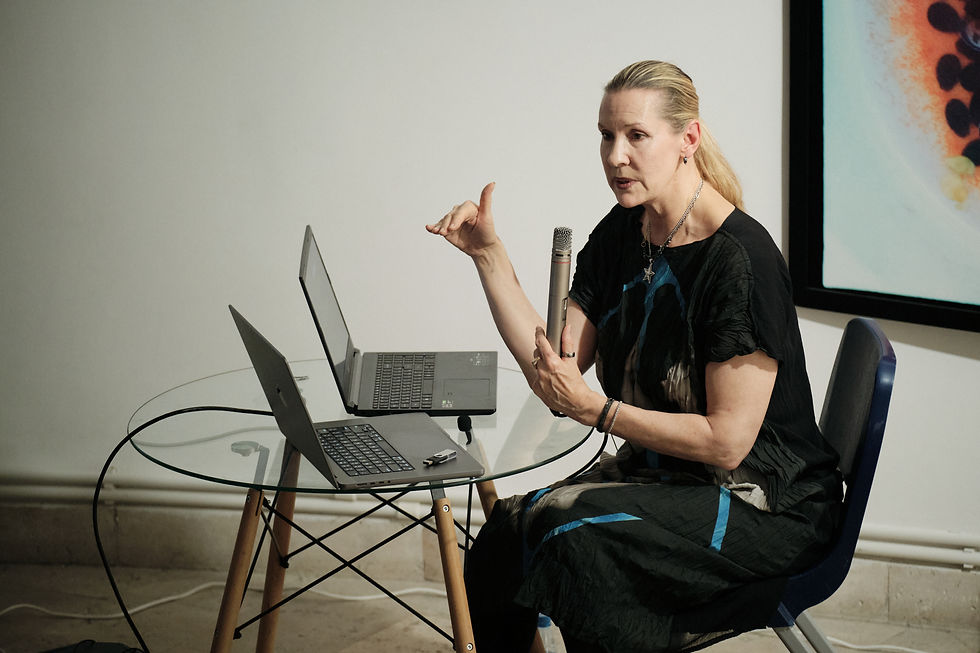
Date: 3.09.2023, 20:00 Duration: 45 min Location: HayArt Cultural Center Language of presentation: English New advances in medical science, transgenics, and biomechtronics offer surgically and genetically-modified “superhumans,” cyborg fantasies, and new evolutionary futures that inspire the cultural imaginary. Beginning with Mary Shelley’s “Frankenstein," a rich landscape of creative work has emerged, which re-imagines the human body by way of technology. Invasive genetic editing, prosthetic augmentation, bio-elective enhancement, and the synthesis of human and artificial intelligence all necessarily complicate the social and ethical dimensions of our technological future. This lecture will discuss manipulations of the human form that summon Mary Shelley’s cautionary tale, which serves as both a metaphor for our darkest fears involving human evolution and an opportunity to consider the concept of “antifragility” as it relates to paradigm shifts in what it means to be human. Patricia Olynyk’s work investigates science and technology-related themes and the ways in which social systems and institutional structures shape our understanding of the world. Olynyk is the Florence and Frank Bush Professor of Art at Washington University in St. Louis, Co-chair of Leonardo/ISAST’s LASER Talks program in New York, and Medicine + Media Arts Fellow at UCLA’s Art | Sci Center. Her work has been exhibited internationally at Palazzo Michiel (Venice, Italy); the Saitama Modern Art Museum (Japan); the Los Angeles International Biennial; The Brooklyn Museum; and the National Academy of Sciences in D.C. (USA). Olynyk’s writing has been featured in Public Journal, the Routledge Companion to Biology in Art and Architecture, Leonardo Journal, and Bio/Matter/Techno Synthetics (Actar Press).

Ellen Pearlman

Language Is Leaving Me – An AI Opera Of The Skin 2023 – Work In Progress

Date: 14.09.2023, 19:30 Duration: 50 min Location: HayArt Cultural Center Language of presentation: English LILM interrogates the relationship between Artificial Intelligence (AI) cinema, epigenetic or inherited traumatic memories of cultures of diaspora, biometrics, performance, and algorithmic justice. AI cinema did not exist two years ago. The basic algorithmic structures and tagging systems of AI purport to represent human experience past, present, and future but are critically flawed by lack of diversity and cultural contextualization. Nonetheless AI image rendering and sound is rapidly being codified into multi layered systems of sorting, identification, and control. LILM uses the basic structure of the algorithm and its’ ‘prompt engineering’ or set of text commands telling AI what type of visual and audio to locate and produce. These algorithms interrogate and recontextualize inherent biases and lack of representation from underserved and non-digitized cultures through structurally flawed semantic tagging embedded into massive image banks. LILM compares and contrasts algorithms, highlighting how memory and meaning deteriorate as signifiers become uncoupled from personal and cultural identity. Once implemented these systems will control routine tasks and human interaction, with no recourse to challenge or change them. Ellen Pearlman is a New York based new media artist, critic, curator and educator. A Fulbright Research Fellow at The University of Warsaw, Department of Mathematics and Informatics she was also a Research Fellow at MIT and is a Senior Research Assistant Professor at RISEBA University in Latvia. Ellen Pearlman created "Noor" an immersive interactive brainwave opera in a 360 degree theater and "AIBO" an emotionally intelligent artificial intelligence brainwave opera. She was Director of ThoughtWorks Arts, a high end art and technology research lab and Founder of Art-A-Hack (TM) a collaborative rapid prototyping workshop and methodology. She received her Ph.D. from the School of Creative Media, Hong Kong City University where her thesis "Noor — Is There A Place In Human Consciousness Where Surveillance Cannot Go?" was awarded Highest Global Honors from Leonardo LABS Abstracts.

Danielle Siembieda

Co-Operative Existence in a Post-People World

Date: 3.09.2023, 18:00 Duration: 60 min Location: HayArt Cultural Center Language of presentation: English Earth has become anti-fragile due to a combination of the depopulation and evolution of humans and nature's own understanding of its science, genomic ancestry, and adaptation. Through the lens of the morpheus influencer “Jean Gnome”, this presentation will connect the naive gestures of curiosity of interspecies communication with the speculative imaging of a post-people world. Danielle Siembieda is a systems artist practicing at the intersection of emerging technology, community and science. Her most recent work focuses on genomics as inspired by her residency at the University of Santa Cruz Genomics Institute Siembieda holds an MFA in Digital Media Art at San Jose State University at the CADRE Laboratory for New Media, focusing on green technology and sustainable materials. Outside her artistic career, she is helping grow the creative economy and cultural engagement in Silicon Valley with the City of San Jose. She is the former Chief Creative Officer of Leonardo/ISAST.
  • Instagram
  • Facebook
  • YouTube

Sign up for our Newsletter

Thank you!

Sose St., house 46,

Yerevan, Armenia, 0019

Ozo g. 28 - 35​

Vilnius, LT-07197

Lithuania

901Brickell Key Boulevard,

Suit 3705,

Miami, FL 33131 

USA


© CYLAND MediaArtLab 2007–2026. All rights reserved. 

bottom of page