top of page

EXHIBITION


Vasilii Bakanov and Andrew Strokov
Slow burning. Still Life (open-ended)
Installation, 2020 (edition of 2021)
OpenCV, Python, Arduino; 3x black box (thermally insulated), heaters, temperature and humidity sensor, HD webcam, flood light, DIN rail, microcontroller modules, Raspberry PI, Korg Monotron Delay, fruits
Engineers Andrew Strokov, Alexey Grachev, Alexander Bochkov; 3D modeling Alexander Bochkov; Python programming Andrew Strokov
Supported by CYLAND Media Art Lab
Three fruits on pedestals are contained inside a black box. In artificially created and regularly maintained conditions, the fruits pass through three chemical reactions — caramelization, the Maillard reaction and enzymatic browning. Usually, these processes take place within minutes in cooking. Here they are intentionally prolonged in time. Inside the box constant humidity and a temperature of 60 degrees Celsius are maintained, thus killing bacteria which cause decay. In ideal and constantly controlled conditions, the fruits preserve their form, and burn up inside from day to day at the lowest possible speed.
Visitors can observe the slowly burning still life by watching it in real-time on the video panel placed on the boxes. But the main activity remains hidden and takes place at the molecular level. Its tangible manifestation is a monotonous soundtrack performed by the fruits themselves. Information about the external appearance of each fruit is converted into sound waves. The processes inside the box are analyzed and sonified by an analog synthesizer. The sound pitch and timbre depend on temperature, humidity, fruit size and color. As the fruit burns up, the sound “burns up” as well and becomes increasingly dull and quiet.
The process is an artificially prolonged borderline state of “in between”. The metamorphosis is too slow to perceive by the naked eye. Because of the unnatural maximum delay, all differences vanish in the abyss of time to the accompaniment of a droning trio. However, it is still an open question as to whether the process will proceed in the way that was intended. Every effort has been made, all we can do is to wait and see what will happen next.
Vasilii Bakanov
Media artist, R&D specialist and chef. Born in 1987 in Kaluga, USSR. Graduated from the Moscow Automobile and Road Construction State Technical University (MADI, Russia). Hardware engineer at CYLAND Media Art Lab. As a chef he participated in the semi-final of the S.Pellegrino Young Chef 2018 (Moscow, Russia), and as an artist in such festivals as Theatrum: Re-Formation (2020, Moscow, Russia) and CYFEST-14: Ferment (2021, Dartington, UK). He gave a workshop on rediscovering ancient techniques of fermentation at Dartington Hall (2021, Dartington, UK). Lives and works in St. Petersburg, Russia.
Andrew Strokov
Engineer, programmer, media artist. Born in 1991 in the Omsk region (USSR). Graduated from the Physics Faculty of Omsk State University (Russia) and the master’s program of the St. Petersburg Electrotechnical University “LETI” (Russia). He has worked on developing electronic and biomedical devices and systems of the Internet of Things. One of the founders and resident of the hackerspace B4CKSP4CE (St. Petersburg, Russia). Head programmer of CYLAND Media Art Lab. Participated in such festivals as Chaos Constructions (2019, St. Petersburg, Russia), Chronotope (2021, Vyborg, Russia) and CYFEST-14: Ferment (2021, Dartington, UK). Lives and works in St. Petersburg, Russia.


Alena Begova
There is nothing wrong
Installation; fabric, mildew microorganisms, 2022
Supported by CYLAND Media Art Lab
In light of the present situation
It has been decided
To close the installation.
These words of prohibition are becoming increasingly common nowadays. They not only change familiar routes, but they also infringe on our rights. We get the feeling that a decision has already been made for us. The endless “You mustn’t!” puts us in a situation where we have no choice. The fabric with “metallic” folds doesn’t permit any further inspection. Its attractive pearly appearance stops us from immediately noticing a corner of the fabric that is starting to go moldy. This is the natural process of decay in any falsely constructed system, which it is impossible to hide.
Alena Begova
Graduated from the St. Petersburg Johansson Art Lyceum at the Russian Academy of Arts. Studied at the film and television art faculty of St. Petersburg University. A student of the “Young Artist’s School” at the Pro Arte Foundation, 2021-2022. Lives and works in St. Petersburg, Russia and Berlin, Germany.


Alexandra Dementieva
Sleeper
Interactive sound installation, 2015–present time
Tapestry, AR, Artivive
A series of tapestries together forms an installation that presents a sequence of film frames from the movie “Sleeper” by Woody Allen. The movie has been glitched and accidentally "edited" by the artist's crashed computer, becoming completely transformed and practically unrecognizable. The order of narrative development has been rigorously preserved: the still images are arranged in the same sequence as they appear in the film. The tapestries convey the movie’s plot, but in their own way, where some parts have been lost and others have remained. The size of each tapestry is 58x77 cm, which corresponds to the television and film format (4x3) of the 20th century. The artist uses an old visual technique: the art of weaving. Even if contemporary digital media were destroyed, this technique would be preserved.
By pointing a tablet with an AR application at a tapestry, visitors can watch a video which gives an explanation for each tapestry. The video is made from the perspective of human descendants / space travelers, who have found the tapestries 2000 years later. Their conclusion is that the tapestry is a way to archive film and video from the 20th-21st centuries. The film they find is Sleeper, a science fiction movie about a dystopian world.
Alexandra Dementieva
Artist. Born in 1960 in Moscow, USSR. She studied journalism in Moscow, USSR, and fine arts in Brussels, Belgium. Her principal interest as an artist is the use of social psychology, perception theory and behaviorism in media installations that combine dance, music, cinema and performance. She organizes LASER Talks Brussels and teaches at the Royal Academy of Fine Arts (Brussels, Belgium). Dementieva received first prize for the best mono-channel video at VAD Festival (2005, Girona, Spain). She is a participant of numerous exhibitions in major international cultural institutions, including Rubin Museum (New York, USA), MACRO Museum (Rome, Italy), Centro de la Imagen Museum (Mexico City, Mexico), the Hermitage Museum (St. Petersburg, Russia), Moscow Museum of Contemporary Art (Russia), and others. Lives and works in Brussels, Belgium.


Alexandra Dementieva
Mirror's Memory
Interactive video installation, 2003
Programing Siegfried Canto
A screen divides a dark, empty and quiet room in half. The images projected on to it imitate a mirror. At the first approach, visitors see their faithful reflection. In the middle of the room, there is an interactive carpet. As you step on it, a signal is sent to a computer to record the visitor for 30 seconds. At the end of this period, instead of your own reflection, you begin to see your own image surrounded by previous visitors. Sometimes you find yourself a witness to a conversation or a quarrel. Sometimes you hear whispers.
This installation reacts to a visitor’s presence on the interactive carpet by superimposing various images, scenes and sounds generated at random. The exhibition behavior evolves during the show, modifying according to the database of all the visitors.
Alexandra Dementieva
Artist. Born in 1960 in Moscow, USSR. She studied journalism in Moscow, USSR, and fine arts in Brussels, Belgium. Her principal interest as an artist is the use of social psychology, perception theory and behaviorism in media installations that combine dance, music, cinema and performance. She organizes LASER Talks Brussels and teaches at the Royal Academy of Fine Arts (Brussels, Belgium). Dementieva received first prize for the best mono-channel video at VAD Festival (2005, Girona, Spain). She is a participant of numerous exhibitions in major international cultural institutions, including Rubin Museum (New York, USA), MACRO Museum (Rome, Italy), Centro de la Imagen Museum (Mexico City, Mexico), the Hermitage Museum (St. Petersburg, Russia), Moscow Museum of Contemporary Art (Russia), and others. Lives and works in Brussels, Belgium.


Luca Forcucci
The Greatest Bubble
Site-Specific Sonic Performance and Installation, 2022
Inkjet Prints on voile; Ableton, Envelope, Jamm Pro, max/MSP, Reaper; field recordings with geophone, hydrophone, miniature microphone, coil, wine amphora
The project is created on-site through the kind invitation of CYFEST and with the precious expertise of the winemakers
Bubbles, metaphors, poetry.
The project explores wine fermentation. Armenia has been producing wine for a long time, and may even have been the first place to do so, around 6,000 years ago. In this project the artist works with time and field recordings related to human activities in winemaking, with the smallest sonic elements of wine fermentation (micro), and resonant spaces of wine production (macro). The central idea resides in exploring temporality in the micro (intern) and macro (extern) relationships in the thingness of winemaking. The presentation of the work as performance and installation involves local techniques, craftsmanship, and objects like KARAS, transformed into loudspeakers.
Luca Forcucci
Artist, composer and researcher. He explores the relationships between the sonic and consciousness, perception, memory and the body. He has a background in sonic arts, cognitive science, and architecture. His research and artworks are presented worldwide on a regular basis. Luca Forcucci has won numerous national and international awards. He has a PhD in Music, Technology and Innovation from De Montfort University, UK, a MA in Sonic Arts from The Queen's University of Belfast, Ireland, and diplomas in architecture and civil engineering in Switzerland.


Anna Frants
Peck of salt
From series “Gravity”
Installation, 2019
video [00:01:56; Full HD, no sound]; LCD screen, stepper motor, fine salt, wooden box, leadscrew, microcontroller, spotlight, acrylic sheet
Engineers Alexey Grachev, Alexander Bochkov, Victor Timofeev
Supported by CYLAND Media Art Lab
From the saying «Чтобы узнать человека, надо с ним пуд соли съесть» (“A man must eat a peck of salt with his friend before he knows him”).
Anna Frants
Artist, curator in the field of media art. Born in 1965 in Leningrad, USSR. She graduated from the Vera Mukhina Higher School of Art and Design (Leningrad, USSR) and Pratt Institute (New York, USA). Founder of the nonprofit cultural foundation Cyland Foundation Inc. Cofounder of CYLAND Media Art Lab and CYFEST. Frants’ interactive installations have been showcased at Museum of Art and Design (New York, USA), Video Guerrilha Festival (Brazil), Manifesta 10 Biennale (2014, St. Petersburg, Russia), Hermitage Museum (St. Petersburg, Russia), Chelsea Art Museum (New York, USA), Russian Museum (St. Petersburg, Russia), Kunstquartier Bethanien (Berlin, Germany), Hatcham Church Gallery, Goldsmiths, University of London (UK), Dartington Estate (UK), Ca’ Foscari Zattere Cultural Flow Zone (Venice, Italy), MAXXI Museum (Rome, Italy), National Arts Club (New York, USA) and at other major venues all over the world. The artist’s works are held in the collections of the Russian Museum (St. Petersburg, Russia), Museum of Art and Design (New York, USA), Sergey Kuryokhin Center for Modern Art (St. Petersburg, Russia) and Kolodzei Art Foundation (New York, USA) as well as in numerous private collections. Lives and works in Miami, USA.


Anna Frants
Artist Union. Still life
From the series “Matter of Chance”
Media Installation, 2019
OpenCV, Python; 3D printing, ink on paper, stepper motors, servomotors, microcontroller, Raspberry Pi, webcamera, oil on plywood
Engineers Alexey Grachev, Alexander Bochkov, Viсtor Timofeev; 3D modeling Alexey Grachev, Alexander Bochkov; Python programming Alexey Grachev, Ruslan Khadzhimirzoev
Supported by CYLAND Media Art Lab
“Artist Union. Still life” is a reflection on the law of large numbers. Is it applicable in visual arts — to colors in painting, lines in graphics, forms in sculpture, and the image integrity in installations? The law of large numbers is a principle that describes the completion of the same experiment many times. According to this law, the joint action of a large number of random factors leads to a result almost independent of the chance. For example, in the XVI century the length of the English foot was defined, by a royal order, as the arithmetic average length of the foot of the first 16 people leaving the church on Sunday matins. Although the law of large numbers was not yet defined, it serves as the basis for the principle of arithmetic mean used in determining the length of a foot.
Anna Frants
Artist, curator in the field of media art. Born in 1965 in Leningrad, USSR. She graduated from the Vera Mukhina Higher School of Art and Design (Leningrad, USSR) and Pratt Institute (New York, USA). Founder of the nonprofit cultural foundation Cyland Foundation Inc. Cofounder of CYLAND Media Art Lab and CYFEST. Frants’ interactive installations have been showcased at Museum of Art and Design (New York, USA), Video Guerrilha Festival (Brazil), Manifesta 10 Biennale (2014, St. Petersburg, Russia), Hermitage Museum (St. Petersburg, Russia), Chelsea Art Museum (New York, USA), Russian Museum (St. Petersburg, Russia), Kunstquartier Bethanien (Berlin, Germany), Hatcham Church Gallery, Goldsmiths, University of London (UK), Dartington Estate (UK), Ca’ Foscari Zattere Cultural Flow Zone (Venice, Italy), MAXXI Museum (Rome, Italy), National Arts Club (New York, USA) and at other major venues all over the world. The artist’s works are held in the collections of the Russian Museum (St. Petersburg, Russia), Museum of Art and Design (New York, USA), Sergey Kuryokhin Center for Modern Art (St. Petersburg, Russia) and Kolodzei Art Foundation (New York, USA) as well as in numerous private collections. Lives and works in Miami, USA.



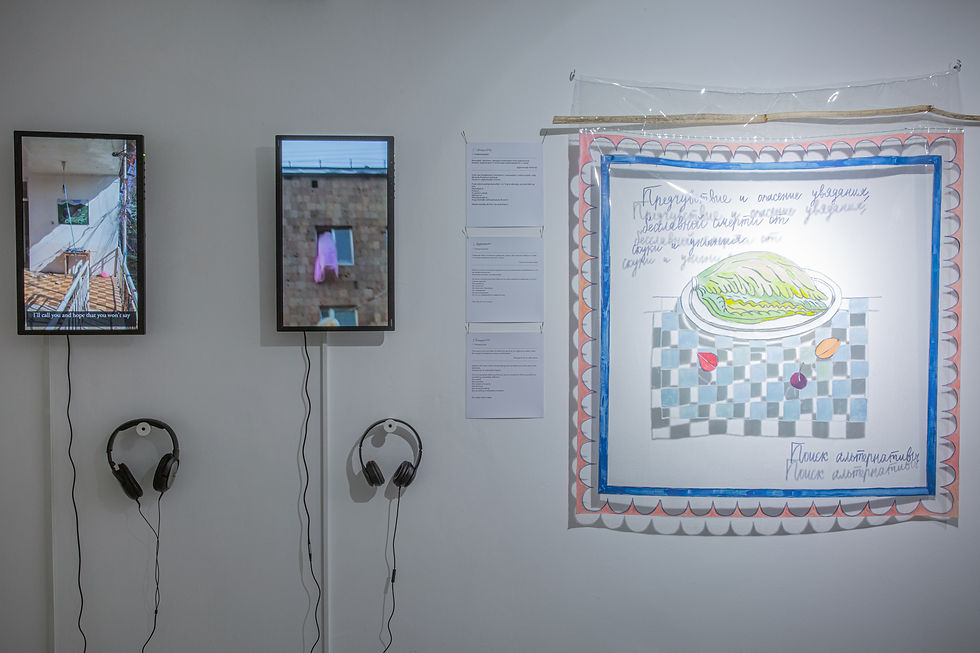
Alexandra Garkusha
Dramatization as Fermentation
Painting, Panel picture (acryl, silicon transparent film), video, text, 2022
Supported by CYLAND Media Art Lab
In my project, I draw an analogy between the processes of dramatization and fermentation. If we look at fermentation in the everyday culinary sense, we may say that this is a controlled process of spoiling food in order to obtain more pronounced taste properties. I believe that drama in the everyday sensual sense carries out very similar functions, and uses approximately the same methods. I juxtapose dramatization and fermentation in four points: prerequisites, mechanism of action, necessary conditions and final results.
The project consists of 4 panels on transparent film, and a video about one of the conditions that enable fermentation – pressure. In this video, I compare the “controlled” pressure characteristic of dramatization that is connected with personal emotions, and uncontrolled external pressure that is connected with global problems.
— Alexandra Garkusha
Alexandra Garkusha
Born in 1994 in Simferopol, Ukraine. Lived in Simferopol, Moscow, Khanty-Mansiysk, St. Petersburg and Dilijan. In 2017, she graduated from the film and television art faculty of St. Petersburg University. A student of the “Young Artist’s School” at the Pro Arte Foundation, 2021–2022.

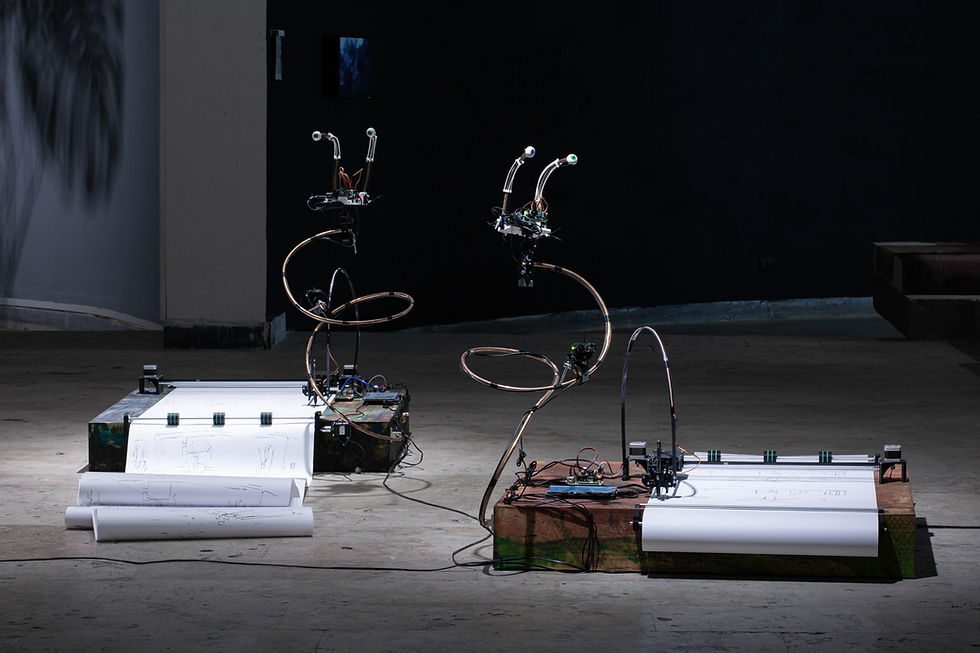
Alexey Grachev, Sergey Komarov
Quantum
Sound Installation, 2017
audio [00:10:00, real-time generated], DSP grains counter; max\MSP, Arduino; steel, welding, soldering, plexiglass, LCD screen, 3D printing, audio tape, tape recorder, sensors, micro controller, speakers
Engineers Alexey Grachev, Sergey Komarov; 3D modeling Alexey Grachev; max\MSP Programing Sergey Komarov
The recording of sound from this artwork was released in CYLAND Audio Archive (CAA—35, 2018). Supported by CYLAND Media Art Lab
One of directions in the collaboration of Aleksey Grachev and Sergey Komarov is the study of noises of the animate and inanimate nature. In this work, the artists conduct an analysis of time-space. Using scientific instruments, they register the noise of sand that trickles in an hourglass on the magnetic tape. Then this sound is analyzed using the regenerating-computing system, accurate to a grain, and the "quanta" of time get recounted. The work is stereophonic: sound reflects time and, in effect, it is time departing from one headphone channel and arriving in the opposite one, having flown through the space-listener. This installation is simultaneously a vocalization of time and an attempt to quantize and recount it.
Alexey Grachev
Media artist, engineer, computer programmer. Born in 1983 in Kaluga, USSR. Graduated from the Bauman Moscow State Technical University (Russia). Completed the program “School for Young Artists” at the Pro Arte Foundation (St. Petersburg, Russia). Technical director and chief engineer of CYLAND Media Art Lab. Participant of the World Event Young Artists Festival (2012, Nottingham, UK), CYFEST (many times), special project “Urbi et Orbi” at the 6th Moscow Biennale (2015, Russia) and “The Creative Machine 2” exhibition at Goldsmiths, University of London (2018, UK). Participant of the “Arts Work of the Future” project in the Tate Exchange space (2018, London, UK). He has given lectures and workshops at the University of the Arts London (UK), St. Petersburg Stieglitz Academy of Art and Design (St. Petersburg, Russia), Pro Arte (St. Petersburg, Russia), and ITMO University (St. Petersburg, Russia). Lives and works in St. Petersburg, Russia and Yerevan, Armenia.
Sergey Komarov
Sound artist, curator, engineer, computer programmer. Born in 1980 in Kaluga, USSR. Since 2008, he has worked as a computer programmer at CYLAND Media Art Lab; since 2012, has curated audio projects and CYLAND Audio Archive (cyland.bandcamp.com). Since 2015, together with Alexey Grachev, he has developed the project “Subjectivization of Sound” based on the interaction between space and spectators. Participant of CYFESTs in various years, Archstoyanie Festival (2014, Kaluga Region, Russia) and “The Creative Machine 2” exhibition at Goldsmiths, University of London (2018, UK). Currently lives and works in Yerevan, Armenia.


Alexey Grachev, Andrew Strokov, Alexander Bochkov
The Multitude
Site-specific multi-channel sound installation, 2021
Arduino; drum kit, robotics, 3D Print, stepper motor, servomotor, proximity sensor, LEDs, custom made circuit board, LED board, synthesizer Korg MS-20, Polivoks;
cylindrical space, railings
Engineers Andrew Strokov, Alexey Grachev, Alexander Bochkov; 3D modeling Alexander Bochkov; Arduino programming Andrew Strokov
Supported by CYLAND Media Art Lab
In this work, the authors study the acoustic properties of space. By placing various sources of sound inside concrete cylinders, the artists study the parameters of sound distribution and focus. The performance uses polymer batteries, portable speakers, control units with low power consumption, 3D-print, drums, cymbals and generative pixel graphics, which react sensitively to the acoustic features of the building, reducing the human footprint in the minimalist-functional art space.
Alexander Bochkov
Engineer, 3D modeler and media artist. Born in 1990 in Orsk, USSR. Founder of the main gravel cycling race in Russia, “Reverse Side of the Road”. Co-founder of the cycling brand Sin_x. Сhief 3D printing specialist at CYLAND Media Art Lab. Participated in such festivals as Chronotope (2021, Vyborg, Russia) and CYFEST-14: Ferment (2021, Dartington, UK). Lives and works in Yerevan, Armenia.
Andrew Strokov
Engineer, programmer, media artist. Born in 1991 in the Omsk region (USSR). Graduated from the Physics Faculty of Omsk State University (Russia) and the master’s program of the St. Petersburg Electrotechnical University “LETI” (Russia). He has worked on developing electronic and biomedical devices and systems of the Internet of Things. One of the founders and resident of the hackerspace B4CKSP4CE (St. Petersburg, Russia). Head programmer of CYLAND Media Art Lab. Participated in such festivals as Chaos Constructions (2019, St. Petersburg, Russia), Chronotope (2021, Vyborg, Russia) and CYFEST-14: Ferment (2021, Dartington, UK). Lives and works in St. Petersburg, Russia.
Alexey Grachev
Media artist, engineer, computer programmer. Born in 1983 in Kaluga, USSR. Graduated from the Bauman Moscow State Technical University (Russia). Completed the program “School for Young Artists” at the Pro Arte Foundation (St. Petersburg, Russia). Technical director and chief engineer of CYLAND Media Art Lab. Participant of the World Event Young Artists Festival (2012, Nottingham, UK), CYFEST (many times), special project “Urbi et Orbi” at the 6th Moscow Biennale (2015, Russia) and “The Creative Machine 2” exhibition at Goldsmiths, University of London (2018, UK). Participant of the “Arts Work of the Future” project in the Tate Exchange space (2018, London, UK). He has given lectures and workshops at the University of the Arts London (UK), St. Petersburg Stieglitz Academy of Art and Design (St. Petersburg, Russia), Pro Arte (St. Petersburg, Russia), and ITMO University (St. Petersburg, Russia). Lives and works in St. Petersburg, Russia and Yerevan, Armenia.


Sofia Grigoryeva, Yulia Ribetki
Dependent
Media Installation, 2022
Supported by CYLAND Media Art Lab
People who live in a community actively influence each other. Words, actions, comments and evaluations by people around us have an effect on us all, even if it is just a silent presence. We are endlessly changing under the influence of other people, sometimes faster, sometimes slower. Society is incessantly fermenting us. "Dependent", the entity that we create, is a state of dependency on those around us that is carried to absurdity. It develops and transforms with every person passing by. It increases in size. It turns the other way. It grows new parts. We look at it, and it looks at us in response with an even greater number of eyes. Walking past it, we don’t know what kind of changes we will provoke, but they will take place without a doubt.
Sofia Grigoryeva
Born in 1995 in St. Petersburg. Graduated from the St. Petersburg Stieglitz State Academy of Art and Design in 2022. A student of the “Young Artist’s School” at the Pro Arte Foundation, 2021–2022. Works with installations, video and public art objects, often addressing controversial social topics. In her works, Sofia studies society and people, their interaction and mutual influence in the most diverse situations. Participant of group exhibitions including “New Time” at the New Tretyakov (Moscow, Russia) and The Museum of Urban Sculpture (St. Petersburg, Russia). Lives and works in St. Petersburg, Russia.
Yulia Ribetki
Born in 1990 in Rostov-on-Don. Studied at the St. Petersburg Stieglitz State Academy of Art Design, specializing in monumental and decorative sculpture. A student of the “Young Artist’s School” at the Pro Arte Foundation, 2021-2022. Works in the genres of installation and performance. She has participated in exhibitions in Russia and abroad. Since the spring of 2022, together with Sofia Grigoryeva she has been working on the ongoing public art project MIASO in the genres of performance and installation. Lives and works in St. Petersburg, Russia.


Elena Gubanova & Ivan Govorkov
Danae
Media Installation, 2014
max\MSP, Arduino, TouchOSC; golden plastic mirrors, steel, custom made circuit boards, 3D printing, milling, servomotors, microcontrollers, computer, contact microphones, surface transducers, DMX light
Circuit board design, 3D modeling, TouchOSC programming, engineer Alexey Grachev; max\MSP programming Sergey Komarov, Alexey Grachev
Supported by CYLAND Media Art Lab
“Light exerts physical pressure on objects in its path, a phenomenon which can be deduced by Maxwell’s equations, but can be more easily explained by the particle nature of light.” (Wikipedia)
The artists approach the myth of the daughter of Acrisius and the god Zeus as a beautiful illustration of the life-giving force of the “immaterial” in art. Danae is a multimedia object-sculpture made of “live” round mirrors that quiver.
In the installation, the artists connect the algorithm of movement of light with the algorithm of movement of a viewer’s eye over Rembrandt’s painting. The mirror’s quivering and the trembling reflection of light from its surface create a sensual, erotic context of the object’s perception. In all ages, scientists and artists strived to represent the mundane as mysterious.The nature of light is one such mystery — photons strike and transfer their momentums. At large scales, light pressure can cause asteroids to spin faster, acting on their irregular shapes as on the vanes of a windmill.The sculpture’s general outline can be visibly correlated with the figure of Danae in Rembrandt’s painting in the Hermitage. It is no accident that one of the asteroids that rush about the Universe in search of living light was called Danae.
Elena Gubanova
Artist and curator. Born in 1960 in Ulyanovsk, USSR. Graduated from the Ilya Repin State Academic Institute of Painting, Sculpture and Architecture (Leningrad, USSR). Works in the fields of painting, sculpture, installations and video. As a curator, she is engaged in CYLAND Media Art Lab projects. Lecturer in the master’s program at the ITMO Art & Science University (St. Petersburg, Russia) and the “Young Artist’s School” at the Pro Arte Foundation (St. Petersburg, Russia) in 2020–2021. Recipient of the Sergey Kuryokhin Award (Russia) for “Best Work of Visual Art” (2012, together with Ivan Govorkov) and “Best Festival in the Field of Contemporary Art“ (2018). Her works have been exhibited at major Russian and foreign venues, including the Hermitage Museum (St. Petersburg, Russia), Russian Museum (St. Petersburg, Russia), Museum of Moscow (Russia), Tretyakov Gallery (Moscow, Russia), University Ca’ Foscari (Venice, Italy), Goldsmiths, University of London (UK), Chelsea Art Museum (New York, USA), Kunstquartier Bethanien (Berlin, Germany) and National Arts Club (New York, USA). Participant of the Manifesta 10 parallel program (2014, St. Petersburg, Russia) and several exhibitions parallel to the Venice Biennale (since 2011, Venice, Italy); frequent participant and curator of CYFEST. Since 1990, she has worked in collaboration with Ivan Govorkov. Lives and works in St. Petersburg, Russia.
Ivan Govorkov
Artist. Born in 1949 in Leningrad, USSR. Graduated from the Ilya Repin State Academic Institute of Painting, Sculpture and Architecture (Leningrad, USSR). He is engaged in philosophy, psychology, painting, drawing, sculpture and installations; he works at the junction of traditional art and cutting-edge technologies. Professor of drawing at the Ilya Repin Institute (St. Petersburg, Russia). Recipient of the Sergey Kuryokhin Award (2012, Russia) for “Best Work of Visual Art” (together with Elena Gubanova). His works have been exhibited at major Russian and foreign venues, including the Hermitage Museum (St. Petersburg, Russia), Russian Museum (St. Petersburg, Russia), Museum of Moscow (Russia), University Ca' Foscari (Venice, Italy), Chelsea Art Museum (New York, USA), Kunstquartier Bethanien (Berlin, Germany) and Sky Gallery 2 (Tokyo, Japan). Participant of the Manifesta 10 parallel program (2014, St. Petersburg, Russia) and several exhibitions parallel to the Venice Biennale (since 2011, Venice, Italy); frequent participant of CYFEST. Since 1990, he has worked in collaboration with Elena Gubanova. Lives and works in St. Petersburg, Russia.


Elena Gubanova, Ivan Govorkov, Sergey Komarov
Abort! Retry! Ignore!
4 paintings, oil on canvas, 120x100 cm each, 2017
Glitch images collecting Sergey Komarov
Paintings Elena Gubanova
Supported by CYLAND Media Art Lab
The project is at the junction of net art and found art. An archive of digital images was gathered in the internet by Sergey Komarov. Originally distinct and informative, they have become indistinct with time. The phenomenon's nature has not been studied thoroughly, but it is known that users that owned the original files tried, in fact, to save them — and, possibly, for good. Elena Gubanova and Ivan Govorkov transferred these images into an old media — the pictures painted with oil on canvas — thus subjecting to destruction the "digit" as a mythologized eternity. Their paintings talk about the problems of storing the digital information that, unlike artifacts of the antiquity, did not even last a single century.
Elena Gubanova
Artist and curator. Born in 1960 in Ulyanovsk, USSR. Graduated from the Ilya Repin State Academic Institute of Painting, Sculpture and Architecture (Leningrad, USSR). Works in the fields of painting, sculpture, installations and video. As a curator, she is engaged in CYLAND Media Art Lab projects. Lecturer in the master’s program at the ITMO Art & Science University (St. Petersburg, Russia) and the “Young Artist’s School” at the Pro Arte Foundation (St. Petersburg, Russia) in 2020–2021. Recipient of the Sergey Kuryokhin Award (Russia) for “Best Work of Visual Art” (2012, together with Ivan Govorkov) and “Best Festival in the Field of Contemporary Art“ (2018). Her works have been exhibited at major Russian and foreign venues, including the Hermitage Museum (St. Petersburg, Russia), Russian Museum (St. Petersburg, Russia), Museum of Moscow (Russia), Tretyakov Gallery (Moscow, Russia), University Ca’ Foscari (Venice, Italy), Goldsmiths, University of London (UK), Chelsea Art Museum (New York, USA), Kunstquartier Bethanien (Berlin, Germany) and National Arts Club (New York, USA). Participant of the Manifesta 10 parallel program (2014, St. Petersburg, Russia) and several exhibitions parallel to the Venice Biennale (since 2011, Venice, Italy); frequent participant and curator of CYFEST. Since 1990, she has worked in collaboration with Ivan Govorkov. Lives and works in St. Petersburg, Russia.
Ivan Govorkov
Artist. Born in 1949 in Leningrad, USSR. Graduated from the Ilya Repin State Academic Institute of Painting, Sculpture and Architecture (Leningrad, USSR). He is engaged in philosophy, psychology, painting, drawing, sculpture and installations; he works at the junction of traditional art and cutting-edge technologies. Professor of drawing at the Ilya Repin Institute (St. Petersburg, Russia). Recipient of the Sergey Kuryokhin Award (2012, Russia) for “Best Work of Visual Art” (together with Elena Gubanova). His works have been exhibited at major Russian and foreign venues, including the Hermitage Museum (St. Petersburg, Russia), Russian Museum (St. Petersburg, Russia), Museum of Moscow (Russia), University Ca' Foscari (Venice, Italy), Chelsea Art Museum (New York, USA), Kunstquartier Bethanien (Berlin, Germany) and Sky Gallery 2 (Tokyo, Japan). Participant of the Manifesta 10 parallel program (2014, St. Petersburg, Russia) and several exhibitions parallel to the Venice Biennale (since 2011, Venice, Italy); frequent participant of CYFEST. Since 1990, he has worked in collaboration with Elena Gubanova. Lives and works in St. Petersburg, Russia.
Sergey Komarov
Sound artist, curator, engineer, computer programmer. Born in 1980 in Kaluga, USSR. Since 2008, he has worked as a computer programmer at CYLAND Media Art Lab; since 2012, has curated audio projects and CYLAND Audio Archive (cyland.bandcamp.com). Since 2015, together with Alexey Grachev, he has developed the project “Subjectivization of Sound” based on the interaction between space and spectators. Participant of CYFESTs in various years, Archstoyanie Festival (2014, Kaluga Region, Russia) and “The Creative Machine 2” exhibition at Goldsmiths, University of London (2018, UK). Currently lives and works in Yerevan, Armenia.

Pavel Ignatev
Reverse Drift. Unpacking and Absorption
Sculptures, 2018–2022
The name of the project refers to situationism and the texts of Guy Debord, primarily the essay “Mode d'emploi du détournement”. Since the time these manifestos were written, “drift” as a form of artistic invasion has become a widespread practice for the author to interact with the surrounding reality.
The project “Reverse Drift” includes copies of classical sculptures, with their surfaces covered in snails. Dozens of snails are also found in the corners of the space. One of the points of attraction is the glass case: inside it the snails replace a familiar exhibit.
The artistic intervention of the academic ends with a removal, a disappearance. The spiral of any process, like the spiral of a snail, can be unraveled and rolled back up. The anthropic has only existed for 20–30 centuries, and this is nothing compared with the millions of years when the biosphere developed. And the practice of “deviation” (détournement) turns out to be accessible not only by people, but also by gastropods.
Pavel Ignatev
Sculptor, researcher and curator. In his sculptural performances, installations and site-specific projects, Ignatev explores the relationship between author and statue, traditional materials and contemporary interpretation, reference local-global heritage and post-human readymade. He uses such technologies as 3D printing, old hand-made practices and computer prototyping. His projects have been exhibited at the Russian Museum (St. Petersburg, Russia), Academy of Fine Arts Museum (St. Petersburg, Russia), Museum of Urban Sculpture, Indiana University (USA), and other venues. He gave performances with clay at the Hermitage Museum Intellectual Marathons. Ignatiev presents his research in the form of museum exhibitions, where he acts as a curator and designer. Ignatev is also famous for his multimedia project — “Cement operetta (2018)“, visual 4 screen play “Vous sortez du sectour americain”(2019) and libretto and scenography for the acousmatic opera “Professor Pavlov’s Session” (2021) Member of the international Dream Mapping Project. Lives and works in St. Petersburg, Russia.


Ivan Karpov
Fine Body
Audiovisual object; Author’s hydroponic system with a live plant, 2022
Hydroponic system with a plant Monstera deliciosa, lab glass/chemical vessels, silicon tubes, air compressor, time switch, LED fixtures, metal tripods and clamps, podium.
Supported by CYLAND Media Art Lab
The installation is a philosophic discourse, a gedankenexperiment that joins two dimensions of life. The fragile and fine hydroponic system works like a clock. It contains a remarkable process of transformation of nonorganic compounds into a more advanced and organic life form. The resource and time of work of the lab device are limited while the potential of a living creature pursues infinity…
Further reasoning on this subject brings me to the thoughts about an unfathomable plan that is in store for people within the framework of life on Earth. Much like the system of glass vessels, our fragile bodies are a substratum that is capable of cultivating a fine spiritual body that exists in a different dimension. What is it capable of? Has there been allotted enough time? Will our fine body be able to achieve self-sufficiency? What nurtures it and what ruins it? What will its subsequent existence be like?
Ivan Karpov
Born in 1986 in Gatchina (Leningrad Region). He graduated from a high school specializing in physics and biology, and then studied to be a radio technician at the The Bonch-Bruevich Saint Petersburg State University of Telecommunications. Physicists and engineers by training, his parents also inspired him to take an interest in growing plants, which mutated into more modern forms. Ivan took up progressive plant-growing, producing micro-greenery, modeling systems and creating various environments for plants. He began by studying the life of plants from a scientific standpoint, and made a smooth transition to creating installations which could no longer be classified as scientific exhibits. Hydroponic systems transformed into mediums of the artistic environment.


Marin Kasimir
Satellite Dishes: A Dish is Not a Meal
Satellite Dishes, Panoramic photography, 3D Studio Max, printing on fiberglass and polyester resin (satellite dishes), 2008
The 6 (previously 9) satellite dishes were created with the support of La Maison des Arts de Schaerbeek (Brussels)
When in November of 2007 I was invited by the small but very active art institution “La Maison des Arts” run by Anne-Cécile Maréchal in the Schaerbeek area in Brussels, I wanted to do two things: firstly, to relate a work (a lightning frieze) in a public space to the art world, and I did so in a difficult social housing area. Secondly, I wanted to create a new specific work which would show aspects of Schaerbeek in an unusual way, but on usual supports that are very well-known there.
I made nine Tondi, circular panoramic images, which I printed on fiberglass and mounted with polyester resin metal satellite dishes of different sizes, and installed them on the backstage of the Maison des Arts. They captured and showed the space around them, not any images from faraway countries or from the universe. Now they have witnessed the time they spent outside, on my terrace.
— Marin Kasimir
Marin Kasimir
Artist. Born in 1957 in Munich, he studied there at the Academy of Fine Arts. In 1985 he received the Young Painters Award, Belgium. In 1989, Kasimir added to his artistшс vocabulary with panoramic photography, which appeared as independent works or in the public space in the form of friezes. A large part of Kasimir's work and research is dedicated to public space. As permanent installations, his works have been exhibited in Belgium, France, Germany and the Netherlands. In 1991, Marin Kasimir was the very first artist invited to the Atelier Calder (France) for a 9 month residency. In 2000, he participated at the Venice Biennale of Architecture “Less Aesthetics, More Ethics” with the installation “Révélateur”. In 1994, for the exhibition “La Ville, Des villes et des nuits” at the Centre Pompidou, Kasimir created a monumental panoramic image of 4x36 m, “L’image Excentrique”, which completely covered the south side of the Centre. In 2012, Kasimir started a work about art fairs, “Tondo Artis: Fair or Unfair?”, a circular film that was finished and presented in 2020. Since 1982 he has lived and worked in Brussels, Belgium.


Marin Kasimir
Kodak: Green as Fuji! (Gondola)
Panoramic photography, printing on paper and plexiglass, 2004
The work entitled “Gondola” — like the name of the tourist café on a hill close to Christchurch in New Zealand — is about different representations of real and different realities.
In the center of the image, there is a surface that is almost black and round, surrounded by a green hoop, apparently a circular photograph of a landscape, probably a panorama. It might be a light box placed in a ceiling. If one looks closer, it shows what might be seen when looking through the windows – but totally in green! The original colors disappeared through permanent UV over a long time.
A second, larger hoop shows the windows of the cafeteria, and through the windows, fragments of the same landscape of the photograph. It is like a second circular horizon, — now in full colors.
The periphery of the image belongs to the ground, the floor, in this case the blue carpet with its red chairs and a large compass, a tool for orientation. It shows the difficulty, or rather the impossibility, to find an orientation in this image, where you don’t have a clear idea of up or down, an image without a center of gravity, without a central perspective, without hierarchies…
Outside of this tondo, everything would be a repetition – since from one point of view, everything was first scanned and then shown.
Perhaps if the colors had not faded from the panoramic photograph, I would never have taken this image. Of course, I have always liked situations like this, the panorama of the panorama with different degrees of reality, and here even more so: the panorama of the panorama of the panorama! But it was definitely the green, the obvious mistake, which made this photograph acquire an image that was almost like a painting.
What is ultimately real in “Gondola”? I would say that the only reality of this work is ultimately the shape of the Tondo: a circle!
— Marin Kasimir
Marin Kasimir
Artist. Born in 1957 in Munich, he studied there at the Academy of Fine Arts. In 1985 he received the Young Painters Award, Belgium. In 1989, Kasimir added to his artistшс vocabulary with panoramic photography, which appeared as independent works or in the public space in the form of friezes. A large part of Kasimir's work and research is dedicated to public space. As permanent installations, his works have been exhibited in Belgium, France, Germany and the Netherlands. In 1991, Marin Kasimir was the very first artist invited to the Atelier Calder (France) for a 9 month residency. In 2000, he participated at the Venice Biennale of Architecture “Less Aesthetics, More Ethics” with the installation “Révélateur”. In 1994, for the exhibition “La Ville, Des villes et des nuits” at the Centre Pompidou, Kasimir created a monumental panoramic image of 4x36 m, “L’image Excentrique”, which completely covered the south side of the Centre. In 2012, Kasimir started a work about art fairs, “Tondo Artis: Fair or Unfair?”, a circular film that was finished and presented in 2020. Since 1982 he has lived and worked in Brussels, Belgium.

Katran
A Thousand Handshakes
Objects; ceramics, glaze, 2022
The project builds upon Sergey Katran’s years of research exploring the ways in which the biocentric concept impacts ethical ties and building special society networks. That said, we register a certain correlation between grassroots initiatives of artistic communities’ networks, and mycelia. Both are based on thin, interlaced fibers of daily existence.
Various forms of cooperation and mutual assistance act as a binding principle in all this. Altruism is viewed as an inalienable component of the biocenosis and aided by the ethical element in anarchist ideas, and these two permanent constituents are present in the life of animal communities, plants and fungi, and occur in natural environments, as well as in human society. Self-organization as a grassroots, independent initiative, confirms the viability of its alternative ethical practices and behaviors that radically differ from those adopted by capitalist societies geared for profit, and based on manipulation to achieve higher standards of living. Mutual communal support is a vital component of artistic practices. By self-organizing as groups, artists find optimal ways of existence steeped in equality and mutual responsibility. The first handshake upon meeting becomes the metaphor for an encounter of kindred artistic souls.
Mushroom anarchy, as a metaphor for grassroots symbiotic artistic communities, establishes the hubs of respect for those living entities that are prone to empathetic behaviors and for interspecies altruism in their joint search for a way out of the environmental and cognitive impasse.
— Katran, Natasha Timofeeva
Katran
Artist. Born in Nikopol, Ukraine, USSR. In 1992 Katran obtained his first degree in Natural Sciences at the Kryvyi Rih State Pedagogical Institute (Ukraine), majoring in biology and chemistry. He later moved to Moscow, Russia, where he received his Fine Arts degree from the School of Visual Arts. Katran is a versatile artist who experiments with Science Art and Bio Art and works in a variety of media, such as installation, sculpture, performance and video. His practice is grounded in recent scientific and technological findings. He is a recipient of the Lomonosov Art Prize for intellectual contribution to contemporary art (2012, established by the Faculty of Philosophy, Moscow State University, Russia) and a laureate of the Fabrika Center for Creative Industries competition (2019, Moscow, Russia). Katran’s artworks can be found in museum, private and corporate art collections, such as Luciano Benetton’s collection Imago Mundi (under the auspices of the Fondazione Benetton Studi Ricerche, Treviso, Italy), Les Jardins d’ Étretat (Normandy, France), the Russian Museum (St. Petersburg, Russia), National Center of Contemporary Art (NCCA, Moscow, Russia), and others.


William Latham
Fantasy Virus (Mutator)
computer-generated VR video, 2020–2021
The project was created by William Latham in collaboration with Stephen Todd and the Mutator VR Team with audio by Peter Todd. The aim was to see if they could use their Mutator/Form Grow generation system to generate “Virus like” mutations using their “evolution by aesthetics” approach. The work is a response to the COVID-19 epidemic; though viruses are terrible, this video art celebrates and parodies their intricate geometry. The video is inspired by what the team have learnt through their scientific work visualising structural biology data for the University of York and the Weatherall Institute of Molecular Medicine.
William Latham
Computer artist. Born in 1961 in the UK. William studied at Oxford University and at the Royal College of Art in London. He is well known for his pioneering Organic Computer Art project based on his work on the IBM with mathematician Stephen Todd. He has also worked in rave music and computer games development with Universal, Sony SCEE and Warner Bros. Since 2007, he has been Professor in Computer Art and Games Development at Goldsmiths, University of London. Since 2015 he has worked extensively on developing Mutator VR that has been shown worldwide including Paris (France), Shanghai (China), Venice (Italy) and Linz (Austria). Lives and works in London, UK.

Anne Marie Maes
Sensorial Skins
Organic Textiles, 2017–2022
Table with Skins, 2017–2022
A “Table with Skins” presents a selection of bacterial grown skins in different sizes and thickness. Structures are variable. All microbial skins are created in collaboration with colonies of Acetobacter xylinum bacteria in combination with yeast cells. They operate as an asymbiotic organism. All skins are dyed with 100% vegetal dyes, grown in the Brussels Urban Open Air Lab of the artist.
Play with Squares, 2021–2022
This checker board composed with bio textiles is focusing on change and temporality. It poetically represents an extensive research into the potential of the circular economy. For several months the artist was collecting all organic kitchen waste as, for example, coffee, fruit and vegetable peels, herbs, tea. These leftovers were dried, grinded and used for creating of the bio textiles final layer, on top of a basis layer made from agar.
All materials come from plants and vegetables grown in the open air lab of the artist.
With the ‘Sensorial Skins’ project Anne Marie Maes investigates the sculptural potential of organic materials. She transforms them into fabrics, tapestries, membranes and biofilms. She thus creates complex surfaces that arouse our senses through their materiality, their texture, their colours and smells. The ever-evolving fabrics shrink, harden or soften in response to humidity, temperature and other parameters of the environment. They result from the processes reminiscent of alchemical practices, grounded in fieldwork and scientific methodology. The fabrics become interfaces between the human and the non-human, the macroscopic and the microscopic. They transform the natural into the cultural realm. They plunge the viewer into earthly colours, materials and textures.
Anne Marie Maes
Artist and researcher. Since 1999 she has been active as an independent professional artist, and as founder and coordinator of several artist collectives. She works with organically evolving elements, generating an art that creates itself. Her work has three main focuses: 1. In the tradition of Joseph Beuys and the Fluxus movement, through her deep concern for socio-ecological issues, she creates artworks that stimulate social change. 2. For many of her projects she uses DIY bio/technology that she develops and integrates in collaboration with fab labs and university research labs. 3. She challenges conventional forms of artistic expression by combining traditional media with living organisms (mainly bees, bacteria and algae). These principles are developed in 3 long-term projects: Connected OpenGreens, Bee Agency and the Lab for Form and Matter. Lives and works in Brussels, Belgium.
Anne Marie has been a fellow in international art/science programs, has written articles and academic papers and has published several publications on her work. She has been awarded several prizes and mentions, Ars Electronica among others. She has exhibited widely as a solo artist and in group exhibitions around the world. Key museum exhibitions include BOZAR (Brussels, Belgium), The Latvian National Museum of Art (Riga, Latvia), The Borges Cultural Center (Buenos Aires, Argentina), De Domijnen (Sittard, The Netherlands), The National Museum of Science and Technology (Milan, Italy), Museum of Tomorrow (Rio de Janeiro, Brasil), The Fundació Joan Miró (Barcelona, Spain), HEK (Basel, Switzerland), iMAL (Brussels, Belgium), IKOB (Eupen, Belgium), Laboral (Gijón, Spain), MAAT (Lisbon, Portugal), among others. Important festival participations include Ars Electronica (Linz, Austria), Transmediale (Berlin, Germany), Mirage Festival (Lyon, France), PIKSEL (Bergen, Norway), Resonances (Ispra, Italy).


Oleg Malenok, Vasily Bakanov, Alexey Grachev, Andrew Strokov, Alexander Bochkov
BPM — Blobs Per Minute
Sound installation, 2021
Glass carboys, water, malt, hop, yeast, custom made circuit boards, speakers, blob counters, heaters, microcontrollers, LEDs, LCD screens, cameras, Raspberry Pi, drum kit, stepper motors, robotics
Engineers Andrew Strokov, Alexey Grachev, Alexander Bochkov; 3D modeling Alexander Bochkov; Python, Arduino programming Andrew Strokov
Supported by CYLAND Media Art Lab
Beats Per Minute (BPM) is an essential concept in music denoting the rhythm and speed of a track in quarter notes. Blobs Per Minute (BPM) is the essential parameter which denotes the intensity of the fermentation.
The basis of the installation is a drum kit and alcohol fermentation system. Together, they form a closed system in which the fermentation process is the source and initiator of sound. The sound in the installation is completely analogue and is formed in real time. The rhythm that the drum sticks beat out depends on the fermentation process. Carbon dioxide is released, and a blob is formed and becomes an impulse for the drum stick movement.
In each vessel, the process takes place with differing intensity. The combination of the ingredients, the temperature, the properties of the drum kit and the fermentation system — all of these things determine the process and nature of fermentation, as well as the rhythmical pattern of the music created. The resulting soundtrack is additional data, an analysis of which helps to gain a better understanding of the fermentation process.
The working principle of the installation resembles a creative process with the need to present the result to the world. In the installation, sound is a sign of life, just as artistic projects are a sign of life in art. A sense of timeliness is useful in both cases — whether the process is complete, or more time is needed for the idea to reach maturity. If it is kept too long or stopped prematurely, the process may end in failure, becoming incomprehensible or incomplete. Or it may ferment excessively and deteriorate.
Oleg Malenok
Engineer of computer networks and telecommunications, drone operator (BPLA), beer brewer. Born in 1986 in Obninsk, Kaluga Oblast, Russia. He works as a cadastral engineer’s assistant. Since 2015 Malenok has studied the art of whole-grain brewing; in 2016–2018 he worked at local breweries, gaining experience from specialists of international class; in 2019–2020 he worked as a brewer at the LaBEERint Brewery in Naro-Fominsk, Moscow Oblast, Russia. He presents beverages of his own manufacture at regional and national festivals. Participant of CYFEST-14: Ferment, held in Dartington, UK in autumn 2021. At present Malenok is studying the cultivation and selection of strains of cultured yeasts. Lives and works in Obninsk, Russia.
Alexander Bochkov
Engineer, 3D modeler and media artist. Born in 1990 in Orsk, USSR. Founder of the main gravel cycling race in Russia, “Reverse Side of the Road”. Co-founder of the cycling brand Sin_x. Сhief 3D printing specialist at CYLAND Media Art Lab. Participated in such festivals as Chronotope (2021, Vyborg, Russia) and CYFEST-14: Ferment (2021, Dartington, UK). Lives and works in Yerevan, Armenia.
Andrew Strokov
Engineer, programmer, media artist. Born in 1991 in the Omsk region (USSR). Graduated from the Physics Faculty of Omsk State University (Russia) and the master’s program of the St. Petersburg Electrotechnical University “LETI” (Russia). He has worked on developing electronic and biomedical devices and systems of the Internet of Things. One of the founders and resident of the hackerspace B4CKSP4CE (St. Petersburg, Russia). Head programmer of CYLAND Media Art Lab. Participated in such festivals as Chaos Constructions (2019, St. Petersburg, Russia), Chronotope (2021, Vyborg, Russia) and CYFEST-14: Ferment (2021, Dartington, UK). Lives and works in St. Petersburg, Russia.
Alexey Grachev
Media artist, engineer, computer programmer. Born in 1983 in Kaluga, USSR. Graduated from the Bauman Moscow State Technical University (Russia). Completed the program “School for Young Artists” at the Pro Arte Foundation (St. Petersburg, Russia). Technical director and chief engineer of CYLAND Media Art Lab. Participant of the World Event Young Artists Festival (2012, Nottingham, UK), CYFEST (many times), special project “Urbi et Orbi” at the 6th Moscow Biennale (2015, Russia) and “The Creative Machine 2” exhibition at Goldsmiths, University of London (2018, UK). Participant of the “Arts Work of the Future” project in the Tate Exchange space (2018, London, UK). He has given lectures and workshops at the University of the Arts London (UK), St. Petersburg Stieglitz Academy of Art and Design (St. Petersburg, Russia), Pro Arte (St. Petersburg, Russia), and ITMO University (St. Petersburg, Russia). Lives and works in St. Petersburg, Russia and Yerevan, Armenia.


Donato Piccolo
Video Machine Mobile 22
Sculpture, 2022
Television screen, electronic circuit board, monitor, servomotors, steel, iron, fiberglass, electric wire
A television screen from the sixties equipped with artificial intelligence that navigates a given space on its robotic legs. This screen communicates with the spectator through fragments of videos that read the subject and subsequently create a dialogue.
Donato Piccolo
Artist. Born in 1976 in Rome, Italy. Studied at the Academy of Fine Arts in Rome. His art explores various natural and emotional phenomena, often through technological and mechanical tools. By means of a thorough study of human cognitive faculties, Piccolo's art analyses the perceptive aspects of the natural world. His artwork investigates natural, physical, biological, and scientific phenomena which are the basis of living, employing their emotional aspect as a tool. In order to induce this special resonance phenomenon, most of the artist's works combine two complementary and inseparable aspects: they are at the same time sculptures and machines, forms and processes. This hybrid character constitutes the actual nature of “holistic art”: an art whose essential function is to explore "the incomprehensible mystery of the visible world". He participated in the 52nd and 54th Venice Biennale and has exhibited in important museums in Italy, Europe and the United States, including MACRO (Rome, Italy), Cini Foundation (Venice, Italy), Boghossian Foundation (Brussels, Belgium) and others. Lives and works in Rome and Milan, Italy.


Mariateresa Sartori
The Pathetics
video, 2018–2022
The Pathetics move like puppets with motivations that elude us, passing from joy to despair, from fear to serenity, from aggression to desolation, abruptly, with no apparent motives other than internal ones made manifest by the music. They are driven by unconscious inner drives that determine dynamics, facts and destinies. Everything changes quickly and everything repeats itself in a kind of carousel without beginning or end.
This is a work about human nature. We are “The Pathetics”.
Mariateresa Sartori
Artist. Born in 1961 in Venice, Italy. Her research revolves around three thematic fulcrums: empirical scientific method; behavioral dynamics, often in relation to neurosciences; music and sound in relation to language. She often collaborates with experts from the various disciplines she explores: geologists, theoretical physicists, linguists, musicologists, musicians, singers, actors, botanists, ornithologists. She has exhibited in numerous museums and galleries in Italy and abroad, including the Stanislavsky Electrotheatre (Moscow), Chopin Museum (Warsaw, Poland), Cairn Centre d'art (Digne-les-Bains, France), Ikon Gallery (Birmingham, UK), Fondazione Querini Stampalia (Venice, Italy), Moscow Museum of Modern Art (Russia), Palazzo Fortuny (Venezia, Italy), Museum of the Russian Academy of Fine Arts (St. Petersburg, Russia), MACRO Museum (Rome, Italy), Hangar Bicocca (Milano), Les Ateliers d’Artistes (Marseille, France) and many more. Lives and works in Venice, Italy.

Bart Vandeput / Bart Land
openEgg — (All Is Well in a Falling World)
(collaborative interactive) installation / 3D printed sculpture, 2022
Linux/Windows, mix of open-source and self-made software, 3D printing, mixed-media parts
Created with 3D printers and other machines at Cityfab (and iMal).
An egg as an organic vessel in which a life develops until the animal hatches from the egg. openEgg as a 3D-printed wire-frame vessel where contributors (artists, organizers and public) can (click) insert unprepared food, tissues, basic electronic parts, simple color triangles, ..., into the appropriate still open triangle to “fertilize/foster/ferment” it. The inserted triangles will “close” the wire-frame egg one by one until it is a kind of “closed” biotope, an organic vessel.
Bart Vandeput
Intermedia artist, a digital wanderer. He studied visual arts (1993–1997) and graphic design and multimedia (1997–1999) at LUCA School of Arts, Brussels. Bart Vandeput creates audio/video installations to deepen our relation to the content created by human and (computer-controlled) machines. As a part of his artistic research he moves in the field of tension between human (nature) and machines (analogue/digital). He works by wandering (in) between technologies and (real) life and questions the end of things and thoughts. In his installations, he uses a range of media technologies such as computers, 3D/infrared cameras, sensors, etc. Lives and works in Brussels, Belgium.


Where Dogs Run
Hematogen made from artists' blood
Speculative performance, mural, 2017
“Hematogen made from artists’ blood” is a project that is fundamentally impossible to realize in the legal space of the Russian Federation, as Russian legislation states that Russian citizens do not have the right to make free use of their own biomaterials (blood, placentas, cellular material) without the supervision of regulatory bodies.
So we give the viewer a heap of notes, diagrams and descriptions of the technological process, a list of equipment and items, and possible problems and ways to solve them. All the things that we usually do when we are preparing to realize a new idea. We simply show our thought process about how we would make hematogen from artists’ blood, providing an honest picture of how we work, not excluding certain aspects that we are confused about, and sometimes approaching the task in an extremely foolish manner. The notes for these instructions were first displayed in 2017.
We would like to thank Nare Ananyan for assistance.
Where Dogs Run
Art group founded in 2000 in Yekaterinburg, Russia. The artists Vlad Bulatov, Natalya Grekhova, Olga Inozemtseva and Alexey Korzukhin create kinetic sculptures, objects, installations, performances and videos, uniting innovative visual methods with tools of scientific research. They study the intertwining of the mythological and mundane through technological processes, and seek new forms of human interaction with reality. Many of the projects are developed in cooperation with students, or are commissioned by organizations that promote scientific development. The group has participated in exhibitions all over the world and at various festivals, including Ars Electronica (Linz, Austria), the Moscow Biennale of Contemporary Art (Russia), and the Ural Industrial Biennial of Contemporary Art (Russia). Works by the group are held at the collections of the Tretyakov Gallery (Moscow, Russia), the National Center of Contemporary Art (NCCA, Moscow, Russia), the Multimedia Art Museum (Moscow, Russia), the Antwerp Museum of Contemporary Art (Belgium) and others.


Where Dogs Run
Kerosene Chronicles. Fungus
Video Installation, 2021–2022
kerosene, glass, video
The project was implemented as part of the residence “Bio-station. Laboratory of Technological Art at Institute of Philosophy at RAS and Techno Art Center”.
The first version of the project was made expressly for the exhibition by Agency NADO “HYDRA | Art of New Media in the Context of Eco-Anxiety” (curators Olga Vad and Lida Gumenyuk).
Project’s science advisor: Anastasia Krivushina, PhD in Biology, senior researcher at the Department of Mycology and Algology, Biology Department, Lomonosov MSU and FSUE “VIAM”
Computer Programming: Sergey Mashkov, Vladislav Tarasenko, Ruslan Orekhov, Arseniy Yarmolinskiy
Technical and moral support: Gleb Andreyev
The current version of the project was made expressly for CYFEST-14: Ferment. Yerevan
The kerosene fungus is an organism that bases its evolutionary strategy on using the consequences of the Anthropocene as an advantage over other bio-agents. It lives inside fuel tanks of airplanes and is capable of causing a plane crash or inflicting significant damage to the oil infrastructure.
The geopolitical transformations taking place nowadays are probably creating a new situation for the kerosene fungus. Routes and freedom of movement of carbohydrates from one part of the world to another may change. What does this mean for the kerosene fungus? Or will it have no effect on the strains spreading freely?
In the project “Kerosene Chronicles. Fungus”, the artists attempted to model a fungus-machine chemical communication in a group of hybrid cyber-organisms. To obtain a strain of the fungus, they collected kerosene samples from the tanks of old airplanes. The artists continue to expand the collection even now. Each kerosene sample is potentially not just the bearer of a bright technophile, but is itself a unique representative of a vanished world order. After all, each sample has its own biogenic additives, its own bio-pollution, and its own carbohydrate struggle. The artists invite us to look at these environments as bio-political texts that pose many new questions without immediate answers, and as a priceless archive of various kinds of evidence.
Where Dogs Run
Art group founded in 2000 in Yekaterinburg, Russia. The artists Vlad Bulatov, Natalya Grekhova, Olga Inozemtseva and Alexey Korzukhin create kinetic sculptures, objects, installations, performances and videos, uniting innovative visual methods with tools of scientific research. They study the intertwining of the mythological and mundane through technological processes, and seek new forms of human interaction with reality. Many of the projects are developed in cooperation with students, or are commissioned by organizations that promote scientific development. The group has participated in exhibitions all over the world and at various festivals, including Ars Electronica (Linz, Austria), the Moscow Biennale of Contemporary Art (Russia), and the Ural Industrial Biennial of Contemporary Art (Russia). Works by the group are held at the collections of the Tretyakov Gallery (Moscow, Russia), the National Center of Contemporary Art (NCCA, Moscow, Russia), the Multimedia Art Museum (Moscow, Russia), the Antwerp Museum of Contemporary Art (Belgium) and others.


Where Dogs Run
The Phobia of Tomorrow
Interactive Installation, 2017
Metal, wood, electronic components, servos, stamp dater, linear displacement elements, microcontrollers, sensors, LCD screen, ink, electronic calendar
Programming Sergey Mashkov
“The Phobia of Tomorrow” is a gray cube with an aperture. Visitors are invited to put their hands in a gray cube box. Inside the box, the hand is stamped from above with tomorrow’s date. The date on the stamp automatically changes every day. People become tense when they stick their hand into the dark hole, like the “Bocca della Verità” in Rome. However, the machine that allows the human hand to enter it is extremely vulnerable at this moment.
Not many people give much thought to the “fear” of the gray box, but we presume that every participant of the process is “afraid” in this situation.
“The Phobia of Tomorrow” continues the project entitled “Museumification of Phobias”. The artists collect various phobias and realize them inside boxes in order to experience these phobias regularly.
They have already realized such artworks as “Portable Mini Customs” (2007, the phobia of passport control: custom inspectors move along the railway car; passengers throw up their hands with their passports; the box lid falls down) and “The Phobia of the Other” (2016, the phobia of a smooth arm without a vaccination where the absence of a scar is like a sign of another species differing from ours).
Where Dogs Run
Art group founded in 2000 in Yekaterinburg, Russia. The artists Vlad Bulatov, Natalya Grekhova, Olga Inozemtseva and Alexey Korzukhin create kinetic sculptures, objects, installations, performances and videos, uniting innovative visual methods with tools of scientific research. They study the intertwining of the mythological and mundane through technological processes, and seek new forms of human interaction with reality. Many of the projects are developed in cooperation with students, or are commissioned by organizations that promote scientific development. The group has participated in exhibitions all over the world and at various festivals, including Ars Electronica (Linz, Austria), the Moscow Biennale of Contemporary Art (Russia), and the Ural Industrial Biennial of Contemporary Art (Russia). Works by the group are held at the collections of the Tretyakov Gallery (Moscow, Russia), the National Center of Contemporary Art (NCCA, Moscow, Russia), the Multimedia Art Museum (Moscow, Russia), the Antwerp Museum of Contemporary Art (Belgium) and others.


bottom of page