top of page

International Media Art Festival
CYFEST 16: Archive of Feelings. A Journey

Organiser CYLAND Foundation Inc.

General Sponsor: Frants Foundation


Venue

Aether Contemporary Art Gallery

Graciano Sánchez 220‑A, Colonia Lindavista, San Luis Potosí, Mexico


Dates: September 12 — October 1, 2025


Hours: 09:30 am - 18:30 pm


Opening Night: Friday, September 12, 2025


Doors open: 7:30 PM


Curators

Anna Frants, Elena Gubanova, Alexandra Dementieva, Lidiia Griaznova, Sergei Komarov, Manuel Cocho Ursini


Artists

Alexandra Dementieva, Anna Frants, Alexey Grachev, Elena Gubanova & Ivan Govorkov, Sergei Komarov & Lidiia Griaznova, Anna Martynenko, Alexander Terebenin, Alexander Bochkov & Matvei Peshkov (stackedplot)​

Comunicado de prensa 

CYLAND MediaArtLab presents

International Media Art Festival CYFEST 16 at Aether Contemporary Art Gallery


CYLAND MediaArtLab, in collaboration with Aether Contemporary Art Gallery, is pleased to announce the 16th edition of the International Media Art Festival CYFEST: Archive of Feelings. A Journey in San Luis Potosí. As one of the longest-running international media art festivals, CYFEST brings together artists, curators, engineers, and media thinkers from around the world acting as a platform for both emerging and established creators working in interactive installations, sound, video art, XR/VR environments, algorithmic composition, and hybrid forms. CYFEST is a nomadic exhibition series—its 16th edition began in Yerevan, Armenia, continued in Mexico City, and is next opening at Aether Gallery in San Luis Potosí from September 12 to October 1.


This year’s theme, ‘Archive of Feelings. A Journey,’ explores the complex relationship between emotional life and technological environments. It considers both the personal and collective dimensions of memory, perception, and inner experience—foregrounding the contradictions between human sensitivity and the impersonal nature of digital systems. The project proposes a return to emotional awareness as a form of resistance against depersonalization, while also acknowledging that new technologies are built from and upon archives of human knowledge and feeling.


The exhibition presents a range of works—from sound installations and algorithmic video to XR environments and robotic forms—that investigate how emotions are preserved, glitched, or lost in translation through technological systems. Rather than offering a nostalgic view of the past or a utopian vision of the future, CYFEST 16 becomes a site to examine how memory is formed, recorded, and manipulated—inviting the audience to engage with technology not only as a tool, but as a mediator of the human condition.


The exhibition opens with a live audiovisual performance sessions by Sergei Komarov & Lidiia Griaznova, Alexander Bochkov & Matvei Peshkov (stackedplot), Alexey Grachev.

Alexandra Dementieva

The Missive

Interactive tapestry (2010), AR installation (2019–2025) Artivive application Production: Adem vzw The Missive: Weaving Time, Code, and Reality The Missive is an exploration of communication across time and space, combining the tactile richness of tapestry weaving with the fluidity of augmented reality (AR). This interactive installation reimagines traditional storytelling, presenting textiles not merely as decorative artifacts but as vessels of encoded knowledge, woven with binary code—the fundamental language of our digital age. At its core, The Missive challenges conventional modes of information exchange, proposing an artistic bridge between generations, where complex concepts of civilization are inscribed into the very fabric of its tapestries. The binary sequences embedded in the weave encapsulate essential knowledge about our world: the structure of the solar system, the intricacies of DNA, and even the first seven days of creation from the Bible and other sources. By encoding such fundamental aspects of human existence, the work becomes a time capsule, carrying messages for future societies in a language that transcends spoken or written words. While tapestry has long served as a means of storytelling, Missive extends its impact through augmented reality. The AR component acts as a dynamic layer that dissolves the boundaries between the physical and the virtual, inviting viewers to step beyond the tangible world into an evolving digital narrative. Through their interactions, spectators do not simply observe the tapestries — they activate them, revealing hidden dimensions that enrich the experience. The work thus fosters a unique dialogue between artist and viewer, creator and receiver, past and future. In this interplay, binary code—typically seen as a rigid system of ones and zeros—becomes a canvas for human expression. Instead of conveying mere data, it carries the essence of human thought, capturing emotions, aspirations, and even existential reflections. The fusion of traditional craftsmanship with cutting-edge technology suggests that art is not bound by time; rather, it continuously evolves, shaped by the tools and languages of its era. By merging ancient techniques with futuristic elements, Missive underscores the transformative power of art as a means of communication. It challenges us to rethink how we record and transmit knowledge, suggesting that through creative expression, we can establish meaningful connections beyond our immediate reality. In an era where data is often ephemeral, disappearing with technological shifts, Missive stands as a testament to the resilience of encoded messages—woven, augmented, and waiting to be deciphered

Alexandra Dementieva

Planet Kquaan

Series of prints / AR and videos, 2022–2025 The Kquaanians are a fascinating fictional species created by Dementieva. They reside on the planet Kquaan and are sentient beings, which makes them unique among life forms resembling tardigrades. These creatures likely have a mix of both alien and tardigrade-like features, blending the resilience and microscopic structure of tardigrades with more complex, intelligent characteristics. Their design might incorporate the segmented bodies and stubby limbs of tardigrades, but with a twist — perhaps larger, expressive eyes or bioluminescent patterns that reflect their intelligence. They could possess advanced tools or wear simple, bio-engineered garments, showcasing their sentient nature. Their environment on Kquaan could be a reflection of their unique biology, perhaps a harsh, extreme world where only the toughest creatures like the Kquaanians could thrive. Dementieva is developing their images in an AI program. It’s a challenge for AI to capture the essence of truly alien beings like the Kquaanians, especially when they differ so radically from anything on Earth. AI programs often default to human-like forms when trying to depict intelligent beings, which can be frustrating when trying to visualize something as unique as the Kquaanians. The failure to break free from anthropocentric designs and fully embrace the bizarre, microscopic, yet sentient nature of these creatures can indeed feel like a missed opportunity. This difficulty highlights the limitations of current AI in conceptualizing truly alien life forms. While AI can generate images based on patterns it has learned, it struggles to create something that exists entirely outside of familiar patterns — like a species that combines the resilience and form of tardigrades with sentient, possibly even social, behavior. This gap can be seen as both a challenge and an inspiration: it might push creators like Dementieva to further refine their descriptions and prompts or even manually tweak the AI-generated images to better align with their vision. It also underscores the importance of human creativity in steering AI toward more original and non-human-centric designs. Alexandra Dementieva’s main interests focus on social psychology and perception and their application in multimedia interactive installations. Her artistic research process happens in the here and now, in the increasingly technologized present. It is deeply rooted in its cultural context. Photography and other digital media always record a trace, which indicates the former presence of something. Attesting to a certain event the trace at the same time enshrines the technology in use, thus acting as a witness to contemporaneous culture. In a similar manner, she tends to reflect on behavioral patterns and cultural mechanisms that are characteristic of contemporary society. Her works can be found in Museum collections and were exhibited around the world. She is a founder and director of LASER Talks Brussels and she teaches in Brussels Fine Arts Academy.

Anna Frants

To Make a Long Story Short

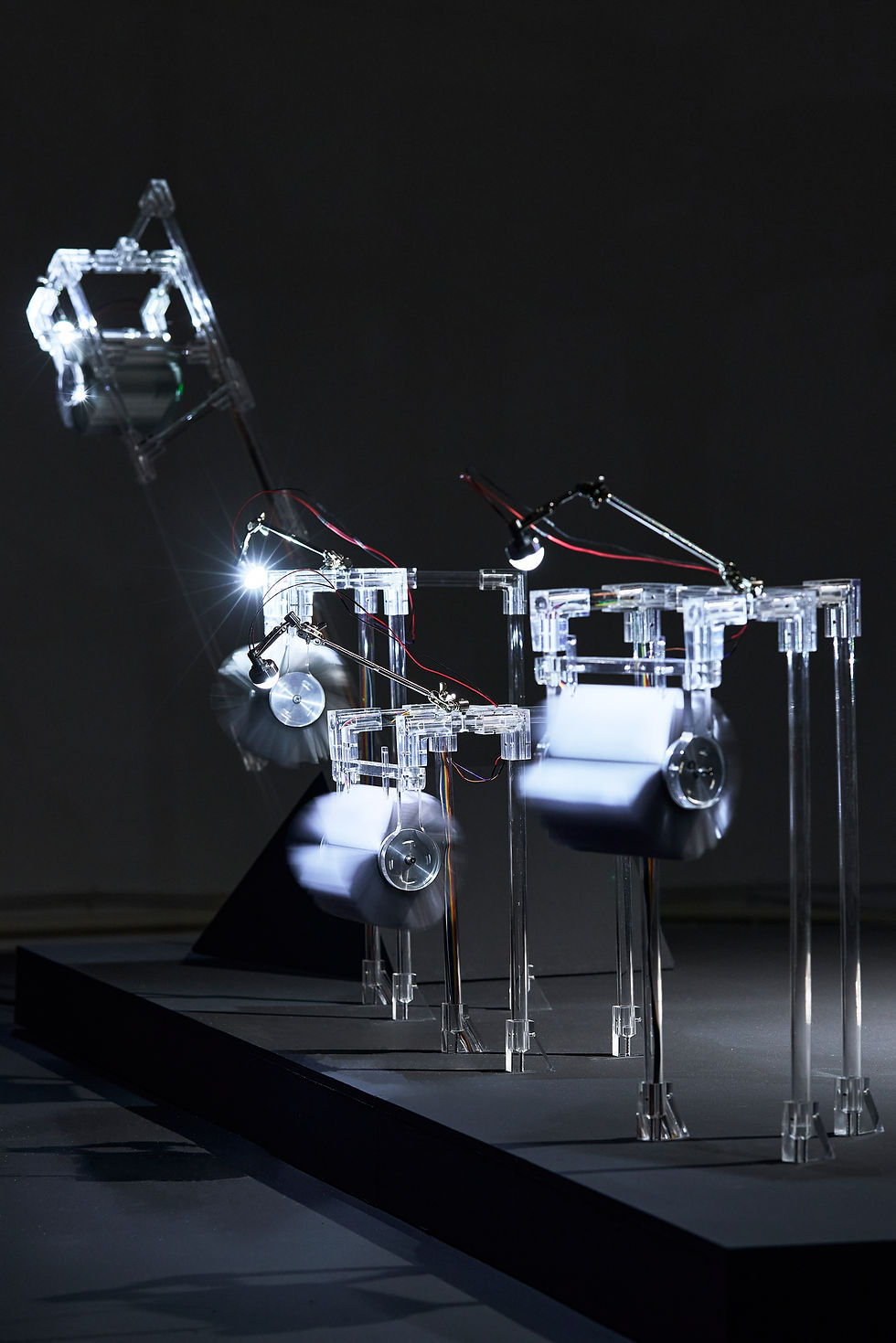
From Series “Simple Pleasures” installation, 2024 kineographs, robotics, mixed media Engineers: Philipp Avetisov, Eugene Pavlov, Eugene Ovsyannikov, Dmitry Shirokov Supported by CYLAND MediaArtLab 30 years ago, when I just came to the United States, one of my first jobs was at a photographic store. Among the services offered, there were development of B/W films copying and retouching of old photographs. During several years of work, hundreds of images passed through my hands and, whether you like it or not, what you saw becomes a part of you. I came upon images from various times: 18th, 19th and 20th centuries. Mainly, those were individual, family and group photographs, portraits of the military and pictures from the Victorian Age when photographs were done with the deceased family members in them. There were some curious incidents: once I was handed an envelope with photographs that contained a note: “Be careful. The photos are really old; they date back to 1715.” (Daguerreotype, by the way, was invented in 1839). Those images stuck in my memory. What astounded me was the fact that practically all the images were alike. It is interesting that, despite the geographic origins of those who were depicted on a photograph, it was impossible to determine where they were from (unless the architecture got captured in a frame). It was impossible to figure out whether they were immigrants from Armenia, Russia, Sweden, Italy or Ireland. It was also impossible to determine on the photographs from different countries where they were taken at the time. Scientists claim that if the brain saw something, it would stay with it for the rest of one's life. However, the fore-conscious* plays its role as well… *Fore-Conscious is a term that indicates the perceptions, thoughts and memories that, while not being part of our current conscious experience, are still remain available for comprehension. Anna Frants is an artist, curator in the field of media art. She graduated from the Vera Mukhina Higher School of Art and Design (Leningrad, USSR) and Pratt Institute (New York, USA). Founder of the nonprofit cultural foundation CYLAND Foundation Inc. Cofounder of CYLAND MediaArtLab and CYFEST. Frants’ interactive installations have been showcased at Museum of Art and Design (New York, USA), Video Guerrilha Festival (Brazil), Manifesta 10 Biennale (2014, St. Petersburg, Russia), Hermitage Museum (St. Petersburg, Russia), Chelsea Art Museum (New York, USA), Russian Museum (St. Petersburg, Russia), Kunstquartier Bethanien (Berlin, Germany), Hatcham Church Gallery, Goldsmiths, University of London (UK), Dartington Estate (UK), Ca’ Foscari Zattere Cultural Flow Zone (Venice, Italy), MAXXI Museum (Rome, Italy), National Arts Club (New York, USA) and at other major venues all over the world. The artist’s works are held in the collections of the Russian Museum (St. Petersburg, Russia), Museum of Art and Design (New York, USA), Sergey Kuryokhin Center for Modern Art (St. Petersburg, Russia) and Kolodzei Art Foundation (New York, USA) as well as in numerous private collections. She lives and works in Miami, USA.

Alexey Grachev

Sense of Proportion

Installation, 2014 Arduino; AtTiny 45, vibrational motor, electronic components; Glass, plastic film, glue, soldering, wires Supported by CYLAND MediaArtLab The work Sense of Proportion is a reflection on humanity’s attempts to approximate the perfection of nature’s evolutionary development. In an ironic tone, it contemplates efforts to create primitive bionic forms and entities. Continuing to work with the parameters of time and chance, the artist creates a rhythmically repeating pattern of flies beating against glass. On closer inspection, what first appears chaotic reveals a precise rhythmic system unfolding across time and tone. Alexey Grachev is a media artist, engineer, computer programmer, musician and performer. Graduated from the Bauman Moscow State Technical University (Russia). Completed the School for Young Artists program at the Pro Arte Foundation (St. Petersburg, Russia). Grachev is the technical director and chief engineer of CYLAND MediaArtLab. Participant of the World Event Young Artists Festival (2012, Nottingham, UK), CYFEST (numerous times), special project Urbi et Orbi at the 6th Moscow Biennale (2015, Russia), The Creative Machine 2 exhibition at Goldsmiths, University of London (2018, UK), ID exhibition parallel to the Venice Biennale (2019, Venice, Italy). Participant of the Arts Work of the Future project at the Tate Exchange space (2018, London, UK). He has delivered lectures and workshops in several educational and cultural institutions in Russia and internationally.

Elena Gubanova & Ivan Govorkov

Wind of changes

Installation, 2018 3D modeling, 3D printing; Arduino and Python programming; windsocks, stands, fans, RSS feed analysis, custom-made circuit boards, Raspberry Pi Engineers: Alexey Grachev, Denis Markov, Dmitriy Shishov, Matvey Peshkov Supported by CYLAND MediaArtLab This installation visualizes the dynamics of the news agenda and our feelings through the metaphor of the wind. Mounted on aerodrome masts and spaced apart, wind caps face countries most frequently mentioned in real-time news. The installation is an artistic representation of the fluid nature of global affairs and a philosophical reflection on the essence of reality. Like the wind, the news is invisible. Yet, it shapes our perception of the world, never fully revealing its true nature, as if inviting us to question whether we perceive the world as it truly is or if it is merely an illusion in constant flux. Elena Gubanova is a visual artist and curator who works in the fields of painting, sculpture, installation, and video art. As a curator, she is engaged in CYLAND MediaArtLab projects. Since 2013, her works have been exhibited at major Russian and international venues, including the Hermitage Museum (St. Petersburg, Russia), Russian Museum (St. Petersburg, Russia), Tretyakov Gallery (Moscow, Russia), University Ca’ Foscari (Venice, Italy), Goldsmiths, University of London (UK), Chelsea Art Museum (New York, USA), Kunstquartier Bethanien (Berlin, Germany) and National Arts Club (New York, USA). Participant of the Manifesta 10 parallel program (2014, St. Petersburg, Russia) and several exhibitions parallel to the Venice Biennale (since 2011, Venice, Italy); frequent participant and curator of CYFEST. Awarded with the Sergey Kuryokhin Award (Russia) for "Best Work of Visual Art" (2012, jointly with Ivan Govorkov) and "Best Festival in the field of Contemporary Art" (2018). Since 1990, she has been working in collaboration with Ivan Govorkov. She lives and works in St.Petersburg, Russia. Ivan Govorkov is an artist engaged in philosophy, psychology, painting, drawing, sculpture, and installations; he works at the junction of traditional art and cutting-edge technologies. Professor of drawing at the Saint Petersburg Repin Academy of Arts. His works have been exhibited at major Russian and international venues, including the Hermitage Museum (St. Petersburg, Russia), Russian Museum (St. Petersburg, Russia), Tretyakov Gallery (Moscow, Russia), University Ca’ Foscari (Venice, Italy), Goldsmiths, University of London (UK), Chelsea Art Museum (New York, USA), Kunstquartier Bethanien (Berlin, Germany) and National Arts Club (New York, USA). Participant of the Manifesta 10 parallel program (2014, St. Petersburg, Russia) and several exhibitions parallel to the Venice Biennale (since 2011, Venice, Italy); frequent participant of CYFEST. Awarded with the Sergey Kuryokhin Award (Russia) for "Best Work of Visual Art" (2012, jointly with Elena Gubanova). Since 1990, he has been working in collaboration with Elena Gubanova. He lives and works in St. Petersburg, Russia.

Sergei Komarov and Lidiia Griaznova

Double Pendulum

Sound installation, 2025 Supported by CYLAND MediaArtLab This is a homage to Pendulum Music, a 1968 piece by minimalist composer Steve Reich. As Reich described it, the work was created “for fun,” as an experiment driven by curiosity. It is both a phase piece and a process piece—a composition that runs autonomously once set in motion, allowing the composer to step away. This work pays tribute to the spirit of early musical experimentation, which profoundly influenced subsequent developments and continues to inspire artists working at the intersection of sound and installation art. In this version, the movement of a double pendulum is employed: its lower element is a shotgun microphone. By chance alone, the microphone encounters a speaker during the pendulum’s unpredictable trajectory. These fleeting moments of contact generate chaotic bursts of feedback—a sonified encounter shaped by dynamics invisible to the naked eye. Sergei Komarov is a curator, engineer, and sound artist. He curates the sound art program at the International Media Art Festival CYFEST and Cyland Audio Archive (CAA). As a sound artist and musician, he is a co-founder of the Kurvenschreiber band. As a Max/MSP programmer, he is involved in creating the installations made in CYLAND MediaArtLab. He was a collaborator in Asymmetrique Answer, an interactive performance group. Works as an independent author of sound art pieces. Currently lives and works in Yerevan, Armenia. Lidiia Griaznova is a curator. Since 2019, she has been a managing editor and curator at CYLAND MediaArtLab. Since 2023, co-curator together with Sergei Komarov of CYLAND Audio Archive and the sound art program at CYFEST. Earned an MA in Curatorial Studies from co-joined program of the Bard College and St. Petersburg State University. Curated several exhibitions and book-based projects for the Boomfest Comics Festival. Guest editor for a special issue of Leonardo Journal (54:1), “CYFEST 13: Cosmos and Chaos” (MIT Press) in 2021. Currently lives and works in London, UK.

Anna Martynenko

Mesozoic

Sound installation, 2024 pre-recorded audio, electronics, speakers, concrete, steel This sound composition is based on research by palaeontologist Ivan Kuzmin. The project was presented at the Diaghilev Museum of Contemporary Art (Curators Stas Kazimov and Maria Grabareva) in cooperation with the Paleontological Museum of Saint Petersburg State University (Director Dmitry Grigoriev). Sprouts break through a pile of concrete rubble. We hear sounds from them that might have been heard by living beings 200 million years ago in the Mesozoic era. The concrete fragments are casts of bones from one such animal, a hydrosaurus, found in a dinosaur graveyard located within the city limits of Blagoveshchensk. From the loudspeakers, we hear the sounds of animals and insects that lived at that time, as well as their descendants, whose sounds we can recognise today: alligator, snake, ostrich, turtle, cicadas, etc. Based on these sounds, an artist has created a possible field recording. Through the bones of the animals that lived in those times, the past sprouts sound in today’s urban reality. Anna Martynenko is a multidisciplinary artist, creating objects, installations, sitespecific and public art projects. Her practice explores physical reality in the information world, observes the transformation of different kinds of signals, works with sound, the city and tactility. Graduated from the Scenography Department of the Russian State Institute of Performing Arts, the Young Artist School of the PRO ARTE Foundation and the New Media Laboratory (the New Stage of the Alexandrinsky Theatre). Participated in group exhibitions, fairs and festivals. Personal projects were presented in St. Petersburg at the Museum of Sound, FFTN Gallery, Nepokoryonye, 17 Studio, Atelier Bez Zerkal Gallery. Finalist of the All-Russia competition of projects by young artists Nova Art 8, winner of the grant programme of the PERMM Museum of Contemporary Art. Lives and works in St. Petersburg.

Alexander Terebenin

Triptychs

Photos, slideshow on three screens, 2007–2017 Supported by CYLAND MediaArtLab The triptych form originated in the early Christian art. It was a popular format for religious paintings in the Middle Ages. The middle part contained the main subject, and the wings were a compositional complement, though they too could be viewed as a separate work. In the early 20th century, a threefold polyptych inspired Kazimir Malevich. Originally, his “Black Square” was called “Tetragon”, and it was a component of the triptych, together with “Black Circle” and “Black Cross”. Alexandre Benois noted: “Undoubtedly, this is indeed the icon which Messieurs Futurists prefer to Madonnas and impudent Venuses”. A hundred years after the advent of “Black Square”, Alexander Terebenin has created a minimalist and abstract triptych, using the pictorial geometry of vanishing scenery. The squares, rectangles, crosses, “spied on” by a camera, are written into the three-part format. Traces of life of the previous generations turn into secret signs and sacral symbols. Alexander Terebenin graduated from the Architectural College in Leningrad. A professional artist and photographer, Terebenin also created art objects and installations. He participated in over 70 exhibitions in Russia and internationally. His works are held in the collections of the Museum of the History of St. Petersburg, the Kolodzei Art Foundation (New York, USA), as well as in galleries and private collections in Russia, the United States, Israel, Germany, Finland, and other countries. Terebenin curated several art projects, including The Conversion (St. Petersburg, 2012) and The Signal (St. Petersburg, 2014). In collaboration with artist Petr Belyi, he was nominated for the Innovation Prize — Russia’s most prestigious contemporary art award — for Best Curatorial Project of 2014.
  • Instagram
  • Facebook
  • YouTube

Sign up for our Newsletter

Thank you!

Sose St., house 46,

Yerevan, Armenia, 0019

Ozo g. 28 - 35​

Vilnius, LT-07197

Lithuania

901Brickell Key Boulevard,

Suit 3705,

Miami, FL 33131 

USA


© CYLAND MediaArtLab 2007–2026. All rights reserved. 

bottom of page