top of page

Media Art
AES+F
Psychosis
2016–2018
single-channel version, 2017
CGI; single-channel digital video installation [18:14]
Concept and direction: AES+F
Soundtrack: Dmitry Kourliandski
Psychosis (2016–2018) is a multi-part project developed over three stages: a CGI video set design for a theatrical production (2016), a single-channel video installation (2017), and a mixed reality installation/performance (2018). Based on AES+F’s reinterpretation of Sarah Kane’s 4.48 Psychosis, the work explores themes of corporeality, mental vulnerability, and altered perception through digitally constructed environments. The single-channel installation translates the psychological intensity of the play into a hyperreal visual space oscillating between the fairytale-like and the unsettling. The single-channel version premiered at Ca’ Foscari University, Venice, during Art Night in 2017.
AES+F was founded in 1987 by Tatiana Arzamasova, Lev Evzovich, and Evgeny Svyatsky (AES). In 1995, photographer Vladimir Fridkes joined the group, forming AES+F. Working across photography, video, CGI, sculpture, and installation, the collective is recognized for large-scale digitally constructed works examining myth, power, and contemporary visual culture. AES+F participated twice in the Venice Biennale: representing Russia at the 52nd Biennale in 2007 and presenting paintings and sculptures from the Trilogy, selected by the curator, in the Pavilion of Venice in 2013. The collective has exhibited internationally at major museums and biennials.


Andy Barrt
Ice Man
sculpture, 2025
textile, synthetic fabric, print, 192 × 160 × 120 cm
Born by the Arctic Ocean, I quickly understood that to survive among perpetual ice and long winters, nature created a unique register of beings adapted only to this place: polar bears, pale reindeer, white foxes and arctic foxes, white ptarmigans, white—white—white ermines, and many others.
A snowy owl folds its white wings before its enormous black eyes—and disappears, becoming a lump of snow on a branch. The boldest animals, in search of warmth, wandered into my city, where their white camouflage turned into a visible mark against the grey walls of buildings. White softness becomes a target, and the city at the edge of the earth reveals itself as a hostile, unnatural environment.
Very early on I began drawing black-and-white ornaments charged with the palpable fear of owls I often saw at dawn, trapped beneath the entrance canopies. Within these rhythms I inscribed the silhouettes of reindeer herders, framing them with the sharp line of the tundra’s endless horizon. The sun was always the principal conductor—the center of my compositions—because in winter it makes the snow burn crimson, and in summer it refuses to leave the horizon, circling day after day above my head… This turned me into a particular kind of person, capable of being whiter than snow and thinking like snow.
Andy Barrt was born near the Arctic Circle, on a peninsula inhabited by polar bears and reindeer. Ten months of snow and ice shaped the language of his painting: his works are composed of only two colours—black and white. This visual logic arises directly from the northern landscape itself: any object set against the vast white expanse of snow appears as a dark mark. The effect is heightened by the northern Sun, which makes the snow blaze with white fire, while everything that is not snow condenses into dense black forms—profiles of reindeer herders and the ornamental figures of polar owls. The background of Barrt’s paintings is always an immaculate snowy plain.
For his performances, Barrt creates sculptural costumes reminiscent of the heavy garments worn by northern hunters and fishermen. When his paintings are installed in gallery and museum spaces, they unfold as ornamental mandalas whose centres reveal narratives of mutual support, friendship, and the inherent ambiguity of life in the Far North


Matvei Peshkov, Aleksandr Bochkov
aerial traffic
installation, 2026
Supported by CYLAND MediaArtLab
LCD Screen, MacMini, TouchDesigner, numpad
Decomposition of chaotic bird flight motion through observation of a single bird among many.
A wall-mounted television displays footage of birds in flight. Beside it, an input device allows the viewer to choose how many birds to track, select a random quantity, or clear the visual field. Once a command is entered, the birds trace their trajectories, generating evolving patterns and drawings in space.
Matvei Peshkov is a visual effects artist specializing in computer graphics, primarily for feature film and series. His A/V performances have been presented at the State Philharmonia of Armenia (2024, Yerevan, Armenia), Centro de Cultura Digital (2025, Mexico City), Aether Gallery (2025, San Luis Potosi, Mexico), and the Urvakan festival (2025, Yerevan, Armenia).
Aleksandr Bochkov is a media artist, engineer, and performer. He is the founder of the gravel cycling race Reverse Side of the Road and the cycling apparel brand SinX. Member of STACKEDPLOT. His work has been presented at festivals including Chronotope (2021, Vyborg, Russia), CYFEST-14: Ferment (2021, Dartington, UK, Yerevan, Armenia), Emerge 2022: Eating at the Edges (2022, Mesa, Arizona, US), XXII International Image Festival, XENOlandscapes (2023, Bogotá and Manizales, Colombia). His A/V performances have been presented at the State Philharmonia of Armenia (2024, Yerevan, Armenia), Centro de Cultura Digital (2025, Mexico City), Aether Gallery (2025, San Luis Potosi, Mexico), and the Urvakan festival (2025, Yerevan, Armenia).


CYLAND Audio Archive (CAA)
selection of records from CAA
2013 — ongoing
20 records, turntable, headphones
Supported by CYLAND MediaArtLab
The CYLAND Audio Archive (CAA) is a division of CYLAND MediaArtLab, created to investigate archiving and exhibiting methodologies of sound art. This archive is a continuous process of working on a structure of various subgenres of sound art, making compilations, and cataloging the growing archive. To date, there are 60 releases, including works by more than 80 international artists. All the records are available for listening on cyland.bandcamp.com. Each release presented is a stand-alone piece accompanied by an artist statement.
Source material for artists varies from existing records—personal or found—filed records, machine signals, or sounds extracted from revitalised devices, which were initially completely strange to sound creation in the first place and turned into sound machines. All of them are reflected and conceptualised by artists, collected together into a contradictory and rich picture of sound to memorise and fix the experience of being present in the world. Where sound—recognised or completely strange—will escape being fully possessed but remains an environment shared by people who heard it together. That is how memories form, building blocks for infinite variations of archives. —Sergei Komarov and Lidiia Griaznova
Artists participating:
CAA—3 Hans Tammen
CAA—10 Yoshio Machida
CAA—13 Sashash Ulz
CAA—19 Zimoun
CAA—22 ZOV
CAA—30 Elena Filatova
CAA—35 Alexey Grachev, Sergei Komarov
CAA—37 Nao Nishihara
CAA—38 Sam Conran
CAA—42 Makiko Yamamoto
CAA—47 Elena Gubanova, Ivan Govorkov, Sergei Komarov
CAA—51 Alessandro Marchesan
CAA—53 Marina Alekseeva & Vladimir Rannev
CAA—55 Michele Spanghero
CAA—56 Alex Pleninger
CAA—57 Sergei Dmitriev
CAA—58 Esther & Nikolaj Søndergaard
CAA—59 Tuula Närhinen
CAA—60 Phenomenon and Paradoxes of Information Transmission
CAA—61 Gustavo Matamoros
The CYLAND Audio Archive (CAA) is a division of CYLAND MediaArtLab, created to investigate archiving and exhibiting methodologies of sound art. This archive is a continuous process of working on a structure of various subgenres of sound art, making compilations, and cataloging the growing archive. To date, there are 59 releases, including works by more than 80 artists. All the records are available for listening on cyland.bandcamp.com. Each release presented is a stand-alone piece accompanied by an artist statement.

Alexandra Dementieva
Mini Totems
series of prints and sculptures, 2022–2025
3D print objects, 6 prints on aluminum
Production: Adem vzw
3D modeling engineer: Denis Markov
Created with the use of Midjourney and ChatGPT
Mini Totem sculptures are part of Alexandra Dementieva’s ongoing research on the metamorphosis of time. The work draws on the ancient concept of totems as symbols of identity and heritage. Here, the totemic reference appears in the vertical structure that invites contemplation while reinterpreting the traditional totem pole.
The element of time is present in the polished metal surface, suggesting continuity, and in the upward movement that points to the infinite. The sculpture also refers to the form of a meat grinder, visible in the base and perforated top, evoking a process of transformation where material and meaning are reconfigured.
By combining these references — totems, time, and the everyday object — the artist constructs a work that examines the intersections of culture, temporality, and human experience. The use of the Midjourney AI tool in Dementieva’s practice connects digital experimentation with physical form, creating a dialogue between technology and artistic tradition.
Alexandra Dementieva’s main interests focus on social psychology and perception and their application in multimedia interactive installations. Her artistic research process happens in the here and now, in the increasingly technologized present. It is deeply rooted in its cultural context. Photography and other digital media always record a trace, which indicates the former presence of something. Attesting to a certain event the trace at the same time enshrines the technology in use, thus acting as a witness to contemporaneous culture. In a similar manner, she tends to reflect on behavioral patterns and cultural mechanisms that are characteristic of contemporary society. Her works can be found in museum collections and were exhibited around the world. She is a founder and director of LASER Talks Brussels and she teaches in Brussels Fine Arts Academy.


Anna Frants
To Make a Long Story Short
from Series “Simple Pleasures”
installation, 2024
kineographs, robotics, mixed media
Engineers: Philipp Avetisov, Eugene Pavlov, Eugene Ovsyannikov, Dmitry Shirokov
Supported by CYLAND MediaArtLab
30 years ago, when I just came to the United States, one of my first jobs was at a photographic store. Among the services offered, there were development of B/W films copying and retouching of old photographs. During several years of work, hundreds of images passed through my hands and, whether you like it or not, what you saw becomes a part of you.
I came upon images from various times: 18th, 19th and 20th centuries. Mainly, those were individual, family and group photographs, portraits of the military and pictures from the Victorian Age when photographs were done with the deceased family members in them.
There were some curious incidents: once I was handed an envelope with photographs that contained a note: “Be careful. The photos are really old; they date back to 1715.” (Daguerreotype, by the way, was invented in 1839).
Those images stuck in my memory. What astounded me was the fact that practically all the images were alike. It is interesting that, despite the geographic origins of those who were depicted on a photograph, it was impossible to determine where they were from (unless the architecture got captured in a frame). It was impossible to figure out whether they were immigrants from Armenia, Russia, Sweden, Italy or Ireland. It was also impossible to determine on the photographs from different countries where they were taken at the time.
Scientists claim that if the brain saw something, it would stay with it for the rest of one's life. However, the fore-conscious* plays its role as well… — Anna Frants
*Fore-Conscious is a term that indicates the perceptions, thoughts and memories that, while not being part of our current conscious experience, are still remain available for comprehension.
Anna Frants is an artist, curator in the field of media art. She graduated from the Vera Mukhina Higher School of Art and Design (Leningrad, USSR) and Pratt Institute (New York, USA). Founder of the nonprofit cultural foundation CYLAND Foundation Inc. Cofounder of CYLAND MediaArtLab and CYFEST. Frants’ interactive installations have been showcased at Museum of Art and Design (New York, USA), Video Guerrilha Festival (Brazil), Manifesta 10 Biennale (2014, St. Petersburg, Russia), Hermitage Museum (St. Petersburg, Russia), Chelsea Art Museum (New York, USA), Russian Museum (St. Petersburg, Russia), Kunstquartier Bethanien (Berlin, Germany), Hatcham Church Gallery, Goldsmiths, University of London (UK), Dartington Estate (UK), Ca’ Foscari Zattere Cultural Flow Zone (Venice, Italy), MAXXI Museum (Rome, Italy), National Arts Club (New York, USA) and at other major venues all over the world. The artist’s works are held in the collections of the Russian Museum (St. Petersburg, Russia), Museum of Art and Design (New York, USA), Sergey Kuryokhin Center for Modern Art (St. Petersburg, Russia) and Kolodzei Art Foundation (New York, USA) as well as in numerous private collections. She lives and works in Miami, USA.


Alexey Grachev
Real-Time Groove
A/V installation, 2014
Supported by CYLAND MediaArtLab
Arduino; 4 iPods, 4 speakers, microcontroller, audio
A huge number of connected events that our brains are unable to fully comprehend happen in the world every second. Each process has its own temporal variable.
Just like in the technosphere, where time is unified. When was the last time you had to adjust the clock on your computer or another electronic gadget?
The installation is intended to show that seemingly identical things might differ from one another once detached from the global tempo. Four identical portable players with audio files of the same length are run simultaneously and appear synchronous at first glance. But after some time, their internal clocks diverge and create a real-time groove.
Alexey Grachev is a media artist, engineer, computer programmer, musician and performer. Graduated from the Bauman Moscow State Technical University (Russia). Completed the School for Young Artists program at the Pro Arte Foundation (St. Petersburg, Russia). Grachev is the technical director and chief engineer of CYLAND MediaArtLab. Participant of the World Event Young Artists Festival (2012, Nottingham, UK), CYFEST (numerous times), special project Urbi et Orbi at the 6th Moscow Biennale (2015, Russia), The Creative Machine 2 exhibition at Goldsmiths, University of London (2018, UK), ID exhibition parallel to the Venice Biennale (2019, Venice, Italy). Participant of the Arts Work of the Future project at the Tate Exchange space (2018, London, UK). He has delivered lectures and workshops in several educational and cultural institutions in Russia and internationally.


Elena Gubanova & Ivan Govorkov
Victory over the Sun
media installation, 2023
3 channel audio [58:39]; Fusion 360; 3D printing; 3D engineering design; welding; PVC "mobiles" attached to metal poles, motors, solar panels, speakers, motion sensor, drive belt
Engineers: Alexey Grachev, Denis Markov
Sound Engineer: Sergey Dmitriev
Sound: the record of the opera Victory over the Sun staged on May 3, 2007 at Vassar College, Poughkeepsie, New York
Score: Georgy Firtich
Performers: Vassar student singers and musicians
Special thanks: Georgy Firtich and Nikolai Firtich
Supported by CYLAND MediaArtLab
A futurist opera Victory over the Sun, staged in 1913 and co-authored by Aleksei Kruchonykh (libretto) and Mikhail Matyushin (music), was conceived to emphasize the parallels between literary text, musical score, and visual art. It became an exemplary collaborative work between poets and artists. The opera tells the story of a group of budetlyane (from the Russian word “budet”, meaning “will be”) who set out to conquer the sun. Commonly, it is interpreted as a vision of the triumph of future technologies over the old natural world. Yet, in this artwork, the very idea of “victory” is questioned. Humanity depends on sunlight — essential to the ecosystem it inhabits. Even a slight alteration in sunlight immediately reveals our vulnerability, as well as the fragility of our aspirations and visions for the future.
The installation operates on solar energy. A system of solar panels accumulates energy and sets the installation’s components — futurist-like kinetic “mobiles”— in motion through motors. These motors are powered by solar panels that follow the sun’s trajectory to maximize energy collection. The direction of the components’ movement is determined by the sun’s path and changes throughout the day. The installation remains active as long as the batteries are charged.
The installation also includes a sound component. A set of speakers plays a contemporary version of Victory over the Sun, staged on May 3, 2007, at Vassar College in Poughkeepsie, New York. The noted St. Petersburg composer Georgy Firtich created a new score for the opera (only fragments of Matyushin’s original music have survived) and came to Vassar to participate in the performance alongside a company of student singers and musicians. The production was conceived not as a historical reconstruction but as a reinvention from a contemporary perspective — an attempt to convey the explosively innovative energy of the early twentieth-century avant-garde.
Elena Gubanova is a visual artist and curator who works in the fields of painting, sculpture, installation, and video art. As a curator, she is engaged in CYLAND MediaArtLab projects. Since 2013, her works have been exhibited at major Russian and international venues, including the Hermitage Museum (St. Petersburg, Russia), Russian Museum (St. Petersburg, Russia), Tretyakov Gallery (Moscow, Russia), University Ca’ Foscari (Venice, Italy), Goldsmiths, University of London (UK), Chelsea Art Museum (New York, USA), Kunstquartier Bethanien (Berlin, Germany) and National Arts Club (New York, USA). Participant of the Manifesta 10 parallel program (2014, St. Petersburg, Russia) and several exhibitions parallel to the Venice Biennale (since 2011, Venice, Italy); frequent participant and curator of CYFEST. Awarded with the Sergey Kuryokhin Award (Russia) for "Best Work of Visual Art" (2012, jointly with Ivan Govorkov) and "Best Festival in the field of Contemporary Art" (2018). Since 1990, she has been working in collaboration with Ivan Govorkov. She lives and works in St.Petersburg, Russia.
Ivan Govorkov is an artist engaged in philosophy, psychology, painting, drawing, sculpture, and installations; he works at the junction of traditional art and cutting-edge technologies. Professor of drawing at the Saint Petersburg Repin Academy of Arts. His works have been exhibited at major Russian and international venues, including the Hermitage Museum (St. Petersburg, Russia), Russian Museum (St. Petersburg, Russia), Tretyakov Gallery (Moscow, Russia), University Ca’ Foscari (Venice, Italy), Goldsmiths, University of London (UK), Chelsea Art Museum (New York, USA), Kunstquartier Bethanien (Berlin, Germany) and National Arts Club (New York, USA). Participant of the Manifesta 10 parallel program (2014, St. Petersburg, Russia) and several exhibitions parallel to the Venice Biennale (since 2011, Venice, Italy); frequent participant of CYFEST. Awarded with the Sergey Kuryokhin Award (Russia) for "Best Work of Visual Art" (2012, jointly with Elena Gubanova). Since 1990, he has been working in collaboration with Elena Gubanova. He lives and works in St. Petersburg, Russia.


Sergey Kishchenko
Papyri from Pontelongo
media installation, 2023
diptych, mixed media, 140 x 100 cm, each part, sound
I arrived in Pontelongo by chance, shortly after my immigration to Italy in the autumn of 2022. At the time I was staying with friends in Piove di Sacco, not far from this small town. Walking along the single street that runs beside the canal near the church, I noticed an old house. On the ground floor were former shop spaces, clearly closed for many years.
The shop windows had been covered from the inside with sheets of white paper. They had hung there for decades. Over time, the surrounding environment slowly left its mark: water, humidity, sunlight, and shifts in temperature transformed the paper into something entirely unexpected. On its surface, traces of time began to emerge—forms resembling Rorschach blots, landscape maps, or satellite images of the Venetian Lagoon. They were neither drawings nor photographs, but impressions shaped by time itself.
At that moment, I understood I was looking at works of art. I decided to rescue them from the abandoned building, but the process proved far from simple. With the help of Italian friends who lived nearby, I began to trace the history of the place. We discovered that the woman who had owned the house had died about thirty years earlier, and that the building had passed to her relatives in Padua. We eventually found them, but opening the shop was not straightforward—the relationships within the family were complicated.
Eventually, the doors opened and we were able to enter. But that was when the real difficulties began. The paper, which had hung in the sun for decades, had become as fragile as a butterfly’s wing. It literally disintegrated in our hands. I had to invent my own method to transfer this crumbling material onto a supporting surface. This is how the series Papyri from Pontelongo came into being.
On one level, the series Papyri from Pontelongo consists of found objects and artistic gesture. On another, it reflects a deeply personal experience connected to the reality of migration: finding oneself in a foreign country, surrounded by an unfamiliar language, and suddenly discovering something that begins to speak to you in a language you understand—a “document of time” that no one intended to create. The sheets that hung for decades behind the windows of a closed shop on the single street along the canal are not drawings or abstractions in the usual sense. They are traces left by air, humidity, sunlight, and temperature—traces of water that transformed ordinary paper into images resembling river deltas or the nervous tissue of the lagoon. It is as if the place itself had tried to write its own biography on this fragile surface. A key aspect of these works is that the sheets were not simply found—they were recovered. The story of gaining access to the house, the complicated relationships among the heirs, and the moment of finally entering the space all form a kind of dramaturgy. Alongside this runs another, more subtle narrative: the authority of the material itself. The fragile paper, which had become like a butterfly’s wing, dictated not a method or a style but an ethic of handling. In the process, I had to invent a technique that would allow this state of transformation to be transferred onto a support—preserving the moment in which nature and time themselves generate texts and forms. Here the organic element is not nature represented, but nature as a process, acting as both author and co-author. —Sergey Kishchenko
Sergey Kishchenko is an interdisciplinary artist based in Venice whose work spans performance, video, installation, and research-based practice. His projects — including Duck Test, Observation Journal, Hortus Conclusus, and Temple of Venus — investigate migration as a movement of memory, myths, and biological forms across time and borders. Central to his work are hybrid figures, archives, and ecological metaphors that reveal identity as a fluid and evolving process. By bringing together cultural history, natural systems, and performative narratives, Kishchenko constructs environments where historical memory and contemporary experience intersect, suggesting migration as a universal condition of culture and human existence.


Sergei Komarov & Lidiia Griaznova
Time Signals. Spiral
multi-channel installation, 2026
part of the ongoing project Time Signals, 2023 — ongoing
This is an emulation of a number station, transmitting messages from other temporalities, where time operates beyond 24/7 regimes. The Latin palindrome In girum imus nocte et consumimur igni can be translated as “We wander in circles at night and are consumed by fire.” Repeated constantly, it accompanies the back-and-forth movement of everyone involved in the processes of production, maintenance, and observation of everything that will happen over the next four months.
Sergei Komarov is a curator, engineer, and sound artist. He curates the sound art program at the International Media Art Festival CYFEST and Cyland Audio Archive (CAA). As a sound artist and musician, he is a co-founder of the Kurvenschreiber band. As a Max/MSP programmer, he is involved in creating the installations made in CYLAND MediaArtLab. He was a collaborator in Asymmetrique Answer, an interactive performance group. Works as an independent author of sound art pieces. Currently lives and works in Yerevan, Armenia.
Lidiia Griaznova is an artist and curator working at the intersection of publishing, sound, and media art. She engages with sound, archival fragments, and experimental book formats to interrogate dominant constructions of time, space, and the body shaped by capitalist and colonial frameworks. She frequently collaborates with artists and writers on projects that dissolve the boundaries between research and artistic production. She holds an M.A. in Curatorial Studies from Bard College (US) and works between London (UK) and Yerevan (Armenia). Since 2024, she has co-curated the CYLAND Audio Archive and CYFEST Sound Art program with Sergei Komarov, commissioning and presenting multi-channel sound installations and performances internationally.

Valery Koshlyakov
Flora
scotch tape painting, 180 x 150 cm, 2014
tape on plastic, framed
The artist reinterprets Rembrandt’s image of Flora through the use of non-artistic materials. Working with packing tape, Koshlyakov creates free reinterpretations of cultural icons from painting, sculpture, and architecture. In an era of great possibilities, he deliberately chooses a non-artistic material — rough, harsh, glossy, and plastic in surface — as the complete opposite of the soft, traditional painterly pigment rich in nuance. Working with packing tape allows him to quickly capture an impression of the object under study. The result speaks not of irony or the profanation of painting but, on the contrary, of its enduring power. The multilayered, wide strips of tape function like glazes or expressive brushstrokes, while the restrained, impoverished synthetic palette lends the work its raw sense of brutality.
Valery Koshlyakov is a painter, graphic artist, and installation creator whose work explores “mythical empires”, blending Greek and Roman architecture with Baroque and Stalinist Empire styles. Since the 1990s, he has used unconventional materials such as corrugated cardboard to emphasize the fragility of the monumental. Koshlyakov represented Russia at the 50th Venice Biennale (2003) and the São Paulo Biennale (2004). His works are held in major institutions including the State Tretyakov Gallery, Pushkin Museum, State Russian Museum, Louvre, Centre Pompidou, MACRO in Rome, Guggenheim Museums, and the Kennedy Center in Washington.

Alexei Kostroma
EGGSHELL
NANO 163
object [60 x 60 x 10 cm], 2017
invisible UV color on eggshells on canvas
EGGSHELL — image of the genome, coding, and storage of information. Eggshell objects by Alexei Kostroma reveal the theme of micro- and macro-worlds governed by the invisible mathematical harmony of numbers. The artist uses natural white eggshells to create geometric structures. Applied in invisible ink to the inner surface of each shell are numbers from 1 to 9, the sum of which represents an information code. Rows of eggshells form an image of the atomic microcosm; circles form an image of the macrocosm. The study of the world of atoms has been actively developed in the age of nanotechnology; hence the series is entitled NANO. The number in the title of each object refers to its composition — for example, NANO 163 was created from 163 digitized eggshells. These invisible numbers are visible only under UV light.
Alexei Kostroma is an artist, theorist, researcher. Since the early 1990s he has formed his artistic worldview, the Organic Way, where the central concept is a study of interrelations between natural and social laws. “The Organic Way is a way of knowing the unity of meanings” (definition by artist, 2016). Working throughout his art practice with eggshells, white feathers, figures (numbers), and lemon yellow pigment, Alexei Kostroma identifies these four media in his work as his “artistic signs” or “brands”. Concentrating all the diversity of his long-term creative work, the artist arrived at the point, his concept of a central phenomenon that determines the end and beginning of all events and all phenomena. Lives and works in Berlin.


Linda Loh
Orbs + Deep Pink
HD video [10:17], 2018–2023
photography, video, TouchDesigner
The Orbs are restless, quivering representations of luminous circular forms, existing and not existing, hovering in their own version of space. They morph across colour fields, eventually transmuting into Deep Pink, a final circle of quietude. An arbitrary boundary, like a drawing, that could be a portal, somewhere...


Tenuous Connections
4K Video [7:15], 2025
polycam phone scanning, Blender 3D, Davinci Resolve
This video work explores digital materiality as transformed from the physical living world. It is a durational video from a 3D phone scan of an acacia gall rust fungus. The scan was colored using luminous textures from the artist’s own digital 3D world, which happens to be like an overgrown garden. The form was animated and decimated to abstraction. Luminous, whirling, ever changing; infinite motion.
Green Dreams
HD Video [1:12], 2025
gaussian splat scan with phone, edited Davinci Resolve
A rendered dreamy fly through of the abstracted parallel-universe-like space in the grass revealed by a Gaussian splat scan.
Linda Loh is a visual artist working between New York City and Melbourne, Australia. Her multimedia practice explores the elusive form and materiality of digital space through transformed sources of light. She has exhibited widely in Australia and the USA, with works included in projection festivals, public LED billboard projects, online events, screenings, and art galleries. Loh has undertaken several international artist residencies, including NARS in New York City (2018). In 2021, she completed a Master of Fine Arts in Computer Arts at the School of Visual Arts, New York.
Natalia Lyakh
WaterProof
installation, 2026
three plexiglass objects [8 x 8 x 2,5 cm], digital photo, sculptured silicone glue, video
plexiglass object [10 x 15 x 2 cm], 5-inch IPS LCD display, built in speaker, Video Mp4 [1:20]
Water is among the oldest symbols in mythology, philosophy, and psychology alike. In the thought of Carl Jung, it becomes a metaphor for the unconscious—individual and collective—fluid, deep, purifying, and treacherous at once.
In WaterProof objects, water is held within miniature screens as a physical metaphor for subjectivity itself. Each viewer perceives the world through a personal lens shaped by their own unconscious. At certain angles, the real image vanishes, displaced by a reflective shadow. As Jung observed: “Until you make the unconscious conscious, it will direct your life, and you will call it fate.”
The video-object engages with the collective unconscious. Dark depths evoke the unknown; drifting ice suggests the slow crystallisation of archetypes; sudden flashes of light emerge as brief incursions of the personal within a collective current. A moving reinterpretation of Olga Rozanova's Green Stripe (1917) passes through the frame as a stream of impersonal psychic energy—without origin or end—while vibrating lines trace the momentary surfacing of individuality above the collective flow.
The installation invites an encounter with the hidden dimensions of the unconscious: our shadows, which may either overwhelm or illuminate us. Whether we drown in these depths or learn to swim and dive through them depends on the quality of our individual awareness—on the willingness to see.
Nataliya Lyakh is a multimedia artist. Passionate about painting, sculpture and photography from an early age, she earned a PhD in neuro-linguistics, focusing on brain-asymmetry and speech processing. Her scientific career did not hinder her artistic development — she continues to experiment with photography and video art. Since 2000, Natalia Lyakh has devoted her full-time attention to photography, video art, short films and video installations, working in Paris, Stockholm, Istanbul, Milano, Rome, New York and London, participating in numerous art shows and festivals. Her works can be found in both private and public collections, including the Russian Museum. Influenced by her scientific background, she invites viewers to discover the magic dimensions, abstractions, hidden in the ordinary objects that surround us, as seen through the lens of a microscope, the prism of binoculars, a periscope or a kaleidoscope. Through materials such as plexiglas, aluminium, and video she invites us to discover our daily life objects or situations with aesthetic, innovative and perplexing treatment. She lives and works in Paris, France.




Tuula Närhinen
Alien Invaders
installation, 2021
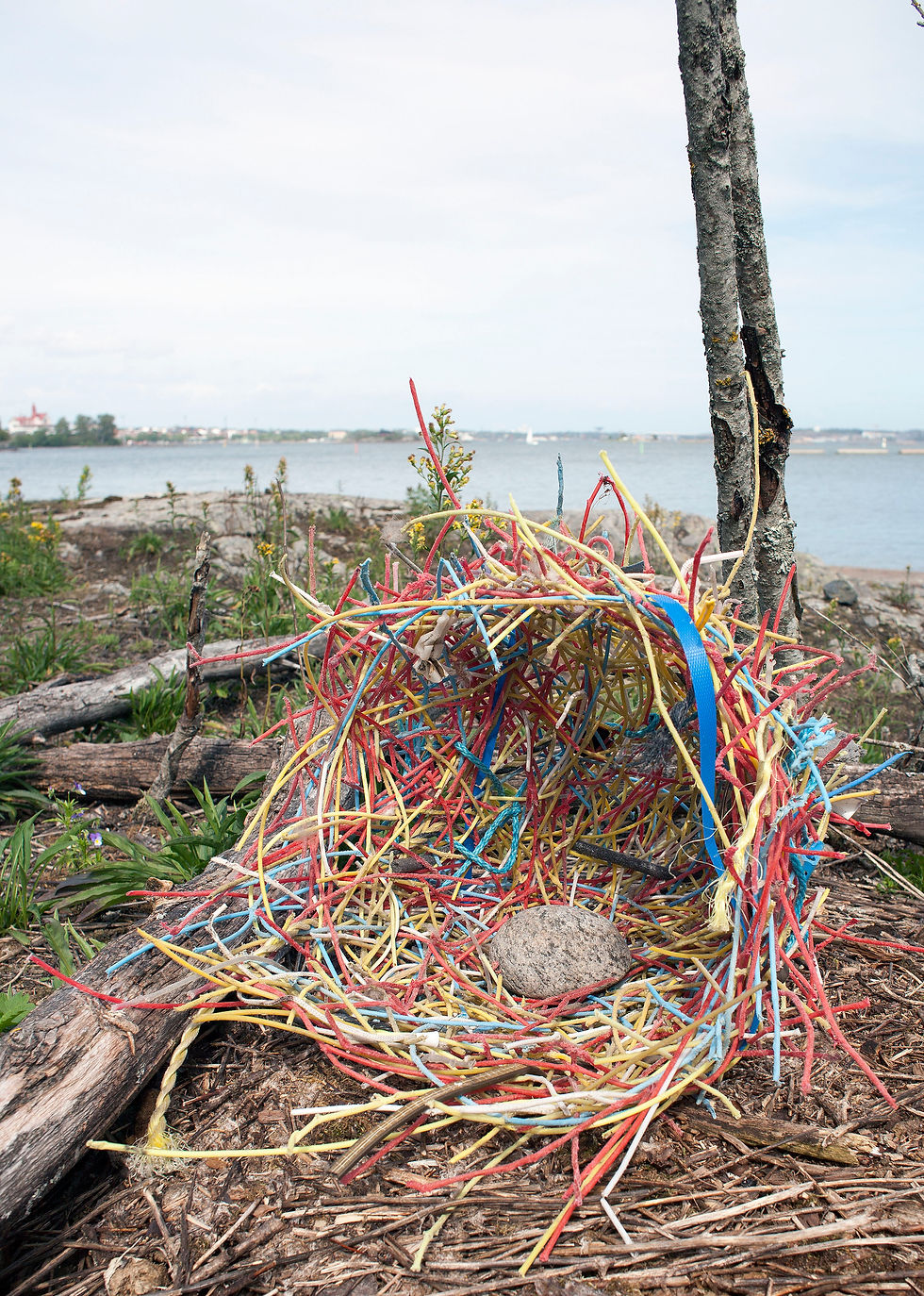
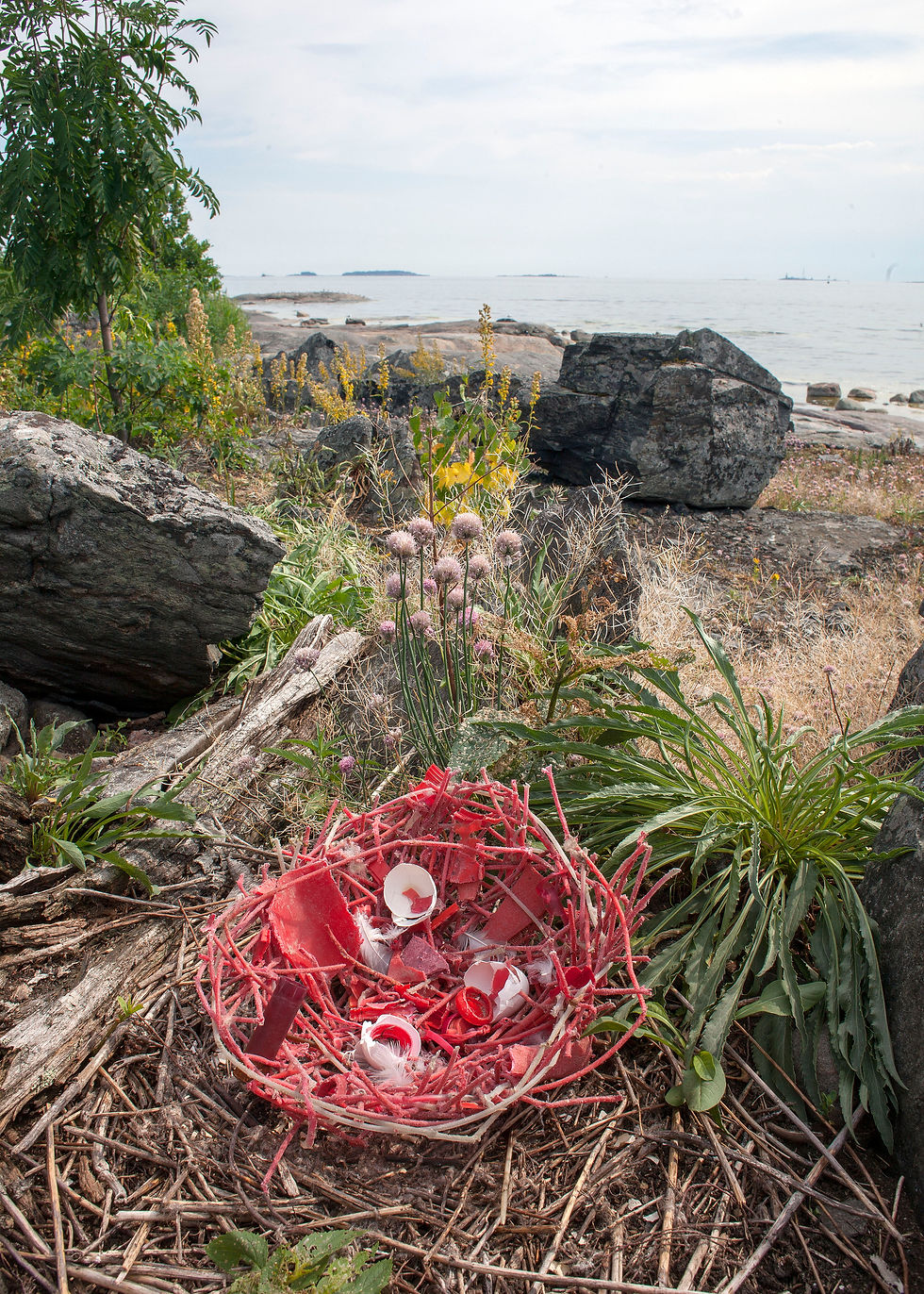
five photographs; nine nest sculptures of variable dimensions (plastic filaments of colour-coded shock-tube detonator wires with other marine plastic detritus, eggshells, stones)
The project was triggered by an observation: some geese on the Harakka island had started using plastic filaments in the construction of their nests. Birds adapt to urban marine environments and tend to appropriate anthropogenic materials for their own purposes. The work sets out to revisit the story of avian evolution by elaborating on the imaginary potential of new hybrid bird species, genetically programmed to thrive on plastic detritus.
The installation consists of nine nest-sculptures put together of plastic waste drifted ashore with photographs of the nests placed in the natural habitat of the island. The main ingredients of the nests are the partly bleached filaments of colour-coded shock-tube detonator wires applied in initiating underbelly explosions. When the city of Helsinki expands, excavated rock material gets dumped into the sea together with bits and pieces of plastic wires used in blasting the bedrock.
Tuula Närhinen is an artist and researcher in visual arts. Tuula Närhinen holds an MFA from the Finnish Academy of Fine Arts and an MSc in Architecture from the Helsinki University of Technology. In 2016 she gained a Doctorate in Fine Arts from the Helsinki University of the Arts. Re-adapting methods and instruments derived from natural sciences, Närhinen facilitates visual renderings of natural phenomena. Alongside tracings and recordings, her installations showcase the processes of inscription and the DIY instruments implicated. Her works are represented in the collections of the Kiasma Museum of Contemporary Art and the Helsinki Art Museum. She lives and works in Helsinki, Finland.


Jaanika Peerna
Cold Love 2
from the project “Glacier Elegy”
installation, 2025
pigment and ice on hand-cut film, magnets
This wall-based sculpture consists of multitude of identically shaped but unique pieces of mylar, each hand cut with uniform cuts and each with paint eroded by ice and water across the surface. The work takes on different forms each time it is installed by the artist, with the pieces recycled and reused, then assembled and falling in different ways. For the artist, this mimics the fluidity of water and the way that the same mass of water can appear in different places across the world and in different forms. Huge mass of water is also held in glaciers. Glaciers were formed layer by layer over long periods of time and hold memory of the atmosphere at the time of freezing. Peerna’s installations are labor intensive and are created one line, one drip and cut at the time. By doing it the artist is tuning into the life of a glacier and the flow of the water in an embodied way.
The title Cold Love refers to the kind of love Peerna calls the world to feel towards glaciers: love them warmly but keep the love cold not to make the beloved disappear.
Jaanika Peerna is an Estonian-born artist based in New York and Lisbon. Her work encompasses drawing, installation, and performance, often dealing with the theme of transitions in light, air, water and other natural phenomena. For her performances she often involves the audience in participatory reflection on the current climate meltdown. Her art practice stems from the corporeal experience of our existence and reaches towards enhanced awareness of the fragility, interconnectedness and wonder of all life.
She has exhibited her work and performed in the entire New York metropolitan area as well as internationally. Her work is in numerous private collections in the USA and Europe and is part of the Fonds National d’Art Contemporain and the Glyn Vivian Museum in the UK. Her work is represented by JHB Gallery, Artrovert and IdeelART. In 2022 a monograph Glacier Elegies was published by Terra Nova Press/MIT Press.


Mariateresa Sartori
Wind SW 2 km/h
video [15:53, no sound], 2023
The camera recorded the anemometer set in motion by the wind. The anemometer is an instrument commonly used in meteorology to measure wind speed. I modified the anemometer by cutting the data transmission cables and applying linseed oil-soaked threads to each cup. Positioned at the centre of a sheet of paper and exposed to natural wind for five minutes, the device produces a circular trace. The resulting pattern varies depending on the wind velocity, duration, shifts in direction, interruptions or complete absence of propulsive thrust. What interests me is the tendency towards a mechanical objectivity, which is never completely achieved since the anemometer thus reworked is imbued with subjectivity. I am interested in the field of tension between the subjective and the objective. The transformation from technological instrument to mechanical/empirical apparatus counteracts the achievement of objectivity, which remains, however, an ideal to strive for, a tension towards. Furthermore, the video is not perfectly in focus to emphasise that no matter how hard we try to understand and grasp reality, it retains a certain degree of opacity. — Mariateresa Sartori
Mariateresa Sartori is a visual and sound artist. Her research revolves around three thematic fulcrums: the empirical scientific method; behavioral dynamics, often in relation to neurosciences; music and sound in relation to language. She frequently collaborates with experts from the various disciplines she explores: geologists, physicists, linguists, musicologists, musicians, actors, botanists. She has exhibited in numerous museums and galleries in Italy and abroad, including the Therese Giehse Halle, Münchner Kammerspiele, Munich, Stanislavsky Electrotheatre (Moscow); Chopin Museum (Warsaw, Poland), Ikon Gallery (Birmingham, UK), Fondazione Querini Stampalia (Venice), Moscow Museum of Modern Art; NGBK (Berlin); Hangar Bicocca, (Milan); Museo Macro, (Rome); Museum Joanneum, (Graz), Palazzo delle Esposizioni, (Rome); Mucsarnok Kunsthaus (Budapest); XLV Biennale di Venezia.
![Mariateresa Sartori, Wind SW 2 km/h, video [15:53, no sound], 2023, Ph: Alberto Messina](https://static.wixstatic.com/media/59c8b9_159a20f756084ef5a49d1ada40fb75b7~mv2.jpg/v1/fill/w_980,h_1225,al_c,q_85,usm_0.66_1.00_0.01,enc_auto/59c8b9_159a20f756084ef5a49d1ada40fb75b7~mv2.jpg)
![Mariateresa Sartori, Wind SW 2 km/h, video [15:53, no sound], 2023, Ph: Alberto Messina](https://static.wixstatic.com/media/59c8b9_98f387414a3d4ac68c51da3eab547dcc~mv2.jpg/v1/fill/w_980,h_1225,al_c,q_85,usm_0.66_1.00_0.01,enc_auto/59c8b9_98f387414a3d4ac68c51da3eab547dcc~mv2.jpg)
Dmitriy Shishov
Manifestation
object, 2026
Supported by CYLAND MediaArtLab
Geiger counter, solenoid, stone, wood, metal, wires and counter
Adviser: Alexey Grachev
Some manifestations of natural forces are felt by humans constantly, while others remain beyond the reach of our senses. A Geiger counter detects high-energy cosmic particles that are inaccessible to human perception. The indicator registers the number of particles captured by the device—traces that may originate in distant galaxies during processes such as star formation, a direct expression of the Universe at work.
Each click is a manifestation of global processes.
Dmitriy Shishov is an electronics engineer, nature explorer, and weather observation enthusiast. Born in Vyborg (USSR), he graduated from the St. Petersburg Electrotechnical University “LETI” (Russia). He develops electronic devices for both industry and art. Electronics engineer at CYLAND MediaArtLab. His work has been presented at festivas including Chaos Constructions (2019, St. Petersburg, Russia), Archstoyanie (2024, Nikola Lenivets, Russia), CYFEST 16 (2024, Yerevan, Armenia; 2025, Mexico City, Mexico). He lives and works in St. Petersburg, Russia.


Eric Vernhes
The Wave
sculpture, 2018
Arduino; steel, nickel silver, aluminum, wood, coated paper, electronics, electromechanics
A little girl on the beach plays with the power to attract and repel the waves. Her gestures synchronize with the back-and-forth movement of a pendulum, which in turn harmonizes with the sound of the ebb and the surf. The synchronization of the child's movement, that of nature (the sea) and that of the watchmaker's device (the pendulum) clearly demonstrates the causal links between them to serve an idea of temporal decomposition. But what exactly are these links? Or which of these three symbols is the most objective, humanly speaking, of the invention of time? I'm leaning towards the little girl, who, in her game of omnipotence, wants to be the organizer of all this imbalance. Beyond Newton's law, gravity or fluid mechanics, it's the unfolding of childhood and its games that make us aware of the advance of time.
Eric Vernhes’ artistic practice is based on the creation of “temporal objects”. This concept, derived from phenomenology, qualifies devices endowed with an intrinsic movement that espouses that of the spectator’s consciousness. Eric Vernhes employs this idea in his work to create a magical moment — the moment when the spectator’s imagination, set in motion by the work, comes embodied within it. Art often proposes questions. The work of Eric Vernhes proposes rather an ambition: to attain an ever higher level of awareness of ourselves, our bodies, the world and time in order to perpetuate, despite all challenges, the experience of our humanity. Represented in Paris by Galerie Charlot, his work is part of several private foundations (Artphilein Foundation, Lugano; Stuart Frankel, Chicago; New Art Foundation, Barcelona, etc.).


Mathieu Zurstrassen
92Lb4
kinetic sculpture, 2025
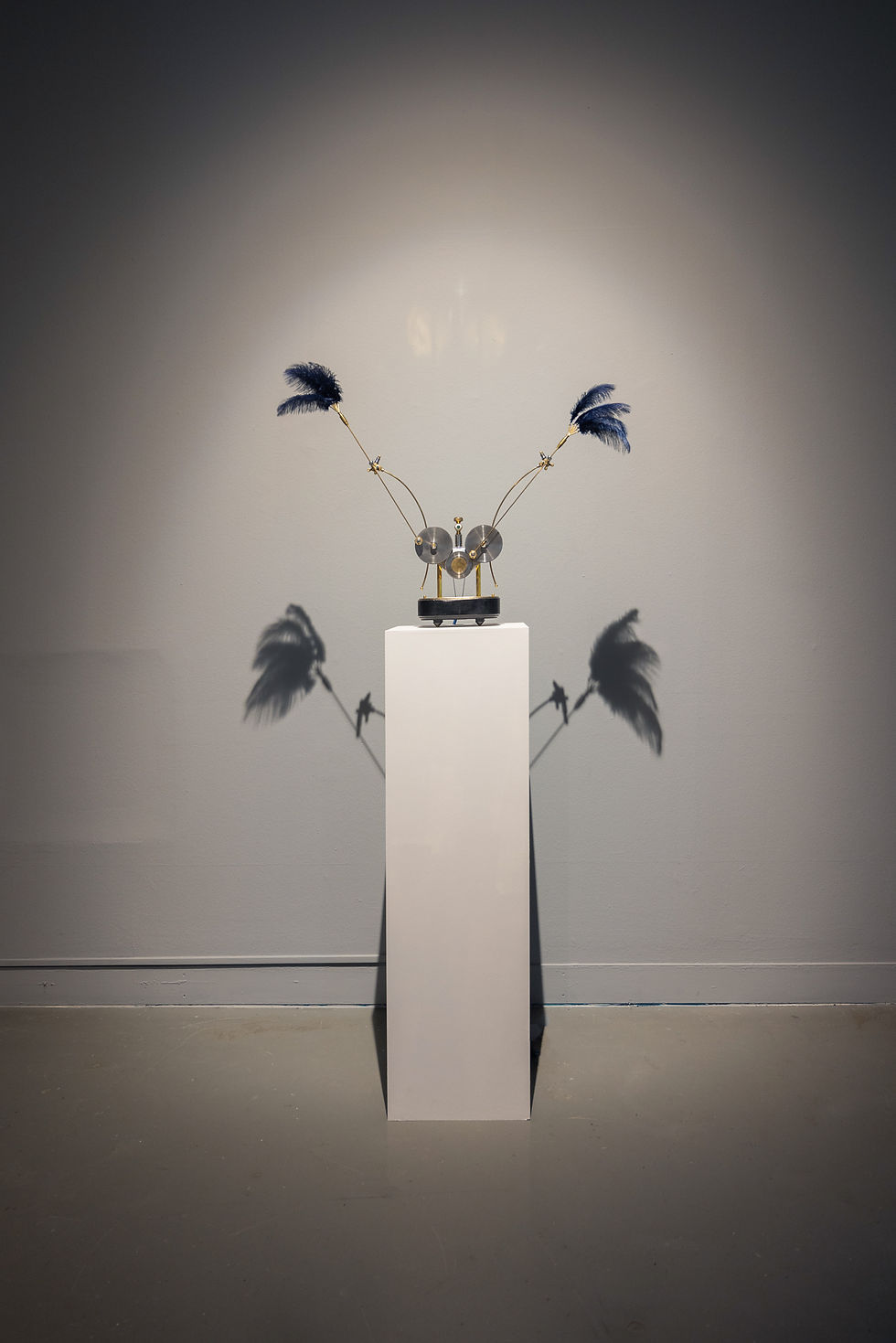
DC motor, brass, aluminum, feathers, glass, wood
The motion suggests breath, instinct, even intention, blurring the line between machine and living being. Each piece from the series has its own character, its own behavior. Some movements may feel delicate and meditative, others restless or insistent, echoing the complexity of natural life. This fusion of electricity, mechanical assembly, and philosophical reflection makes the piece more than an object; it becomes an organism of sorts, stimulating the imagination and inviting viewers to experience energy as life itself.
Mathieu Zurstrassen is a trained architect who from 2013 embraces the path of visual arts. In designing objects, he moves away from the projection of the drawing and focuses on the experimentation of construction. He gives added value to his work, symbolic and philosophical, on the quality of the invisible and the relationships thus created between the sender and receiver. He uses the codes of craftsmanship to solve aesthetical issues often at the borders of the unspeakable. Highly technical, Mathieu Zurstrassen combines the ambiguity of materials, a poetic thought made of humor and delicacy. He has exhibited in various events, galleries and festivals such as the KIKK Festival, Ars Electronica, Venice Biennale.



Silvia Burini, Giuseppe Barbieri, Maria Redaelli
ZORVED
video
The video establishes a dialogue between the works of the Organic School from MOMus-Museum of Modern Art-Costakis Collection, Thessaloniki, and the exhibition’s central themes, in relation to the works on display. It aims to foreground the “deep roots” of an
artistic approach that has undergone numerous transformations over the
following decades, while preserving—in its fundamental dynamics—a vital point of reference and inspiration for contemporary artistic
practices.

bottom of page