top of page

PERFOMANCES & SOUND PROGRAM
Luca Forcucci
The Greatest Bubble
Date: 11.10.2022, 19:00
Duration: 40 minutes
Location: HayArt Cultural Center
Site-Specific Sonic Performance and Installation, 2022
Inkjet Prints on voile; Ableton, Envelope, Jamm Pro, max/MSP, Reaper; field recordings with geophone, hydrophone, miniature microphone, coil, wine amphora
Bubbles, metaphors, poetry.
The project explores wine fermentation. Armenia has been producing wine for a long time, and may even have been the first place to do so, around 6,000 years ago. In this project the artist works with time and field recordings related to human activities in winemaking, with the smallest sonic elements of wine fermentation (micro), and resonant spaces of wine production (macro). The central idea resides in exploring temporality in the micro (intern) and macro (extern) relationships in the thingness of winemaking. The presentation of the work as performance and installation involves local techniques, craftsmanship, and objects like KARAS, transformed into loudspeakers.
The project is created on-site through the kind invitation of CYFEST and with the precious expertise of the winemakers.


Alexey Grachev and Alexander Bochkov
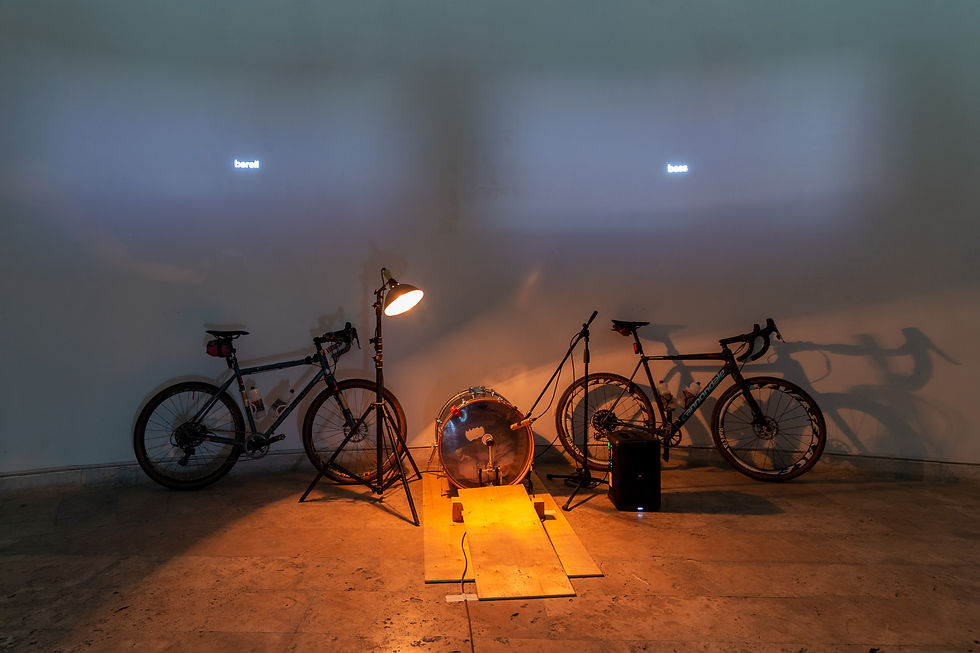
Symphony for bicycles — barrel and bass
Date: 23.10.2022, 19:00
Duration: 60 min
Location: HayArt Cultural Center
2021 (edition of 2022)
Performance
max/MSP; 2 Bicycles, 2 Kick Drums, 2 Hi-hat, Snare Drum
Engineers Alexey Grachev, Alexander Bochkov
The artists on the bikes regulate the sound and rhythm by their pedaling, and together create the final work. How the “symphony” is performed depends on the motion of both cyclists. The intentions and aspirations of the participant acquire sonic expression. They may become synchronized, and try to turn the pedals in the same rhythm, to be in harmony. Or they may intentionally disturb this and cause harmonic fluctuations, creating complex combinations of sounds that arise when movements are not synchronized.
This is an experiment on what an object is capable of besides its original purpose. The functionality of a technological object here is valued not for its usability, but for the distinguishing feature which determines what sound will be created.
The other aim of the work is to reveal rhythms and connections in space whose existence usually is not grasped in everyday life. Potentially, a sound may be produced from any object. In this project, the source of sound is the “bicycle-human” techno-assemblage. The abstract sound of a bicycle incorporated in the installation refers to all the “wordless” processes and objects which elude direct observation, but still play an important role determining the sort of world that we live in.


Alexey Grachev & Sergey Komarov & Anton Shchegolev
Subjectivization Of Sound — SySexintation
Date: 22.10.2022, 19:00
Duration: 60 min
Location: HayArt Cultural Center
As part of the project “Subjectivization of Sound”, the artists continue to study the space of capabilities for working with spatial/specific sound. For the eight-channel sound mixing, they are joined by Anton Shchegolev. The idea is that the factory presets of the world’s most mass-produced synthesizer, the Yamaha DX7, will mutate, randomly change volume, timbre (a total of 155 parameters) and become localized in the space. The artists will use a 8-channel sound system and an echo effect line for each channel.


Gray Cake / Alexander Serechenko & Katya Pryanik
Another state of living
Date: 14.10.2022, 19:00
Duration: 45 min
Location: HayArt Cultural Center
Audiovisual performance, 2020
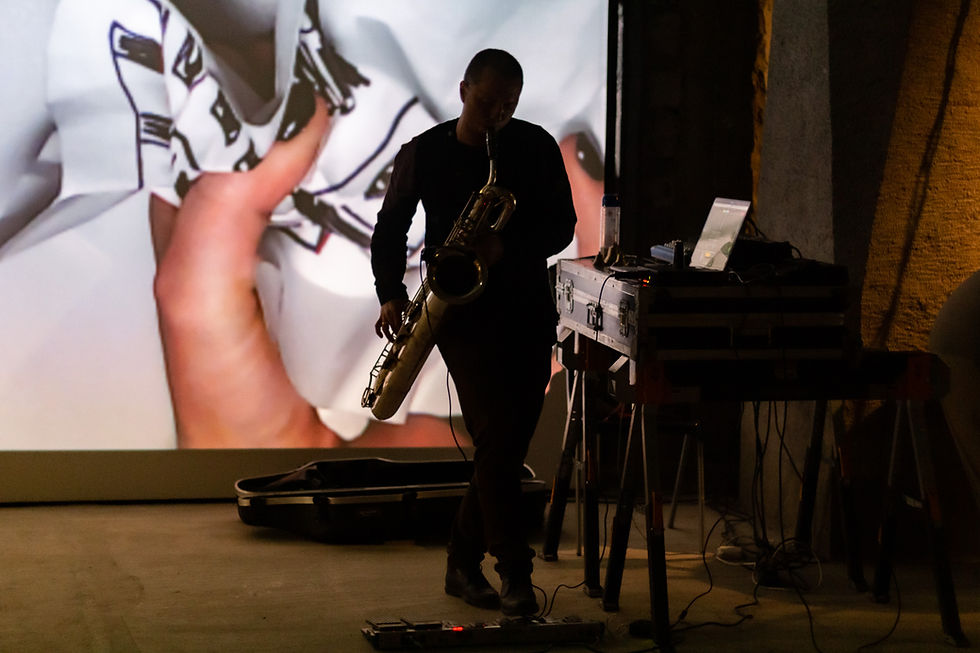
Custom Python code, Ableton Live, pix2pix algorithms; Computers, webcam, neural networks, baritone saxophone, sound objects, video projection
The Gray Cake duo uses neural network algorithms and custom loopers to create a performance in which everyday objects and their visual properties become the source material for the story.
Multi-instrumentalist Alexander Serechenko (solo.operator), experimenting with loopers and live improvisation, performs in collaboration with artist Katya Pryanik and a neural network programmed by them. The neural network reads primitive illustrations, everyday objects and the artist’s hands through the camera, and transforms them into houses, plants, space, the sky, the ocean and chaos of similar shapes. Thus, the artists build a narrative of the maturation of the world from outer space to the modern urban landscape.

Hayk Karoyi
Parallels
Date: 10.10.2022, 20:00
Duration: 60 min
Location: HayArt Cultural Center
As Armenia has always been a land of many different influences, the Idea is to show how music changed during all of these transformations, but still kept the fundamental sound characteristics of the territory. By playing all the music at the same time, we can observe the time parallels and understand Armenian music not from some narrow perspective, but rather widen our perception of all aspects of it.
Katherine Liberovskaya
3 Island Wind Songs (2019)
Date: 18.10.2022, 19:00–21:00
Duration: 45 min
Location: Composers Union of Armenia
Video-audio single-channel screen installation piece
A set of three visual and sound "sessions" (Song 1, Song 2 and Song 3) where 2 lavalier microphones (lapel mics) and 2 empty drink cans "perform" with the wind and sun of the Greek Cyclades Island Syros.
Created during Syros Sound Meetings' Sounding Paths Residency (Ano Syros, Greece, July 2018).


Phill Niblock
Music and films
Date: 18.10.2022, 20:00
Duration: 60 min
Location: Composers Union of Armenia
Music:
Browner (2020, 20 minutes) for Matière Mémoire, the Belgian label. This will result in 20 LPs with a new piece from each artist, and also an artwork (visual) by them. The piece consists of materials by four artists — Arne Deforce, cello; Deborah Walker, cello; Erik Drescher, flute; Dafne Vicente-Sandoval, bassoon. It was recorded with a Brauner microphone at Marcus Schmickler's studio in Cologne, Germany.
Praised Fan, for bassoon (2016, 17 minutes). Dafne Vicente-Sandoval, bassoon. Commissioned by Ilan Volkov for the Adelaide Festival, Australia.
Bag (2014, 21 minutes). David Watson, Scottish bagpipe.
Films:
Meudrone 1 (00:30:29);
Meudrone 2 (00:17:16);
Agosto (00:18:36)


Nikita Tsymbal & Dmitry Polikarpov
ICE XIX
Date: 21.10.2022, 19:00
Duration: 45 min.
Location: HayArt Cultural Center
Audiovisual performance, 2022
Video sequence: Nikita Tsymbal
Audio sequence: Dmitry Polikarpov
ICE XIX is an artistic interpretation of the defragmentation of crystals: from precise geometric structures to polymorphic changes, phasal transformations, defects and instability. The digital fermentation of the video sequence is accompanied by an analogue audio sequence by Dmitry Polikarpov – a sound artist renowned for his Stropharia project. In ICE XIX Dmitry creates an analogue sound synthesis on a eurorack modular synthesizer that he assembled himself.
Nikita Tsymbal, a media artist and participant of experimental festivals and events in Moscow and abroad, provides the video sequence. It contains an extensive photo collection of minerals and crystals: Dark red spessartine crystals on muscovite druse, Massive aggregate of fine-rayed pyrolusite, Octahedral magnetite crystal on andradite brush, Rhodochrosite, Realgars from Romania, Pyrite, Azurite with malachite, Brochantite on chrysocolla (Chuquicamata, Antofagasta prov., Chile), Azurite with malachite (Bisbee, Arizona), Brilliant wolframite and quartz druse, Black tourmaline druse with dark blue-green crystal caps, Kerchenite, Malachite bud, Rhodochrosite (Hedgehog Pocket, Sweet Home Mine, Alma, Colorado, USA), Pink apatite with aquamarine on albite, Tourmalines from Madagascar, Charoite, Agate, Calcite on an ammonite shell, Topaz, Golden barite on calcite of concretions…


Alexander Serechenko
multi.operator
Date: 14.10.2022, 19:45
Duration: 20 min
Location: HayArt Cultural Center
Interactive music performance, for saxophone and audience, 2016 — present
The audience is invited to part in live sampling, by using their mobile devices and WiFi connection to the musician's laptop. The saxophonist plays jazz tunes, simple melodies, abstract sounds and noises, and with their phones listeners choose what and when to repeat, to compose together a canvas of unpredictable but fascinating glitch jazz. A fixed tonality converges this chaos in a tonal base and makes it sound just like a massive free jazz improvisation, introducing this culture to unprepared listeners just by giving them the opportunity to play it by themselves.
The audience is as important as the performer or author, and technology blurs the boundaries between the two sides. The piece of music lives and exists only when the listeners show an emotion, judge, or react in any other way. This cross-dependence is a good way to explain the phenomena of mass raves, blues jams, the popularity of dadaism practices with a ready-made concept (the audience became an author by declaring some non-art object to be aesthetically valuable) and other collaborative practices. In the multi-operator project, the author directly addresses this viewpoint of the listener's role. At the same time, by using net technologies he emphasizes the networking foundation of society and its collaborative practices, in this case musical improvisation.


bottom of page