top of page

HayArt Cultural Center


Babi Avelino &
Ronald Dagonnier
Almost Human, the Illusion
of Understanding
Immersive installation, 2023
Arduino Firmata, MadMapper; robotic arm with 6 servo motors, 2 webcams, projector, LED, computer; round wooden plinth
“Almost Human, the Illusion of Understanding” is an interactive art installation that explores the complexity of human relationships through the eyes of a robotic arm. The two artists worked together on this project for the first time, using photos and videos of their romantic relationship as raw material. They excavated their memories five years after they met.
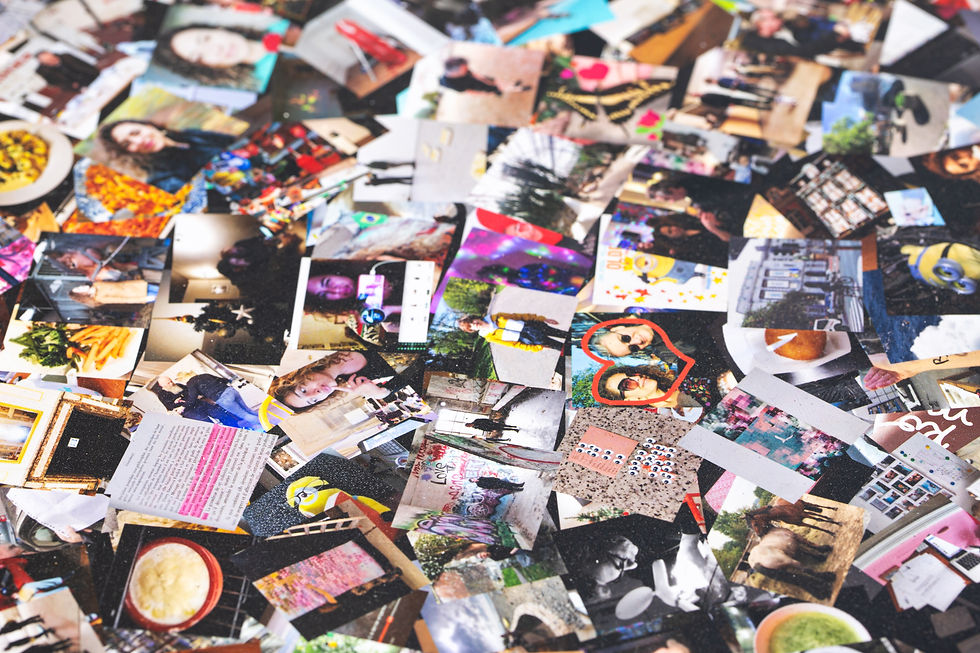
The robotic arm is equipped with a camera that captures images of the photos arranged on the floor. These images are then projected onto a wall before it, creating a visual montage of the artists’ relationship. The robot moves around the room erratically, giving the impression of a desperate attempt to understand the human emotions and motivations underlying the relationship.
The projected images show intimate and sometimes conflicting moments in the artists’ relationship, ranging from tenderness to frustration, joy, and sadness. Spectators are invited to stand in the room with the robot to see the projected images from their point of view and thus experience the installation immersively.
This installation questions the nature of human understanding and the possibility of translating it into robotic language. Through this immersive experience, the artists seek to challenge our ability to understand the complex relationships around us, inviting us to share their own experience of love and frustration, recapitulated five years after they met.



Milena Avetisyan
Weaving a Way Home
Documentary photography, 2021 — ongoing
59 photographs, digital prints on photo paper
When living in the present, it is hard to understand the value of what we own in the moment. The most important memory is that of the house you live in. Here, you have breakfast and lunch, fall asleep and wake up in the same bed every day, sliding your fingers on the patterns of the pillowcase, following these patterns.
This series of photos of old, soviet things reminds everyone of their grandmother’s house, interweaving memories through patterns and objects, having the prototype of that house in front of their eyes. However, the series started with renovation in our home and I began to photograph, reconstructing the memory of my home.
By taking pictures of objects I found in different houses, I wove my home, the memories of the house and of myself. I could feel how my house was being transformed unaffected Milena Avetisyan Weaving a Way Home Documentary photography, 2021 — ongoing 59 photographs, digital prints on photo paper by the latest design solutions, but rather by the past woven through the photographs. — Milena Avetisyan


Samvel Baghdasaryan
Haun(t)remor
Installation, 2000
Courtesy of the artist and “Samvel Baghdasaryan” Art Foundation
Samvel Baghdasaryan’s HAUN(T) REMOR medium-based installation is a rectangular plane spread out horizontally and made of a layer of metal dust particles, which turns into a unique electronic scoreboard when the magnets hidden under the dust particles connect to an electric current. Under the influence of an electromagnetic field, they rotate and position themselves, enabling Armenian letters to appear and disappear on the plane’s surface; the word HETAPNDOGH becomes visible, and due to the operation of the electric relay being three-phase, the word disappears in parts. Here, at this second intermediate stage, the drama of chance appears. The disappearance of the beginning of the word reveals that the letter combination on the board also suggests a separate word, DOGH, which is not noticeable when the word HETAPNDOGH is fully displayed. — Nazareth Karoyan


Max Blotas
Crystal clear / Eau de Roche
Installation, 2020
Python; infrared camera with embedded LED, motor, Raspberry Pi, 15″ screen, 12″ CRT display, PMMA box, aquarium pump, water, leaf
A dramatic static image of human hands is transformed via technology conversion into moving guilty shaky hands, revealing vulnerability that was previously hidden from the image.
The static digital photograph is displayed on a monitor. Above the pixelated image, a pump agitates the water inside a transparent container. The image is filmed through the flickering surface and is transferred as a live video onto a CCTV cathode-ray screen a few meters away.
In the center, a motorized leaf propels transparent water-like drops (glycerine) onto the computer that controls it, in a repeated attempt to sabotage itself. The work generates a physical and temporal gap between video technologies. It also tackles the effort to comprehend and accept our own weaknesses through a change in our perspective.


Giuliana Cunéaz
The Seekers of Light
(I Cercatori di Luce)
Immersive installation, 2021
Autodesk Maya; 3D, computer graphics, performance, videomapping, cinema; full HD projectors, speakers; video [00:31:07, color, sound, loop]
Assistant Director: Alessandro Reani
3D modeling: Sergio Ricciardi
Sound: Paolo Tofani
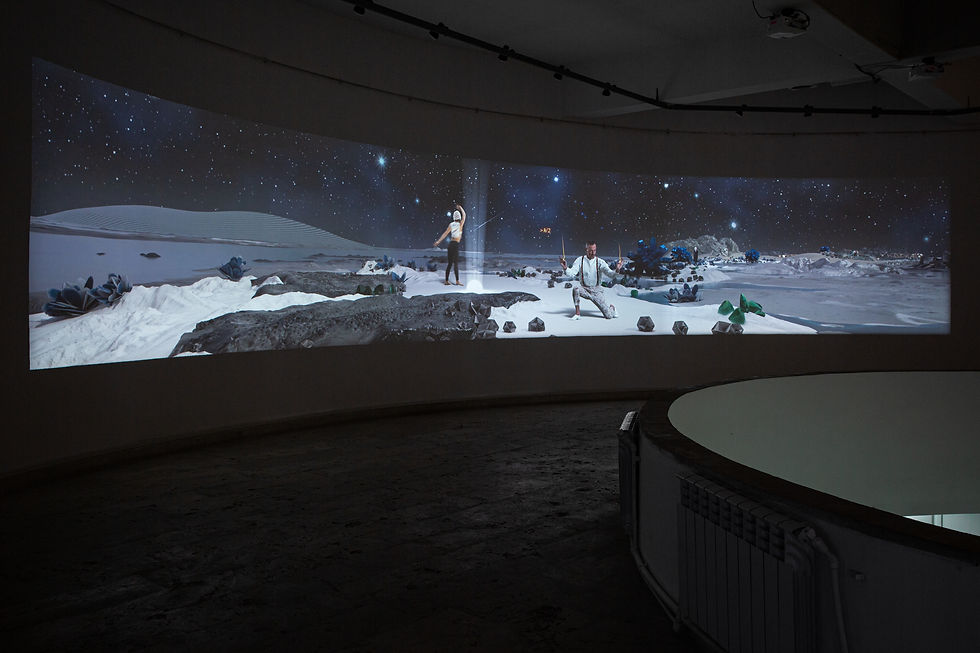
“The Seekers of Light ” is a video installation on multi-screens featuring the participation of actress Angela Molina. It is an immersive work created with the use of sophisticated technologies and forms of expression ranging from performance to cinema, from dance to theater. Within a strikingly evocative work, the real figures move in a setting created in 3D. The central aspect of the work is the overcoming of vulnerability. The characters face the transition from darkness to light on the basis of a relationship of human complicity and solidarity. The serene sharing of social life and responsibility towards the ecosystem are fundamental components.


Alexandra Dementieva
Chronoscape
Multimedia interactive installation, 2023
3D modeling, 3D printing, welding, soldering, laser cutting; Arduino, Fusion 360, Max/MSP; stepper motors, controller, 2 19″ screens, Mac Mini, camera, proximity sensor, aluminium clock hands, 3D printed gears, shafts, drivers; steels frame
Engineers: Alexey Grachev, Denis Markov, Sergey Komarov
Supported by CYLAND MediaArtLab
The totem consists of a clock mechanism, a monitor, and hidden video camera. It is a symbolic representation or embodiment of the concept of time and serves as a reminder of its flow, the impermanence of life or the cyclical nature of existence. Standing in front of it, the visitors speeds up the clock with their presence — the more they stand, the faster the hands spin, the ticking sound speeds up, their image on the monitor screen breaks up into pixels and disappears completely. When the visitors leave, the clock returns to the original local time position.


Alexey Dymdymarchenko
Untitled
Installation, 2019
Sound [00:04:00, stereo, loop], audio player, headphones; series of drawings: graphite pencil, charcoal, wax crayon, pastel on paper, glass
Alexey Dymdymarchenko (1986– 2020) is known for his minimalist, amalgam-like artworks that embrace sound, material, and process. Although influenced by his own experience of living in a residential institution (called an internat, PNI in Russian) his work does not refer to particular social conditions but rather takes up the radical possibilities of abstraction. Dymdymarchenko himself was minimally verbal and created each drawing by taking a box of fragments of wax crayons, graphite pencils, or pastels and dumping it out over the paper as a visual, gestural, and auditory process. The resulting composition suggests clusters of marks, dots, dashes, smudges, and scratches, melted into voluminous, cloudy shapes that simultaneously connote sound spectrograms, natural textures or scrawled graffiti. Into these decontextualized, non-hierarchical surfaces constructed via dust and gesture, the artist inscribes his own narratives and creates a new form of autofiction at the time of the resurgence of figuration and identity politics in the arts.


Maria Cristina Finucci
TRANSMUTATION (site specific)
Installation, 2023
Deep Learning with graphic inputs; Keras with TensorFlow Backend, Artivive; print on canvas, AR, metal wire mesh, rubber gloves, LED light
Special thanks to Claudia Marra, Riccardo Rossi, Cristiano D. Sebastiani
Industry produced objects are extremely vulnerable as they are consistently discarded by humans. Both humans and goods become victims of consumption culture. These discarded objects eventually end up being destroyed and melted together, leading to a state of entropy. However, with the assistance of Artificial Intelligence, these objects manage to organize a new form of life for themselves.
My question is: What does an object experience when it undergoes transmutation and returns to being part of the cycle of life and the universe? Does it retain any memory of its previous existence? In 2014, for an installation at the MAXXI Museum in Rome, I made a registry census of thousands of various plastic objects that could potentially be discarded after use. At CYFEST in Yerevan, I presented all these thousands of objects after their transmutation. — Maria Cristina Finucci


Anna Frants
Vagaries of Affections
Installation, 2023
Arduino C, Python; Raspberry Pi 3, Arduino controllers; stepper and servo motors, aluminum tubes, steel, PLA plastic acoustic horn, vinyl records, podium
Engineers: Philipp Avetisov, Denis Andreev, Eugene Ovsyannikov, Dmitry Shirokov
Supported by CYLAND MediaArtLab
“Love is a many splendored things...”, “Love, I’ll be a fool, for you...” — and one could cite many other words of love. Furthermore, if we are to believe Google, quotations about love outnumber quotations on any other subject. In her installation Vagaries of Affections, Anna Frants reflects on this and shows that this feeling could be expressed not just in words, but also in numerous other sounds that are generated in various and never repeated combinations. Some people say that affection is just a chemical reaction, while others believe that we understand that we are in love when love songs finally make sense. This work of the artist demonstrates that, whatever “physicists and lyricists” claim, love is always unpredictable.


Anna Frants
Trembling Creatures
Installation, 2010
Arduino; microcontroller, proximity sensors, servo motors, bicycle spokes, metal frame; felted wool hats
Felting: Hannes Kivits
Robotics and programming: Alexey Grachev
Engineers: Alexey Grachev, Philipp Avetisov, Maxim Lukin, Dmitry Shirokov
In Dostoevsky’s “Crime and Punishment”, Raskolnikov pondered the question: “Am I a trembling creature, or do I have the right?” This installation answers both parts of this question positively: yes, you are a trembling creature, and yes, you do have the right... to tremble from any change in the world, like these felted hats by the Estonian artist, Hannes Kivits. These hats start to move, or rather to tremble, from any gesture by the viewer. Perhaps they literally follow the mandate of Paul the Apostle “to work out your salvation with fear and trembling.” Or they remind us that life is movement — unlike the immovable stones in the Arctic Circle, that strangely enough served as an inspiration for this work.


Elena Gubanova & Ivan Govorkov
Seventh Heaven
Site-specific installation, 2021
Arduino, MATLAB, Fusion 360; 3D modeling and printing; stepper motors, stepper motor drivers, Arduino microcontroller, GT2 belt; hammocks, plaster, fishing line, white paint; speakers
Engineers: Alexey Grachev, Alexander Bochkov, Denis Markov, Denis Andreev
Supported by CYLAND MediaArtLab
“Seventh Heaven”, an expression signifying the highest degree of joy, happiness, and bliss, derives from the Greek philosopher Aristotle (384–322 BC), who described the arrangement of the celestial spheres in his work “On the Heavens”. The installation examines the urge to break free from the heaviness of existence, from boundaries and illusions, from fears and time, and from the Earth’s gravity.


Lena Herzog
Last Whispers. An Immersive Oratorio for Vanishing Voices, Collapsing Universes and a Falling Tree
Installation (first version, AV), 2016; (immersive version, VR), 2022
Blueprint, C++, Unreal Engine, Maya; AlloSphere; VR build and spatialized sound; VR 360 playback [00:30:00, black and white, sound]; murals
Special thanks to Jonathan Yomayuza, Marco Capalbo, Mark Mangini, Amanda Tasse, Maggie Morris, Kevin Tsuki
“Last Whispers” is an experiential, immersive project dedicated to the mass cultural extinction — of languages. It is an incantation of extinct and endangered languages. It is both a modern as well as a traditional choral work. The spatialized sound composition layers recordings of speech, recitatives, incantations, songs and ritual chants, with audible punctuations of sounds from nature and outer space frequencies (made audible), including gravitational waves of supernovas (dying stars) recorded by LIGO, “The Listening Ear.” The impact of “Last Whispers” is amplified through its use of cutting edge image and sound design, and technology. Visually, the audience is dropped into landscapes and symbols devoid of people, as human voices call from deep space. The immersive and spatialized sound projection is interpreted by the human ear as a distinct 360° soundscape. This enveloping visual and sound environment prompts the brain to perceive the voices in the piece as “present” and “real.” “Last Whispers”, premiered at The British Museum and The Venice Biennale.


Ellen K. Levy
Untitled (Domino Theory)
New media installation, 2023
Unity/Vuforia; Zibra Liquids Simulation; Artivive; AR; animation, suspended platform, painted prints, works on paper
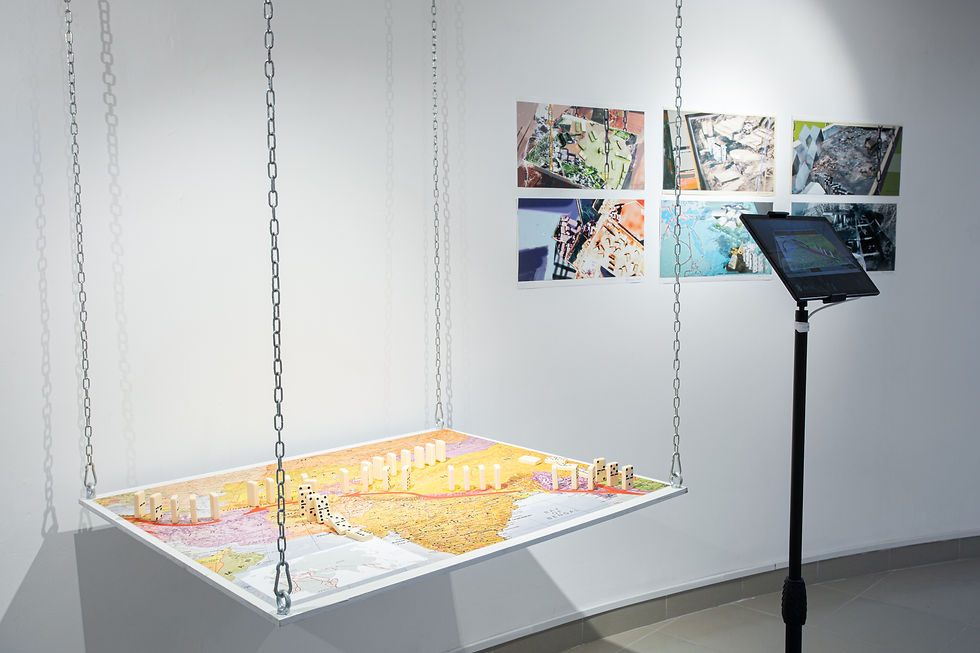
Untitled (Domino Theory) concerns the vulnerability of systems brought about by human action, especially anthropogenic climate change. I create a state of self-organized criticality to explore interactions between environment, system and observer. Migration can result from flooding and political turmoil, consequences of global warming. To exemplify this, I suspend a platform precariously upon which dominoes (“homes”) are positioned along migration routes on a map. Viewers must avoid toppling the structure. When viewed through AR, a video is triggered of floods toppling “homes”, suggesting how one’s actions influence the configuration of the entirety, key to our ability to ameliorate environmental disaster. — Ellen K. Levy


William Latham
Panoramic B+W Mutation Mirror
Organic Tadpole series
Computer drawing, video, 2023
Mutator (Evolution, AI and Physics software), custom software developed 1987 — present time; Nvidia 1080 Graphics Cards, PC, Kinect; high resolution black and white image printed on paper; video, 48″ screen
Software: Stephen Todd and Peter Todd
The work is a B+W wall size panoramic snapshot of an evolved 3D mutator form having undergone structural mutation and interactive breeding by the artist and then put in an infinity mirror chamber and rendered. This B+W drawing series follows directly from the artist’s Fantasy Virus (Mutator) series which the team worked on through the Covid Epidemic. This new work is part of the Mutator project dating back to the late 1980s. The work is a result of the ongoing creative and technical collaboration with Stephen and Peter Todd.


Natalia Lyakh
Untitled 23
Video [00:01:13, color, sound, loop], 2023
32″ screen, player, headphones
Vulnerability: Us and AI
Should we pose “semantic”, ethical, legal and psychological questionsto ask to AI? According to Searle’s “Chinese Room” theory, we can call ourvulnerability sensory-semantic, and AI’s (non?) vulnerability syntactic.
We often expect deep answers from AI, but for now, our semantic filters are necessary and inevitable since “semantic” values ultimately determine development, creativity, discovery.
We see on the one side the elasticity and flexibility of “semantics” and on the other side boundless but predeterminеd possibilities of “syntax”.
When glass breaks, the resulting crystals retain some kinetic energy and continue moving for some time, then, due to inertia, this movement fades to zero. With the maximum degree of vulnerability test: on the one side, there is tension and supereffort of restoration, recovery and even development, and on the other side, a diminishing kinetic impulse.
Do we desire the emergence in the near future of an equivalent consciousness in AI? Do we still retain control over this dimension? Shall we increasingly prize our different vulnerabilities especially the creative ones and cultivate and test them more and more? — Natalia Lyakh


Tigran Martirosyan
QS-QS
Installation, 2023
An artistic text, as a birth that has to do with language environment, in addition to verbal specifics, is affected by linguistic thinking of the epoch. Characters in a Greek tragedy spoke in a completely different style, the speech of Shakespearean heroes was dissimilar, Chekhov’s actors speak differently in their roles, and today’s stage characters speak even more differently. It is precisely the epoch that contains the linguistic vulnerability of those characters, the one that lies in the realm of sensory experience of an actor. This is all the more true if the speech of such performers consists mostly of slang and strictly mundane emotions. In particular, the word KYANQS, in which case the poetic, high-style and passionate speech of Shakespearian heroes becomes perceptually difficult for him and practically unachievable. Borrowed from the slang of prostitutes, the primitive and noxious word, by its very presence, makes inaccessible emotional nuances of love expressed by the sonnet language of Romeo and Juliet, Hamlet and Ophelia as well as the tone of their corresponding reproduction.


Nao Nishihara
Diligent Machine (Yerevan)
Kinetic sound machine, 2023
Mixed media
“Diligent Machine”, shifts our sense of time in our daily lives. It runs on a railway slowly with sounds of instruments and daily objects. The audience has to wait, and keep their senses sharp. These ideas and process are rooted in the “MA 間”, the traditional Japanese notion of time and space.


Tuula Närhinen
Drop Tracer
Sound and video installation, 2011
70 soot-coated glass slides, 4 pigment prints enlarged from the glass slides, 144x95 cm, the Drop Tracer instrument with an unexposed soot coated glass slide, candle, matchbox, HD video [00:49:20, color, sound, loop], projector
The Drop Tracer includes 35mm glass slide frames sensitized with soot and exposed to rain, photographic enlargements of the splash patterns made by the raindrops, and a video which allows the audience to experience the duration of the splashes. Falling on the soot-coated slide, raindrops leave traces which remain visible even after the water has evaporated. A contact microphone catches the sound of the collision.
The work draws from a method devised by the meteorologist Vincent J. Schaefer for recording raindrops’ collision with glass. When a drop of rain hits the glass surface, air trapped under the droplet lifts up tiny particles of soot that end up creating explosion patterns on the surface of the slide.


Patricia Olynyk and Adam Hogan
Black Swan in Three Variations
Video installation, 2023
3-channel video [UHD 4K; binaural sound], AR;
3 65″ screens, headphones, Apple iPad; plinth
Drawing from Nassim Nicholas Taleb’s timely and relevant book from his Incerto Series, “Antifragile”, and the notion that individuals can gain from the impact of highly improbable events, this triptych and evocative soundscape offer three meditations on a selection of black swan events, including 9/11 and its aftermath, the 2008 Lehman Brothers bankruptcy and collapse of the global financial market, the sinking of the Titanic, and the recent rise of ChatGPT. The score in particular explores perceived randomness and variability through algorithmic electroacoustic composition and granular synthesis.


Fabrizio Plessi
Energy
Video installation, 2016
7 40″ screens
What is the meaning of Energy, after all?
Changing and reversing the lapidary order of things.
This is Energy
Altering the rational pattern of our perception.
This is Energy
Overturning the very meaning of the work and extending its potential.
This is Energy
Running on unfamiliar terrain using unapproved strategies.
This is Energy
Entering and leaving without fear of the circumscribed borders.
This is Energy
Crossing without complexes the separateness and discomfort of creativity.
This is Energy
The true and authentic Energy, in the end, is only that of the light of a flash in
the deep darkness of the night.
— Fabrizio Plessi


Katya Pryanik
Flowers
Photography, video, 2019
6 prints produced in chlorophyll printing technique, 86×60 cm each; video [00:07:46, color, sound, loop]; 19″ screen, headphones
Special thanks to Ludmila Zinchenko
Photosynthesis directly or indirectly supports almost all life forms on Earth. Photosynthesis starts when photons emitted by the Sun enter specific pigment molecules — chlorophyll contained in the membranes of the chloroplast cell organelles, ones that color the leaf green. It is chlorophyll in the process of photosynthesis that chemically reacts to the sunlight.
Photosensitivity is the ability of a substance to change its chemical or physical properties under sunlight exposure. Photography is closely related to this process. Kliment Timiryazev, botanist, first began to experiment with photosynthesis and discovered that light is absorbed through the grains of chlorophyll. Timiryazev named his own method of research “The photographic self-registration of the chlorophyll function on a living plant.”
After numerous experiments with different plants, I’ve elaborated a photosensitive emulsion, by which printing is carried out. This is analcoholic extract of chlorophyll produced from the ficus leaves. Chlorophyll and the process of photosynthesis caused prints to acquire a light green color. The emulsion does not contain silver salts and other nonbiological chemical elements, therefore, the image is not fixed: over time, the color fades and then disappears completely.
Artificial flowers are placed on emulsified paper and illuminated by an ultraviolet lamp. They develop and come to life from the dead through the process of photosynthesis, which in turn plays a leading role in the biosphere processes, globally forming organic matter from inorganic. Transformation of the living into the dead to represent life in a new specific dimension. — Katya Pryanik


Samvel Saghatelian (Sam Saga)
Great Navigation
35 mm prints on photo paper, 1998 (Yerevan); 2003 (USA) — ongoing
Special thanks to all the women from Yerevan to Los Angeles, who let me use for this project their prepared meal, kitchen utensils or washing water
Societies without established systems are often, in time, forced to survive by initially sacrificing a woman’s integrity; separating her maternal role from her female sexuality. As stewards of the family hearth, charged with maintaining its cohesion and purity, mothers inhibit their sexual desires, channeling their primal energies into the daily routine of a patriarchal household. This project touches the curtailment of womens’ sensuality, imagination and freedom for the abstraction of a higher good, the family structure becoming just another name for practical unity.
P. S. Personal
My mother often recalled one event. When I was a kid, playing in the park, she was sitting with her girlfriends on the bench. She noticed that a respectable old man sitting on a bench, dressed in a white suit, wearing a white summer hat and glasses, was following me with his eyes. He turnedto my mom and asked her:
— Is he your child? Take a good care of him, he will become an exceptionally talented person.
I remember that my mother was encouraged by that old men words and It was her dream to see her child become a talented person. And now, in retrospect, I can say that her spirit navigated me to the Great Navigation. — Samvel Saghatelian


Danielle Siembieda
Co-Operative Existence
BioArt installation, 2023
Ferrofluid, plastic, wood, magnets
In a post-people world, the planet has become anti-fragile due to a combination of depopulation and evolution of the human and nature’s own understanding of its science, genomic ancestry, and adaptation. Humans realized that their actions were causing irreversible damage to the environment, creating new systems and technologies aimed at preserving the planet’s resources. However, nature’s ability to adapt and evolve played a crucial role in the planet’s transformation from a vulnerable to an anti-fragile one. Through natural selection and genetic variation, species were able to survive and thrive in changing environments, leading to a more diverse and resilient ecosystem. The descendants of Homosapiens have learned to coexist with nature, cultivating a mutualistic relationship that one must not obliterate the other. Together, human ingenuity and nature’s adaptive capacity have created a new paradigm of living that promotes sustainability, resilience, and long-term survival.


Where Dogs Run
Faces of Smell
Interactive installation, 2012
Arduino IDE; metal, plastic, glass, stainless steel, aluminum, silicone, gas sensors, photoion detector, electronic components, fan, microcontrollers, computer, 48″ screen, stand, cutting table, range finder; screen, gas analyzer, air
Most people cannot reconstruct smells from memory (it’s rather hard to mentally “picture” a familiar smell, although someone’s face would be pretty easy to visualize). As yet, there exists no mechanism to even approximately reconstruct and reproduce a smell from memory. However, there is a well-established and widely used method of recalling and recreating a visual image: the facial composite, where a previously seen face is reconstructed by comparing and selecting individual facial features. We have decided to use the same method for fixing smells. To do that, we have created an array of gas analyzer sensors that continuously examine the space and the people within their operating range. The data from the gas analyzers constitute a pattern that is unique to this place, this person, and this moment in time — because airflow constantly changes the air composition in the space that is being examined. This unique, ever-changing pattern is visualized in a facial composite. This is how it works: when a person approaches the analyzer, sniffing tubes “sniff” him, then gas analyzers process the information, which then passes to a computer program that translate air composition data into data concerning the shape and position of facial features (the components of a facial composite). As a result, a person sees a face of their smell that is conditional, in no way related to their actual physical appearance.


Where Dogs Run
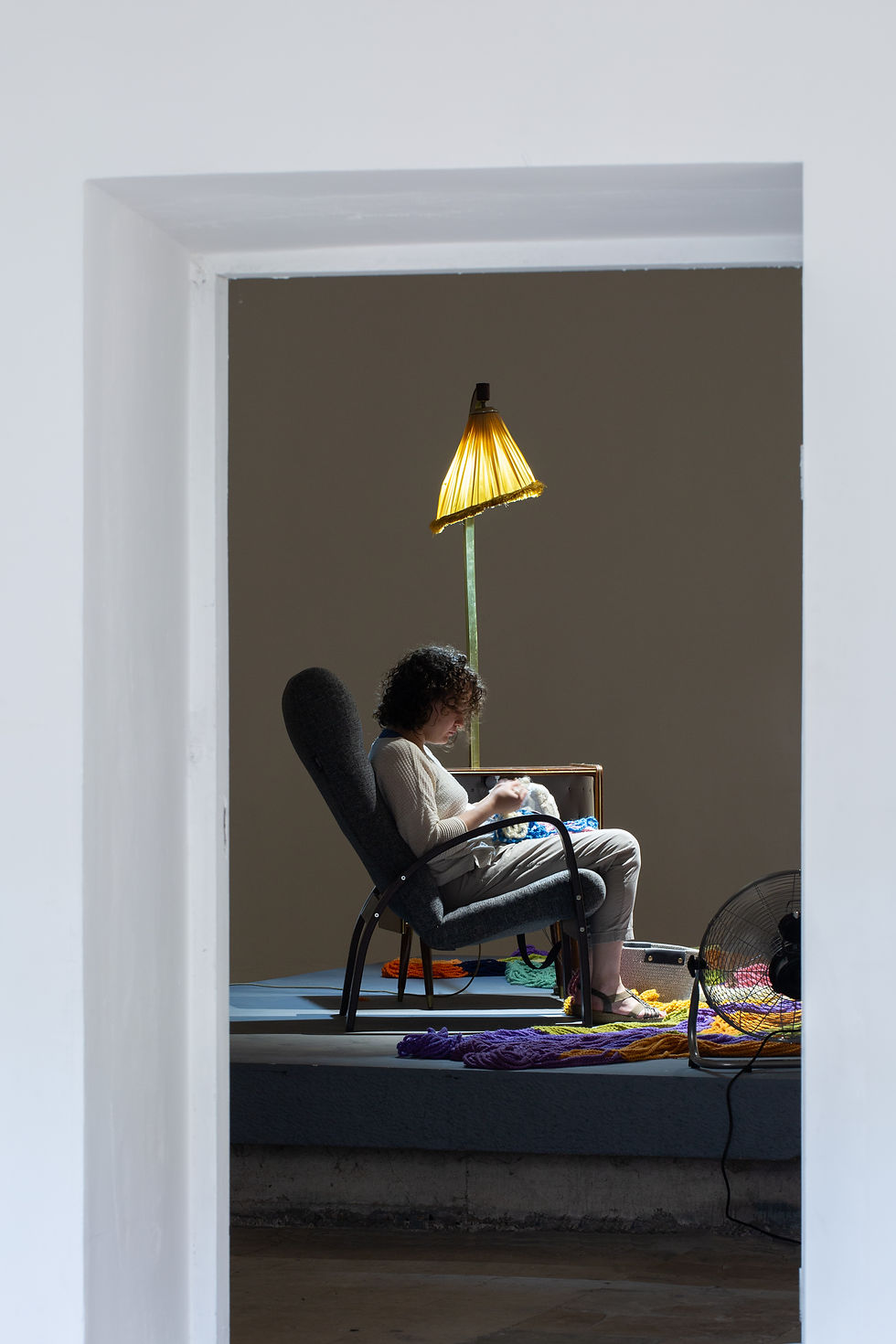
Knitting and Crocheting the Mandelbrot Set
Performance, 2007–2024, work in progress
Sound, 2024
Threads for knitting, text documentation of the process, knitting hook
Performers: Anna Asvarishch, Evgeniia Tatarenko, Vasilisa Litvinenko
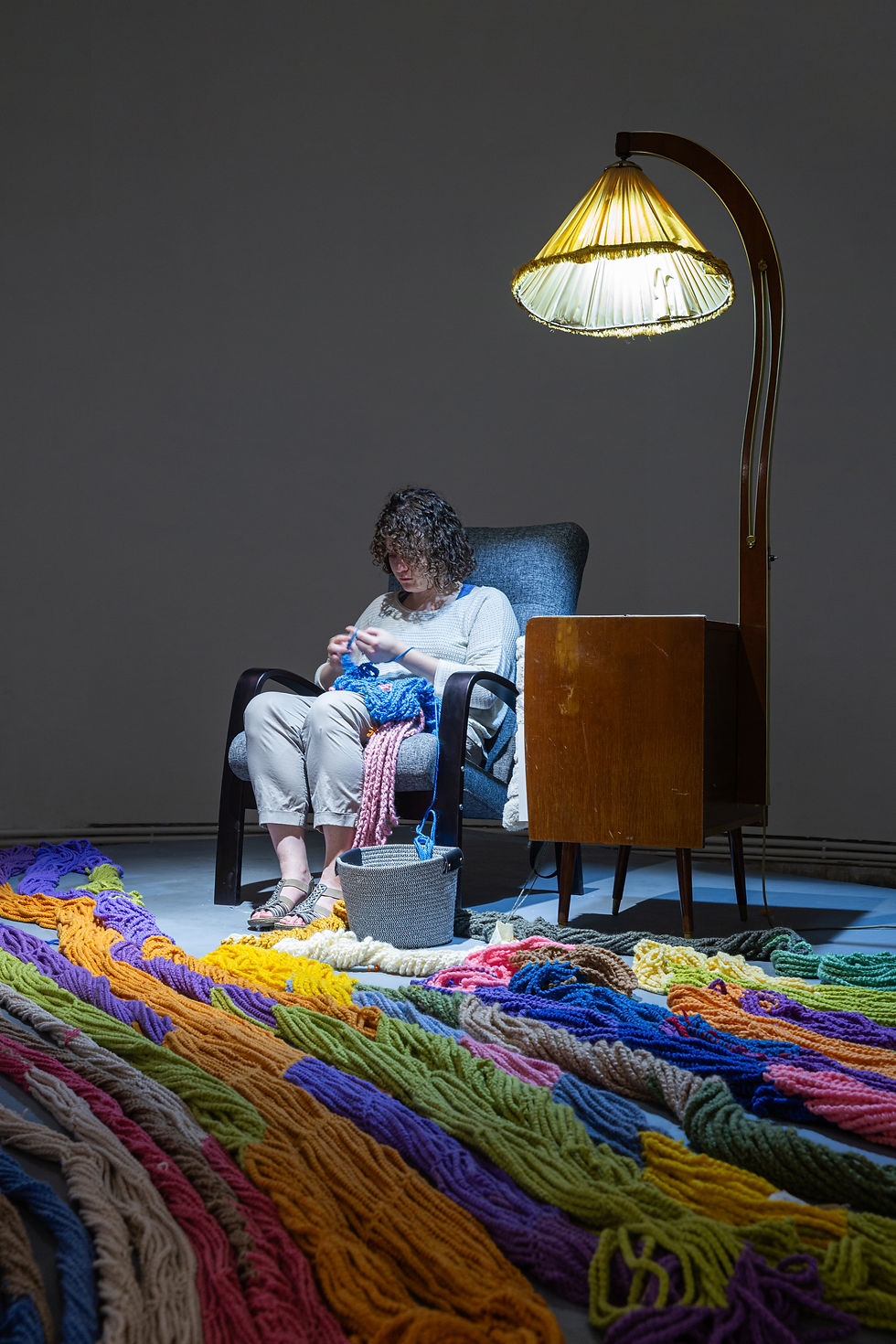
A woman is knitting the Mandelbrot set converted into a knitting pattern. She is bounding the void.
The Mandelbrot set can be called a boundary of escaping to infinity. One chooses a point not far from zero and then inputs two coordinates — x and y —, into two simple
expressions. A resulting two numbers, the coordinates of a new point, are substituted into the same expression, and so on. So if the initial point is lucky (or not so “lucky”) to be within the Mandelbrot set, then, passing through the equation, all the subsequent points stay close to the origin. If the initial point is even a little bit beyond the set’s boundary, then its descendants will not hold a position; they will lose touch with the origin point and fly to infinity. The coordinates of the iterated points will only grow and will never return to the vicinity of zero, where their ancestors dwell.
The boundary of the Mandelbrot set cannot be described by even the most complex of equations. It is always generated by trial and error. One takes a point, performs repeated calculations, and sees whether the results remain bounded. It is impossible to check each point, as their number is even greater than the standard (countable) infinity, which in our childhood, used to begin somewhere beyond a million or a billion. The generated boundary is always approximate: one million of points is definitely inside the set, another million of points is definitely outside it, and the boundary is somewhere in-between. Any fragment of the boundary, even smallest one, looks similar to the entire boundary. That’s why it is called a self-similar shape, or a fractal. It is impossible to generate and draw it without a computer. There are many structures similar to the Mandelbrot set that exist in nature: blood vasculature, coastlines, etc. Our interest here is the attitude towards the indeterminable boundary. What is better: to stay inside and be marked black (the points within the set are traditionally marked black), or to stay outside knowing that one will have to fly to infinity anyway, or to exist on the boundary and infinitely self-similar?


bottom of page