top of page

CYFEST 15: Deering Estate

This project is made possible in collaboration with the Kolodzei Art Foundation. The project's general sponsor is One Market Data.


Deering Estate16701 SW 72 AvenueMiami, FL 33157


December 1, 2023 — January 3, 2024

Special event: December 10, 2023 — project presentation and performance program


Artists

George Bagdasarov, Todd Barton, Rumore Bianco, Anthony Bisset, Bred Blondie (Gleb Glonti), Vasilii Bakanov & Andrew Strokov, Alexander Bochkov, Budhaditya Chattopadhyay, Sam Conran, CYLAND Audio Archive, Alexandra Dementieva, Lena Filatova, Anna Frants, Glia/Bugaev, Jonáš Gruska, Elena Gubanova & Ivan Govorkov, Alexey Grachev, A. Nigh Herndon, Sergey Komarov & Alexey Grachev, Sergey Komarov & Lydia Griaznova, Max Kuiper and Thorsten Soltau, Luke Lund, Yoshio Machida, Gustavo Matamoros, Nao Nishihara, Akira Rabelais, Thorsten Soltau, Esther & Nikolaj Søndergaard, Vasily Stepanov, Hans Tammen, Sashash Ulz, Peter Vogel, Ruslan Yusipov, Zov, and Miami's Subtropics 2023 Marathon participants (TBA).


Curators

Melissa Diaz, Liliam Dominguez, Anna Frants, Gustavo Matamoros, Sergey Komarov, Lydia Griaznova


Curatorial Statements 

Vulnerability. Elena Gubanova and Silvia Burini

Vulnerability: to get back to earth and to become earthly. Lydia Griaznova

Press Release in Spanish (.docx)


Plan Your Visit to Deering Estate

CYLAND Media Art Lab presents International Media Art Festival CYFEST 15: Vulnerability at Deering Estate.

The exhibition comprises three layers—media installation, sound, and performance—that invoke technologies developed to rediscover and affect space. The Deering Estate, a historical landmark with over 450 acres of natural landscape, including eight native ecosystems, will host a series of works expanding on the festival’s theme of Vulnerability. These pieces created with CYLAND Media Art Lab engineers will be in dialogue with the historical context of the place, irrevocably connected both to the past and future, the urban and natural.  


This exhibition is an invitation, while following the route from one artwork to another, to take a closer look at the issue of how we are included in the world. At the Deering Estate, we featured the works of artists who closely collaborated with the CYLAND Media Art Lab. At the core of CYLAND is the creation of media art in close dialogue between artists and engineers. 


CYFEST 15 at the Deering Estate is designed to be placed in spaces with characteristic sensibility and meaning, such as historic buildings or natural environments. It is envisaged as a cross-disciplinary and multi-sensory exhibition that stimulates the perception of the artwork’s idea via different senses and experiences.


CAA (CYLAND Audio Archive)


CAA—2 Peter Vogel

CAA—3 Hans Tammen

CAA—6 Ruslan Yusipov

CAA—9 Jonáš Gruska

CAA—10 Yoshio Machida

CAA—11 Anthony Bisset

CAA—12 Vasily Stepanov

CAA—13 Sashash Ulz

CAA—14 George Bagdasarov CAA—15 Source material from Max Kuiper and Thorsten Soltau

CAA—17 Akira Rabelais

CAA—18 Todd Barton

CAA—22 ZOV

CAA—23 Bred Blondie (Gleb Glonti)

CAA—24 A. Nigh Herndon

CAA—25 Rumore Bianco

CAA—26 Esther & Nikolaj Søndergaard

CAA—27 GLIA/Bugaev

CAA—30 Lena Filatova

CAA—31 Budhaditya Chattopadhyay

CAA—33 Thorsten Soltau

CAA—34 Luke Lund CAA—35 Alexey Grachev, Sergey Komarov

CAA—37 Nao Nishihara

CAA—38 Sam Conran

Alexandra Dementieva

Source of Energy

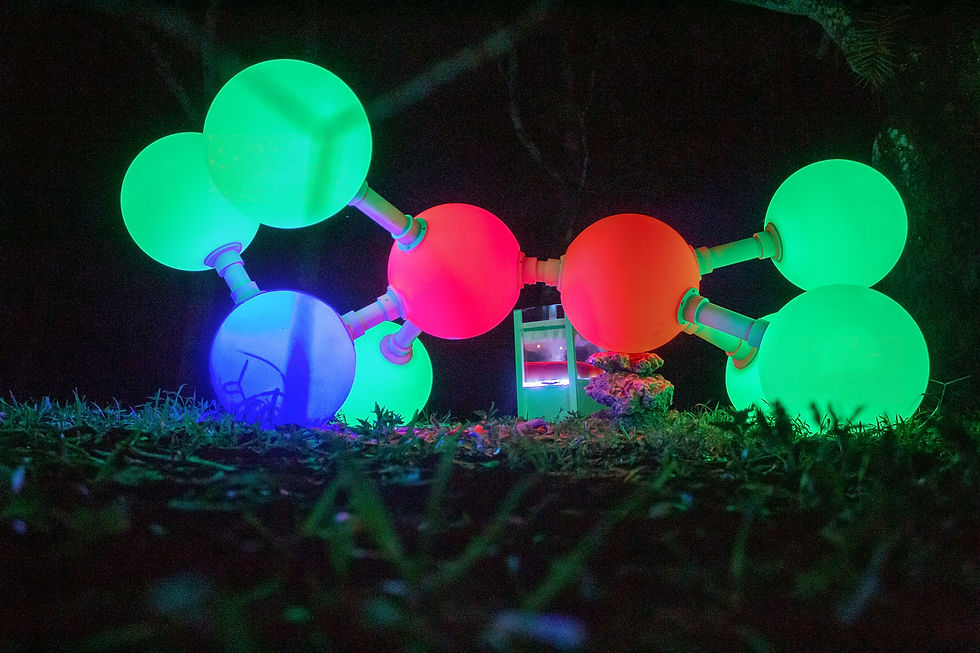
Interactive Sculpture, 2021 3D printing, brazing; microcontroller, light-scattering plastic spheres, RGBW LEDs, Arduino, acid sensor, PVC pipes, Kombucha SCOBY Engineers: Alexey Grachev, Andrew Strokov, Alexander Bochkov, Sergey Komarov;Arduino programming Andrew Strokov; 3D engineering design Alexander Bochkov Supported by CYLAND MediaArtLab A light sculpture shaped like an ethanol molecule connected to a jar with SCOBY-producing Kombucha. LEDs match the colour of elements: Hydrogen, Carbon, and Oxygen. The brightness of the object changes depending on the fermentation process. Adjacent to the sculpture, there is a jar containing SCOBY Kombucha immersed in a sweet tea broth. The fermentation process of the SCOBY is monitored through the use of an acid sensor placed inside the jar. This sensor detects the pH level of the Kombucha culture, creating a dynamic feedback system. As the pH level fluctuates within the SCOBY Kombucha, the sensor triggers changes in the light patterns emitted by the LEDs within the sculpture. The shifting colours and patterns of light reflect the real-time biochemical activity of the Kombucha culture. By placing SKOBY as the main actor, the artist emphasizes the agency and importance of non-human entities in shaping our understanding of nature and the environment. By shifting the focus from a purely human perspective to a more inclusive and holistic view, the installation prompts us to reevaluate our relationship with nature and foster a greater appreciation for the diverse forms of life and their significance in sustaining the planet. It challenges us to recognize that the well-being of the planet depends on our ability to value and protect the diverse actors that shape it; to see ourselves as part of a larger ecosystem, interconnected with all living beings, and emphasizes the need for caring attitude in coexistence with non-human entities.

Anna Frants

Artists Union

From the series “Matter of Chance” Media Installation, 2019 OpenCV, Python; 3D printing, ink on paper, stepper motors, servomotors, microcontroller, Raspberry Pi, web camera, oil on plywood; drawing paper rolls, pens, plinths Engineers Alexey Grachev, Alexander Bochkov, Viсtor Timofeev; 3D modeling Alexey Grachev, Alexander Bochkov; Python programming Alexey Grachev, Ruslan Khadzhimirzoev Supported by CYLAND MediaArtLab “Artist Union. Still life” is a reflection on the law of large numbers. Is it applicable in visual arts — to colors in painting, lines in graphics, forms in sculpture, and image integrity in installations? The law of large numbers is a principle that describes the completion of the same experiment many times. According to this law, the joint action of many random factors leads to a result almost independent of the chance. For example, in the XVI century, the length of the English foot was defined, by a royal order, as the arithmetic average length of the foot of the first 16 people leaving the church on Sunday matins. Although the law of large numbers was not yet defined, it serves as the basis for the principle of arithmetic mean used in determining the length of a foot.

Alexey Grachev

Field

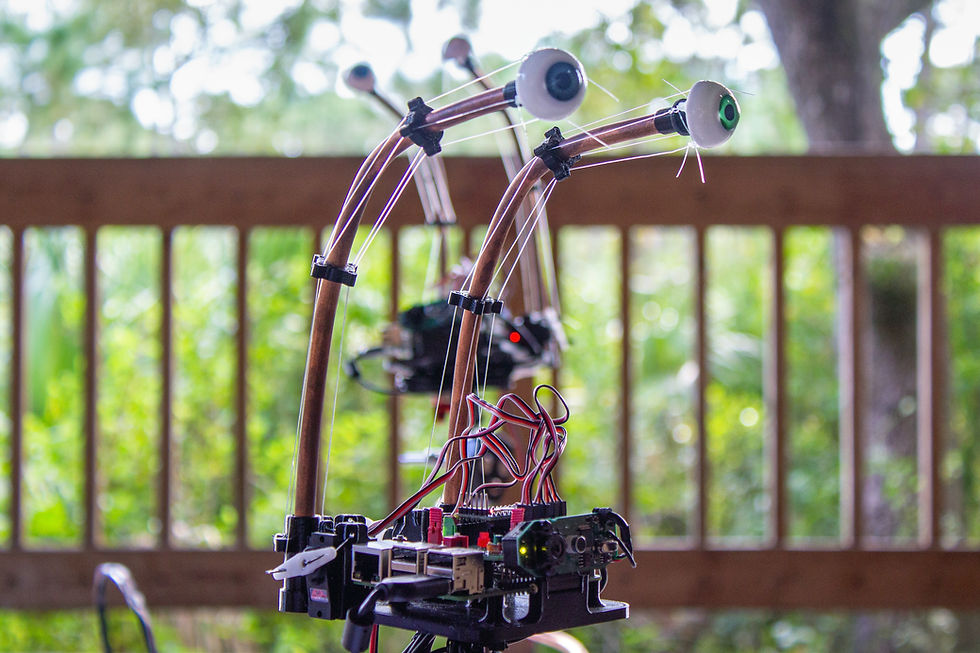
Interactive Sound Installation, 2023 Arduino, KiCad; custom made circuit boards, speakers, LEDs, proximity sensors Engineers: Dmitriy Shishov, Alexey Grachev Supported by CYLAND MediaArtLab As a part of his ongoing artistic practice, Alexey Grachev continues to play with a word’s meaning. He merges a title with different definitions into how to perceive a word and the artwork it was named after. This interactive installation is a set of speakers with antennas working as the theremin. The installation is located in the field, and it creates a sound field. A sound appears when someone moves in close proximity. People can move freely between objects. Each object is based on a round printed circuit board (PCB), and each board has a graphic depiction of a contact field. Its composition refers to various images made from above the Earth’s point of view — from circular fields of center-pivot irrigation to circular formations on crop fields hinting at the signs of extraterrestrial life. A satellite vision extends the perception of reality to the planetary level, where the trueness of what is captured is blurred in abstract forms. The sense of one’s own position in this view is lost in coordinate numbers associated with low-resolution pixelated data. If you come back to the field and there is no one around, the artwork is still active. The theremins’ antennas swing in the wind and make short sounds. This movement disturbs the state of the system. They call upon us to enter the field, to change a field, to feel ourselves on the game field.

Alexey Grachev, Sergey Komarov

1:1.78055*10226
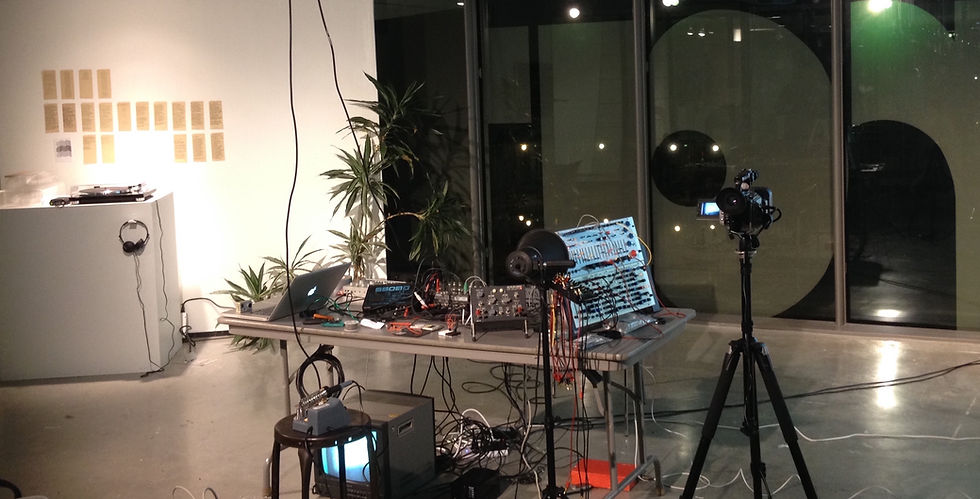
A/V performance, 2015–2023 Max/MSP, Touch Designer; Yamaha TX7 Duration: 00:30:00 Real-time graphics by Alexander Bochkov; Math consulting by Sergei Kostyrko Supported by CYLAND MediaArtLab Sound artists Alexey Grachev and Sergey Komarov continue their research series ‘Subjectivization of Sound’ with the new experiment 1:1.78055*10226. The creative duo specializes in various research of sound both as a physical entity and as a sensitive medium in the artists’ toolbox. The ‘Subjectivization of Sound’ project interrogates different problems of interfaces and communication of analog and digital syntheses, computing equipment, and the world around. The 1:1.78055*10226 is an experiment in chaotic programming of the digital FM synthesizer Yamaha TX7 (1985). This is a desktop version and is one the bestselling synthesizers in history — Yamaha DX7. But it has a lack of interface where sound patches can be edited. Over 150 parameters should be controlled via the old-fashioned MIDI System Exclusive (SysEx) messages, instead of the familiar and convenient CC controllers (continuous controller number). The unique historic sound and failings of the interface inspired Alexey and Sergei to experiment with this vintage audio gear piece. This is the second attempt to implement this idea (the first was 1:3.44743*10251 with the Waldorf Microwave synthesizer) of interfacing with outdated hardware, combining system restrictions and ‘overclocking’ to push synthesized sounds to the limit. In short, the idea is to fill the synthesizer with random parameters and play around with the data while fine-tuning the adjustments. For these purposes, the Max patch is used to manage SysEx messages running TX7. According to the multiplication theorem on probability, the probability of the sound event can be presented as 1 to 1:1.78055*10226 — that’s the total number of TX7 parameter combinations that can be set.

Elena Gubanova & Ivan Govorkov

Victory Over The Sun

Outdoor Media Installation, 2023 Fusion 360; 3D printing; 3D engineering design; welding; PVC "mobiles" attached to metal poles, motors, solar panels, speakers, motion sensor, drive belt Engineers: Alexey Grachev, Denis Markov Sound Engineer: Sergey Dmitriev Supported by CYLAND MediaArtLab A futurist opera Victory Over The Sun, staged in 1913 and co-authored by Aleksei Kruchonykh (the libretto) and Mikhail Matyushin (the music), was intended to underline parallels between literary text, musical score, and the art of painting. It became an exemplary collaborative work of poets and artists. It is about how the group of budetlyane (from the Russian word “budet”, “will be”) set out to conquer the sun. Commonly, it is interpreting the win of advanced technologies of the future over old nature. In this artwork, a supposed victory is put into question. Humanity depends on sunlight which is essential to the ecosystem it is part of. Even slight change in sunlight immediately shows how vulnerable we are as well as our aspirations and ideas for our future. The work of the installation depends on sunenergy. A set of solar batteries accumulates the energy and puts it in motion via motors the installation components — Futurist-like kinetic “mobiles”. The motors are connected to a set of solar batteries which follow the movement of the sun to collect power. The direction of movement of the installation components is defined by the trajectory of the sun and will change during the day. The installation is active as long as the batteries are charged. The installation has a sound component. A set of speakers is playing a new version of the opera Victory Over The Sun staged on May 3, 2007 at Vassar College in Poughkeepsie, New York. The noted St. Petersburg composer Georgy Firtich created a new score for the opera (only fragments of Matiushin’s original score have survived) and came to Vassar in order to take part in the performance with a company of Vassar student singers and musicians. It was envisaged not as a historical restoration but as reinvention from the perspective of the present, one that aspired to convey the explosively innovative impulse of early twentieth-century avant-garde. This year celebrates the 110th anniversary of the premiere of Victory Over The Sun and, by happy coincidence, the 85th anniversary of Georgy Firtich's birth. Engaging in a dialogue with its predecessors, this installation continues its explorations and offers its own reflection on the opposition between technology and nature.

Elena Gubanova & Ivan Govorkov

Monitoring the Rotation of the Earth on the Sofa

Site-specific Video Installation, 2020 A short throw projector, speakers; a sofa, wrapped in plastic household items, blackout curtains Video by Elena Gubanova Sound: CAA—47 Elena Gubanova, Ivan Govorkov, Sergey Komarov, Redshift, 2011 Supported by CYLAND MediaArtLab In a semi-dark room there are packed and unwanted items lying around: wrapped chairs, sofas, household items. This abandoned room has been turned into storage. A video is projected on the wall in front of the sofa, showing only a gobelin carpet. The landscape on the carpet presents a fairy-tale composition: distant countryside, hills, a river, an autumn forest. A deer is depicted in the foreground. It breathes of peace and tranquillity. Such carpets were very popular in the 60s–80s of the last century in St. Petersburg and other Russian cities. In the video, sunlight slowly drifts across the carpet, transforming a kitschy image into an Italian Renaissance painting due to the play of light and shadow. The video is accompanied by the sound of the Sun obtained by NASA's spacecraft by converting electromagnetic waves into sound. This work is about the time within us. The wrapped items inside the room are a symbolic image of our profane world, our established perceptions. The installation invites the viewer to stop and observe the "earth movement" signified by the motion of light across a fairytale landscape with a deer from their childhood and to recall their presence in outer space.

Sergey Komarov & Lydia Griaznova

Time Signals

8-channel Sound Installation, 2023 8 waterproof speakers, 8 synchronized players Supported by CYLAND MediaArtLab The installation is an 8-channel sound work, where time signals are subsequently interfered with children counting out rhymes. The time signals have a strict utilitarian purpose and are used as a reference to determine the time of day. Not only humans but machines too are sensitive to it. Coordinated Universal Time — an imposed time — splitting space into time zones and days on the slots for labour and leisure. A seemingly ordered and planned timing of a day is bending the stream of life. It sets up hours by a hierarchy of choices we make throughout the day. Various counting rhymes from different countries with subdued time signals impact their rhythms and durations. They upset the strict rhythm of time signals, making them unreliable, depriving their utilitarian purpose and stripping them of rhythmic sound. Worldwide synchronized general time dropped out from the organised and constantly maintained structure in which it resides. Counted time is slipping into continuous time. It is displaced by a subjective one, guided by one's sense of time, where what is considered too long or too short is a question of one's perception of what and when it is happening. It is lost in a temporally staged game that exists only for play with no obvious purpose. The ending of counting rhyme defines the random-made choice — the one on whom the last word or syllable falls is eliminated until all are counted out except the one who is “It.” Whatever slice of time will be chosen, it will be neither beginning nor end. They are all part of a general continuity, where a sound from this installation is the only one of many fragments. You are it, time! Performers: Margherita Catricalà (Italy), Ulyana Degtyareva (Russia), Anna Kolodzei (US), Adele Kübar (Estonia), Antonia Castro Martinez (Colombia), Michelle Mkrtchyan (Armenia), Izuru Nishihara (Japan), Kai Ayaz Vedel and his parents: Yäniyä Mikhalina and Joen Vedel (the Republic of Tatarstan–Denmark)

Vasilii Bakanov and Andrew Strokov

Slow Burning

Installation, 2020 (edition of 2021) Chemical reactions, real-time generated sound, live streaming from webcam located inside boxes OpenCV, Python, Arduino, 3D printing, soldering, 3 thermally insulated black boxes, heaters, temperature and humidity sensors, HD webcams, flood lights, DIN rails, microcontroller modules, Raspberry PI, Korg Monotron Delay, portable speakers, fruits, china plates Engineers Andrew Strokov, Alexey Grachev, Alexander Bochkov; 3D engineering design Alexander Bochkov; Python programming Andrew Strokov Supported by CYLAND MediaArtLab Three fruits on pedestals are contained inside a black box. In artificially created and regularly maintained conditions, the fruits pass through three chemical reactions — caramelization, the Maillard reaction and enzymatic browning. Usually, these processes take place within minutes in cooking. Here they are intentionally prolonged in time. Inside the box constant humidity and a temperature of 60 degrees Celsius are maintained, thus killing bacteria which cause decay. In ideal and constantly controlled conditions, the fruits preserve their form, and burn up inside from day to day at the lowest possible speed. Visitors can observe the slowly burning still life by watching it in real-time on the video panel placed on the boxes. But the main activity remains hidden and takes place at the molecular level. Its tangible manifestation is a monotonous soundtrack performed by the fruits themselves. Information about the external appearance of each fruit is converted into sound waves. The processes inside the box are analyzed and sonified by an analog synthesizer. The sound pitch and timbre depend on temperature, humidity, fruit size and color. As the fruit burns up, the sound “burns up” as well and becomes increasingly dull and quiet. The process is an artificially prolonged borderline state of “in between”. The metamorphosis is too slow to perceive by the naked eye. Because of the unnatural maximum delay, all differences vanish in the abyss of time to the accompaniment of a droning trio. However, it is still an open question as to whether the process will proceed in the way that was intended. Every effort has been made, all we can do is to wait and see what will happen next.
  • Instagram
  • Facebook
  • YouTube

Sign up for our Newsletter

Thank you!

Sose St., house 46,

Yerevan, Armenia, 0019

Ozo g. 28 - 35​

Vilnius, LT-07197

Lithuania

901Brickell Key Boulevard,

Suit 3705,

Miami, FL 33131 

USA


© CYLAND MediaArtLab 2007–2026. All rights reserved. 

bottom of page